Few events in the history of archaeology have stirred so much interest or had such an impact as the discovery of the tomb of the boy king, Tutankhamun in 1922. For the first time since serious exploration of the Valley of the Kings began in the early 1800s an intact tomb had been found. The finding unearthed the mummified remains of a king of Egypt interred many thousands of years ago, and revealed to the world the true wonder and artistry of the ancient Egyptians.
The treasures uncovered at King Tut’s tomb stunned the world, and even today we stare in amazement and admiration at the beauty and craftsmanship of the objects interred with the king to help him in his journey through the Afterlife.
Mummification
 The king was buried in an elaborate set of shrines and coffins. The nested shrines that encased the boy king and his artefacts dominated the tomb, and also revealed the complexity and detail of the funerary rituals carried out by the ancient Egyptians. During the seventy day ritual of mummification, King Tut’s body was carefully wrapped in a layer of bandages into which over one hundred amulets and charms were woven. These were carefully placed as incantations to the gods of the Afterlife. They also acted as protective spells to protect the body from the dangers it would face in the process of resurrection, judgment, trial and immortality.
The body was then placed in a nest of three ornately decorated coffins, and transported on sledges from the West Bank of the Nile to the site of the tomb in the Valley of the Kings, where the nested coffins were placed in a magnificent quartzite sarcophagus and sealed.
The Outer Shrines of King Tut
Four nested shrines, which almost filled the burial chamber, were placed over the sarcophagus and a large number of domestic, magical and ornate objects were placed in the limited space available between each shrine. Finally, the entrance to the painted burial chamber was bricked in and the tomb sealed to remain almost undisturbed for over three thousand years when English Archaeologist Howard Carter and his team broke through the walls and shattered forever the peace of the boy king, Tutankhamun.
When they broke through the wall between the Anti-chamber and the Burial Chamber, Carter’s team were met by the dazzling hues of the outermost shrine, the first of four, each of which was copper-bound at its lower edge and fitted at its eastern end with double folding doors. The shrines were extremely fragile and difficult to dismantle despite the clearly written hieroglyphic instructions inscribed on each individual part. The doors were held shut by ebony bolts sliding into silver coated staples, and there were two other staples intended for a cord binding and seal.
The First Shrine
The first, or outer, shrine occupied almost the entire Burial Chamber. The interior of the shrine is heavily inscribed with spells and incantations from The Book of the Dead and the Book of the Divine Cow, and a pair of Wadjet eyes decorates what was intended to be the shrine’s north side but are, curiously, on its south side.
The opening of the four nested shrines in the burial chamber is vividly described by Howard Carter in a recording made for the BBC in which he describes seeing ‘wonderful objects’ and articulates the intense excitement and awe he felt when he began to realise that the burial chamber really did contain the preserved mummy of a Pharaoh, and that he would be the first person to see it in over three thousand years!
The Second Shrine
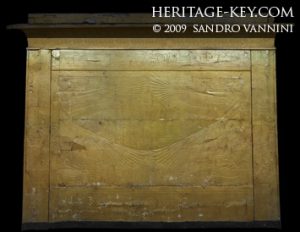
The magnificent Second Shrine is in the shape of a per-war, or Great House, similar to that which once housed a cult image of the region’s tutelary goddess, Nekhbet. The shrine was built of sixteen separate pieces held together by tenons of wood and cooper, a method that allowed all four nesting shrines to be assembled in the Burial Chamber following the hieroglyphic directions written in black ink on individual pieces.
The shrine is inscribed with spells from The Book of the Dead, as well as vivid imagery. The Eastern door holds an image of the goddess Isis presenting the king to her brother/husband, Osiris, the king of the netherworld. On the west door, Ma’at, the goddess of order, leads Tutankhamun to meet the sun god, Re-Horakhty. These two scenes demonstrate the merging of netherworld and solar imagery in the funerary art of the Egyptians at this time. In fact, both were necessary to ensure that the king could successfully make the journey to the afterlife and be reborn to immortality.
To the delight of Carter and his team, the second and third shrines were both sealed, proving that the sarcophagus, coffins and mummy must be intact, protected by the inner shrines and perhaps by the spells and amulets surrounding them. Believers of the curse of the mummy might be interested to know that these spells included the legend of the Destruction of Mankind. The peace of the boy king wouldn’t last for long.
Image of the second shrine (top) by Sandro Vannini. Digital reconstruction of the shrines (bottom) by Heritage Key King Tut Virtual Museum. All rights reserved.