 It’s long been a common stereotype that Akhenaten was a pacifist, someone who avoided warfare when possible. If you read Heritage Key’s article on Nazi Egyptology you will see that the Nazis hate him for that precise reason.
But recent research, presented this weekend at an Egyptology symposium in Toronto, shows that the Amarna leaders – including Akhenaten, King Tut and Nefertiti – all supported a sizable fortress in the Sinai desert.
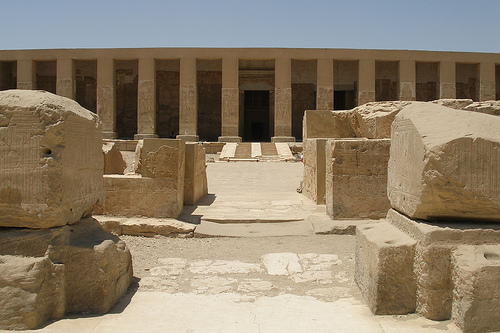
Located at Tell el-Borg it was a formidable bastion. It was 120 meters east-west by 80 meters north-south. The walls were four meters thick (at the base) and it was at least partially surrounded by a moat.
The research was presented by Professor James Hoffmeier of Trinity International University. His archaeological team finished excavations in 2007 and they are now in the process of publishing their results.
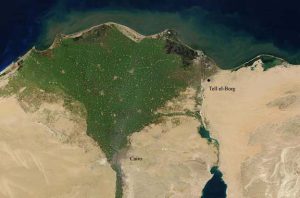
As you can see from the map here, the site is in the Sinai Desert just east of the Suez Canal. In ancient times a lagoon would have been near it. The topography of the North Sinai area makes it difficult to get into Egypt proper, without first passing through the fort.
The site has been through a lot – erosion, the deflation of its walls (there is almost nothing left of them) and some modern day bulldozing.
Dry Moat
In an interview with Heritage Key, Professor Hoffmeier explained what the moat would have been like.
It was lined with fire brick, to prevent it from collapsing. “It was probably a dry moat,” Hoffmeier said – not something you would want to put a crocodile into. However, as the water table changed, it would have gotten wet.
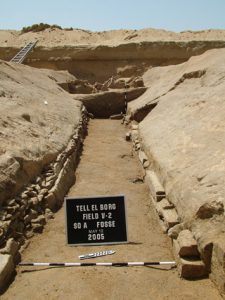
The idea behind it seems to have been that an enemy soldier, trying to attack the fort, would fall into it. They would then have to climb out in order to continue their assault. In the meantime the defender can shoot arrows and other projectiles at him.
The moat may have been only partially completed. Hoffmeier said that the western wall of the fort, including any signs of the moat in that area, has not survived, hindering their investigation.
It was in use until the end of the 18th dynasty. At that time the Amarna fort was abandoned in favour of a new fort that was being built beside it. The moat was filled with stone blocks.
The team found it interesting that the stone was used as fill, instead of sand. The stone appears to have come from a building located somewhere in the vicinity.
“It is tempting to think there might have actually been an Aten temple in the (region), the blocks of which we’re finding re-used at our site,” said Hoffmeier.
During the Amarna period the Aten sun disk was worshipped as the main deity. By the end of the 18th dynasty this religious view had fallen out of fashion. It’s possible what happened is that the soldiers, no longer caring much for the Aten temple, decided to use its bricks to plug in the moat.
A Garrison With Charioteers
The team has some idea as to how many soldiers, in total, would have been stationed at the fortress.
The 19th dynasty fort has an inscription which says that a unit equivalent to about 250 men and three officers was posted there. The Amarna age fort is quite a bit bigger than the 19th dynasty fort – which means the garrison could have been larger than 250 men.
In addition the Amarna fortress appears to have had a chariot unit.
Inside the moat the team found donkey and horse remains. “Horses would have been for chariots, donkeys would have been for pack animals,” said Hoffmeier. He added that the team has found a religious stele that was dedicated by a man called “overseer of horses.”
“Clearly there were stables there and stables of horses would have been associated with charioteer.”
“A Royal Flush”
The inscriptions the team found show that the fortress was kept-up throughout the Amarna period. “We have a royal flush I guess you would say for the Amarna period,” said Hoffmeier.
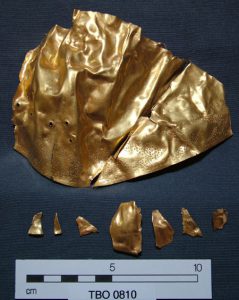
The team found at least one royal cartouche for all the pharaohs. These include Queen Tiye, Akheanaten, Tut, and, here’s a surprise – Nefertiti. “This appears to be one of those rare writings of Nefertiti in her capacity as co-regent,” said Hoffmeier.
The inscription was found on a handle that had been put in a garbage pit. It has Nefertiti’s name and reads, “is serviceable and beneficial to her husband.”
“(It is) really interesting to find this out in Egypt’s frontier, technically outside of Egypt’s borders,” said Hoffmeier.
The team found many such jars at the site and can say with certainty that a substantial amount of wine was sent by the ruling administration to the fort. He said that it is known that wine was being produced in the area to the northwest of Tell el-Borg.
The soldiers were not cut-off from events in Ancient Egypt.
The archaeologists found desecrated names of Amun. When Akhenaten went to power, proclaiming the Aten the main deity, the names of other gods, including Amun, were scratched out.
The finding of desecrated names, at Tell el-Borg, is the only known instance where this act occurred outside of Egypt itself.
Why Build This Fortress?
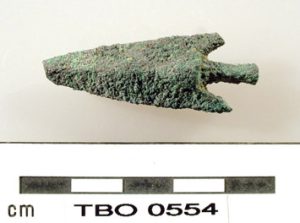
The fact that this fortress was kept up, during the Amarna period, means that Egypt did not drop its defences. It kept a robust presence in the Sinai desert.
“He wanted to preserve his peaceful empire,” Hoffmeier said, explaining why Akhenaten supplied this fortress.
He added that the idea of the heretic king as a pacifist is a “false image,” that simply does not fit the facts.
In the 19th dynasty, a new fort was constructed, replacing the Amarna fort. This new fortification appears to last until sometime in the 20th dynasty – where there is evidence that it was destroyed. “It is tempting to suggest that it might have been hit by the Sea Peoples,” said Hoffmeier.
As for the Amarna fortress itself, in all the time it was being used – during the 18th dynasty – there is no evidence that it was ever challenged or conquered.
Not bad for a pacifist.