• greece

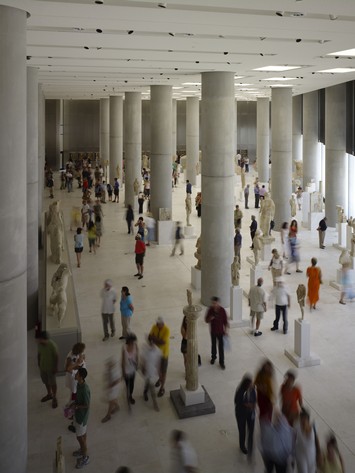
    Interview: New Acropolis Museum Architect Bernard Tschumi on Building a Home for Missing Marbles

    The New Acropolis Museum is arguably the most high-profile building to go up this decade (since we in New York are still peering into a big hole in the ground that is supposed to produce a new World Trade Centre). Essentially a smack in the face of the British Museum’s argument that Athens has no suitable venue in which to house the Elgin Marbles, it’s also the most controversial. I spoke to Bernard Tschumi, the outspoken architect who designed this extraordinary building. Replacing the smaller old Acropolis Museum, the purpose-built new museum ensures that architectural treasures too delicate to be…
  • greece

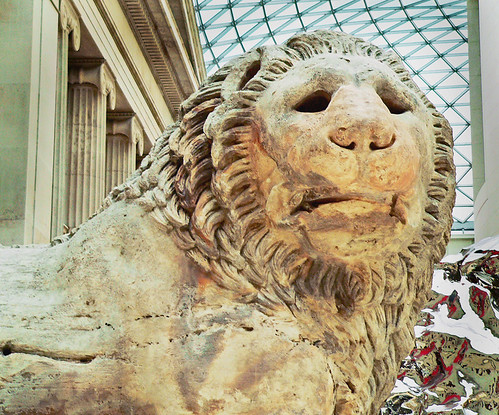
    Lion of Knidos

    Key Dates 350 BC Key People The Lion was found in 1859 by British architect Richard Pullen. The Lion of Knidos is a colossal 6-8 ton fearsome lion sculpture formed from one giant lump of Pentellic marble. It lay on a funerary base at the top of a 200ft cliff overlooking vessels sailing on the Mediterranean past its home in the ancient Greek city of Knidos, on the modern-day Datca Peninsula in Turkey. Its dates are disputed – some believe it to have been built as a celebratory piece following Conon’s triumphant defeat of the Spartan fleet at the city…

  • greece

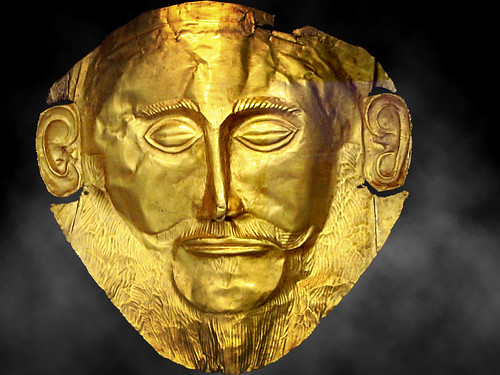
    Mask of Agamemnon

    Key Dates 1500 BC The Mask of Agamemnon is an artifact discovered at Mycenae. The mask is one of ten discovered in the shaft graves at Mycenae, three in Grave V and two in Grave V. It is now housed in the National Archaeological Museum in Athens. Key People The mask was discovered in 1876 by Heinrich Schliemann a German archaeologist, an advocate of the historical reality of places mentioned in the works of Homer, and an important excavator of Troy and of the Mycenaean sites Mycenae and Tiryns. Schliemann believed that he had discovered the body of the legendary…

  • greece

    Socrates

    Attribution: 469 BC – 399 BC Relationship People Associated Plato, Xenophon Despite the fact that he left no literary legacy of his own, Socrates is still considered to be the founding father of Western Philosophy. Born in 469 B.C.E he took an early interest in science, studying under Archelaus. He gave up on the examination of the physical world, however, to concentrate on the exploration of morals and humanity. Socrates invented the conception of philosophical dialogue and spent much of his time in discussion with the aristocratic youth of Athens. He was greatly respected by the younger generation and during his time as a teacher to…

  • greece

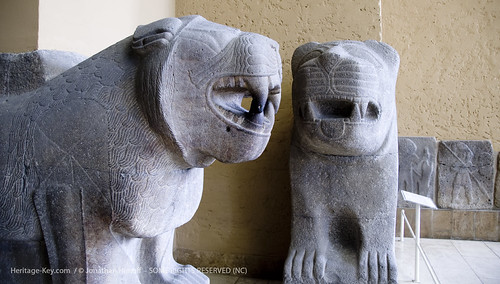
    Lions of Sam’al (Zincirli Lions)

    Attribution: Jon Himoff Key Dates 1888 The site was excavated from 1888 to 1902 in Zincirli Hoyuk. The Zincirli lions were discovered during excavations at Zincirli Hoyok in Turkey. They were executed under Aramaean influence and were part of the portal of the Citadel of Sam’al (Zincirli). They are part of a group of lions, some of which are now also in the Istanbul Archeological Museum. The city of Sam’al in Turkey developed during the late Hittite era, and became the capital of the late Hittite Kingdom, before becoming part of the Assyrian Empire. When the German Oriental Society began…

  • greece

    Spedos Figurine (Cycladic)

    Attribution: Photo by Ann Key Dates 2550 BC Dated between 2700 and 2400 BC This figurine of a woman is Cycladic (Keros-Syros culture), dated to 2700-2400BC and said to be from Syros. Compared to other figurines from that type, it is rather large and clumpsy and made from a strange material. Most of the Cycladic figures are made from white marble, but this one is carved from compacted volcanic ash, presumably from the island of Thera (Santorini).  Perhaps because it was produced on one of the few islands in the Cyclades where marble is not found. The left eye of the figure…

  • greece

    Pythagoras and the Stars

    “Number rules the universe.” – Pythagoras Astronomy may already have been in rude health by the time the ancient Greeks built their fearsome empire, but it was the Hellenistic world which gave us some of the most radical – and accurate – foretelling of the universe. And it was the Ionian mathematician Pythagoras who formed some of the most intriguing conclusions about the heavens. “Philosophy begins with Thales.” – Bertrand Russell Pythagoras was far from the first thinker to stun the Greek empire with his observations of the planets, having been beaten to that title by the Milesian philosopher Thales.…

  • greece

    Statue of Pericles

    Attribution: Jon Himoff Key Dates 440 BC Created around 440 BC The statue of Pericles (also known as Perikles) was created by the Greek Sculptor Kresilas who was originally from Kydonia. Pericles was an powerful statesman in Athens through the Golden Age. He lived between 461 and 429 BC, and had a major influence on Athenian society. The Corinthian Helmet over his head symbolises his position as a General in the military. There are also other examples of it in the British Musuem and the Vatican Museum. Origin & Collection Discovered at: Zincirli On display at: Altes Museum, Berlin Physical…

  • greece

    The Polis: Was the Ancient Greek City-State the Greatest Political System Ever?

    The Greek City-state, or Polis, is arguably the greatest political system ever created – remarkable given its appearance some 2800 years ago. The Greeks successfully built a system to foster those most elusive of human desires – freedom and equality, and their efforts have had an influence on western thinking since the Hellenic culture was re-discovered during the Middle Ages. But the Polis was much more than a governmental system. It was a culture built around expansion of the human intellect – through philosophy, architecture, drama, and mathematics. The Polis was the engine of these accomplishments because it valued and…

  • greece

    Schliemann’s Troy Treasures

    Attribution: Jon Himoff Neues Museum, Berlin Germany Key Dates The artefacts date from throughout the occupation of the ancient Greek city of Troy, which archaeologists date as having been populated from as early as 3000 BC until as late as the 1st century BC. They were discovered during excavations in the 1870s, and donated to the “German people” in 1881. Much of the collection was looted by the Russians in 1945. Key People The items were discovered by the famous and eccentric German businessman and archaeologist Heinrich Schliemann. Key People: Heinrich Schliemann Schliemann’s Troy Treasures comprise a varied selection of…