9 May 1874 – 2 Mar 1939 Archaelogist and Discoverer of Tutankhamun Key Dates Howard Carter was born on 9 May 1874. He discovered the tomb of Tutankhamun on 5 November 1922. He died on 2 March 1939. Relationship People Associated Tutankhamun, George Herbert, 5th Earl of Carnarvon, Giovanni Battista Belzoni, Theodore Davis, Almina Wombwell Howard Carter (9 May 1874 – 2 March 1939) was an English archaeologist and Egyptologist. He is noted as a primary discoverer of the tomb of Tutankhamun in 1922 (subsequently designated KV62) – by far the best preserved and most intact pharaonic tomb ever found…
-
-
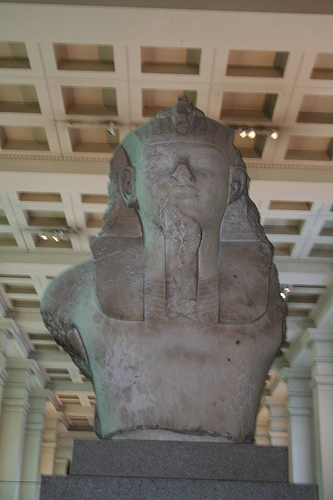
Key Dates This item dates from the 19th Dynasty of the New Kingdom, circa 1279-1213 BC. Key People This statue was made during the reign of Ramesses II. Key People: Ramesses II Ramesses II, whose name is inscribed on the pectoral of each of the baboons, took a special liking to this massive statue; Four baboons adoring the sun was placed at the base of one of the obelisks of the temple of Luxor, with the baboons literally facing the sun. It was thought that the baboons honoured the sun so as to guide it throughout its course each day.…
-
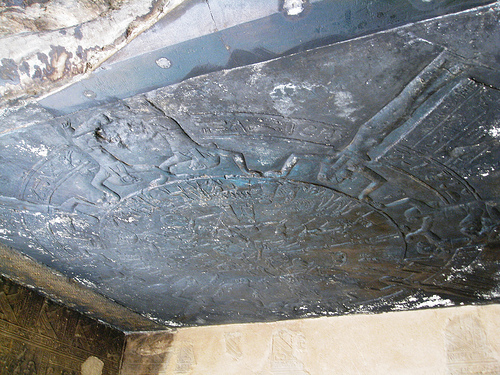
One of the most famous, popular and mysterious ancient Egyptian treasures of the Louvre, the 2060-year-old Le zodiaque de Dendéra – the Dendera Zodiac – has witnessed more than its fair share of controversy over the centuries. Stripped from the portico of a chapel dedicated to Osiris at the Hathor Temple at Dendera in 1820, then shipped to Paris, the beautifully carved bas-relief played an unlikely role in fierce disputes over science and faith in Napoleonic and Restoration France. Today, the zodiac continues to spark debate. As the first known depiction in history of the classical zodiac of twelve signs,…
-
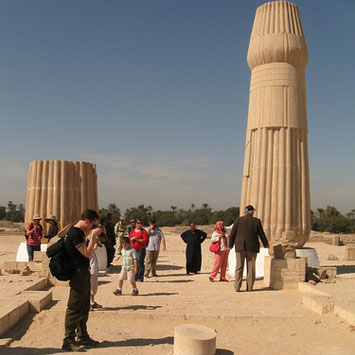
“There is no other site like it,” states the introductory paragraph on the website of the Amarna Project – the body which, since 2005, has been responsible for excavations and research at Tell el-Amarna, the short-lived capital city of the “heretic pharaoh” Akhenaten (who may well have been King Tut‘s dad) in the 14th century BC. As a living site, Tell el-Amarna is perhaps unparalleled in all of Egypt in terms of scale, ready accessibility and quality of preservation. Professor Barry Kemp – of the University of Cambridge – is the director of the Amarna Project, and also the chairman…
-
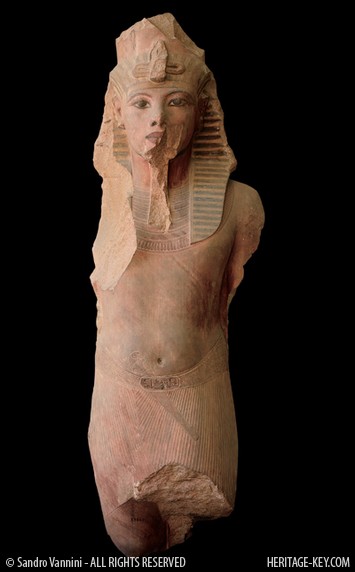
Attribution: nrares 1403 BC – 1354 BC Relationship People Children Akhenaten Partners Tiye Amenhotep III was the 9th Pharaoh of the 18th Dynasty. He ruled Egypt from 1391BC to 1354BC after his father Thutmose IV died. Amenhotep III was the son of Thutmose by Mutemwia, a minor wife of Amenhotep’s father. His reign marks the highest point of ancient Egyptian civilisation, both in terms of cultural achievement and in political power. Amenhotep became king at the age of 12 with his mother Mutemwia acting as his regent. Early in his reign he took a wife, Queen Tiy, who featured prominently…
-
Tut has returned to Toronto. After 30 years the boy king’s treasures are back in the Canadian city, with a new show set to open this Tuesday, at the Art Gallery of Ontario. It’s the first time the king’s been in town since 1979. In that year Egyptomania was at its height, and Steve Martin was doing his King Tut dance and all. Before the media preview began today, the organizers tried to re-create a little bit of that 1970’s magic. A pair of dancers from the group ‘For the Funk of it’ performed a tutting dance routine in front…
-
The recent reopening of Berlin’s Neues Museum has brought back into the limelight one of the ancient world’s greatest treasures. Yet as Thutmose’s masterful Bust of Nefertiti takes centre stage in Germany’s latest collection, the woman behind Egypt’s most famous sculpture remains a conundrum. Heresies, lost kingdoms and mysterious kingships have made Nefertiti more than the ‘most beautiful woman in the world’. But who was she, and how did she become one of the greatest leaders in Egypt’s history? Nefertiti’s origins are a mystery. Born some time around 1370 BC, theories abound that she was the daughter of army general…
-
We know lots about the Great Pyramid of Giza – it’s age (about 4,569 years), who it was built for (the Fourth Dynasty Egyptian King Khufu), who designed it (Khufu’s brother, the architect Hemienu) and even who rolled up their sleeves and did the work (tens of thousands of skilled labourers from across the kingdom, as opposed to slaves as was once believed). But ask a room full of experts how it was built, and you can expect a whole lot of head-scratching and beard-stroking, followed by heated argument and possibly some light fisticuffs. The main bone of contention is:…
-
This year’s Egyptological Colloquium, held in the British Museum‘s fantastic BP Lecture Theatre, was roundly applauded as a great success. No fewer than eighteen gifted minds took to the lectern, as a glut of opinions, theories, excavations and discoveries were explored to a large audience’s enthralment. Some of the speeches were incredibly specialist; others not so. But what is certain is that the past week has seen some of the most compelling and intriguing axioms on one of Ancient Egypt’s greatest pieces of iconography, the Book of the Dead. From colours to kingdoms, magic bricks to evil demons; the colloquium…
-
18 to 20 year old male, Caucasoid, cause of death: unknown. It’s a brief that wouldn’t have sounded unfamiliar to Jean-Noël Vignal – a forensic anthropologist who works with police to create likenesses of murder victims at the Centre Technique de la Gendarmerie Nationale in France – when it landed on his desk in 2005. Yet the tragic young man in question on this particular occasion was no ordinary subject – he was the most legendary ancient Egyptian that ever lived. Tutankhamun, a Pharaoh of the Eighteenth Dynasty, died mysteriously in 1323 BC. His body lay undisturbed for over 3,200…