egypt

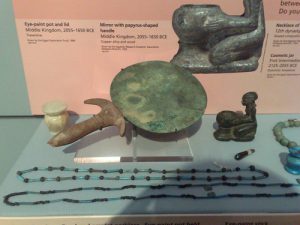
Mirror with Papyrus shaped handle

Glasgow
Scotland
Key Dates
1900
BC

This mirror with papyrus shaped handle hails from the Middle Kingdom period 2055-1650 BCE and was given to Kelvingrove Art Gallery and Museum by the Egyptian Research Students Association (Glasgow Branch) in 1923

Key People

The mistress of any royal household in the Middle Kingdom would have owned a mirror such as this. The Middle Kingdom spanned the 11th to 14th Dynasties and took in the reign of Pharaohs such as Wanka Intef II, Mentuhotep II, III and IV, Senusret I, II, III and Amenemhat I, II and III.

In the Middle Kingdom the typical hand mirror consisted of two pieces: a metal disc and a wooden or ivory handle. The handle was traditionally shaped as a papyrus column with a spreading umbel. The mirror disc itself, made of copper alloy is attached to the handle with a rivet. Used in Egypt since the Old Kingdom, the mirror had a funerial and religious purpose as well as a practical function. Mirrors were believed to be endowed with magical properties because they had the power to hold ones image. This power is embodied in the Egyptian word for mirror, ‘ankh’, which is also the ancient Egyptian word for life.

Origin & Collection
Additional information on display location:
Ancient Egypt collection, ground floor left of main entrance
Reference Number:
1923.330
Physical properties
Width:

12.00cm

Diameter:

12.00cm

Materials:

Bronze