
Think you know all there is to know about these goliaths of the ancient world? Heritage Key picks out ten key facts about pyramids. 1. There are actually 118 pyramids in Egypt. Sure, you might have heard of Khufu‘s, or Khafre’s – or even Djoser’s incredible Step Pyramid at Saqqara, the first known pyramid ever built. But what about the ones which don’t grab the headlines: Amenemhat III‘s Black Pyramid of Dashur looks more like Ayer’s Rock than an Egyptian tomb, and Sahure’s fine mausoleum in Abusir once stood 47m high. 2. The 118th pyramid was unearthed by Egypt’s most…
-
-
2589 BC – 2566 BC Relationship People Children Djedefre Khufu was born in 2589BC and died in 2566BC. He was Pharaoh of the 4th Dynasty which lasted from 2613-2498BC. He was the son of Sneferu and Queen Hetepheres I, and is believed to have had three wives. His is credited with building the Great Pyramid of Giza which stood at a massive 147 metres. The pyramid took about 23 years to complete, and took 2,300,000 building blocks, each weighing an average of 2.5 tons. Although he reigned for approximately 24 years there is very little known about him other than…
-
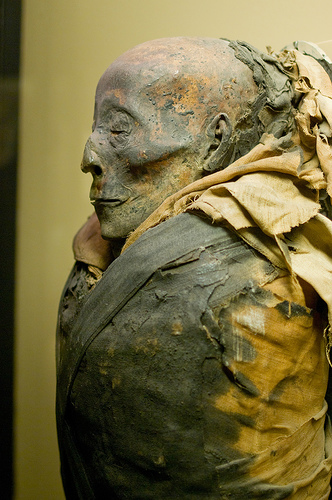
Key Dates 700 BC Thought to date from around 700 BC, 25th Dynasty. Key People Harwa Perhaps one of the most popular mummies in The Field Museum’s collection is that of Harwa, who died around 700 BC (25th Dynasty). His wrappings have been removed so that visitors can gaze upon his ancient face, preserved for almost 3,000 years. During the unwrapping process, dozens of colorful amulets made of gold, semi-precious stones, and glazed pottery were found within Harwa’s burial linens. Many of the amulets are displayed with his mummy in the approximate place in which they were originally found. Each…
-
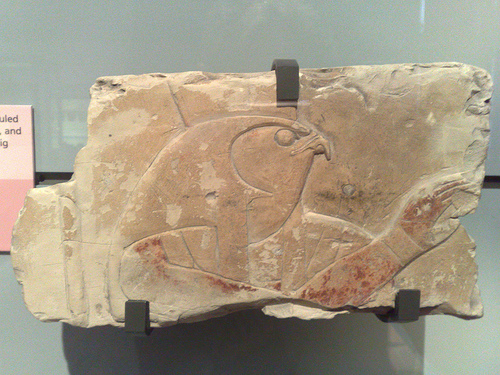
Key Dates 1800 BC Created during the Middle Kingdom 2055-1650 BCE, given to Kelvingrove Art Gallery and Museum 1903 by the Egypt Exploration Fund Key People The Eye of Horus is an ancient Egyptian symbol of protection and royal power from deities, in this case from Horus or Ra. The symbol is seen on images of Horus’ mother, Hathor, and on other deities associated with her. Horus ruled the living and his father Osiris ruled the dead. He protected the reigning pharaohs, and appears as . In this limestone tablet, Horus, the ancient Egyptian sky god, also known as Re…
-
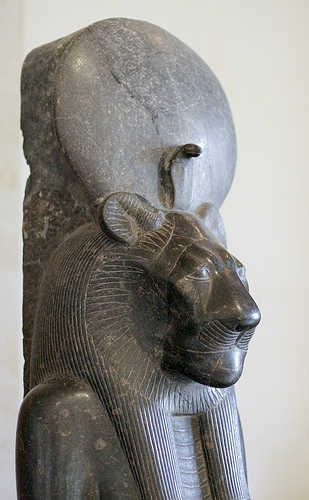
Key Dates This item dates from the 18th Dynasty, circa 1391-1353 BC. Key People An inscription at the bottom of this statue reads, “Amenophis III, beloved of the goddess.” This statue of the Sekhmet is one of many diorite sculptures dedicated to the powerful goddess. Sekhmet is portrayed with a dual personality; she has the body of a woman and a lion’s head. This statue is particularly interesting, however, by virtue of the artist’s great skill in blending the lion’s features with those of a woman; the lions mane morphs into human hair, and Sekhmet wears a dress down to…
-
The Great Pyramid of Giza is one of the world’s oldest and most iconic ancient structures – a 4,500 year old mass of more than 2.3 million limestone blocks, built as tomb for Fourth dynasty Egyptian Pharaoh Khufu. Reaching 138.8 meters into the sky, for thousands of years it was the tallest man-made structure on earth. The Great Pyramid has attracted explorers and tourists by the bus load for decades. But not all of its secrets have yet been revealed. One set of features that remains a source of bafflement to experts are the two narrow shafts – each about…
-
Abydos is arguably the most sacred site of ancient Egypt, and quite possibly the most important archaeological site to Egyptology. Many would argue that other locations, such as the Memphis Necropolis or the Valley of the Kings are much more important, but before you cringe at the above statement, consider the work of the Pennsylvania University, Yale University, and New York University Institute of Fine Arts’ joint expedition to Abydos. After more than four decades in the field, the Penn-Yale-IFA expedition held a symposium at the University of Pennsylvania Museum of Archaeology and Anthropology on September 19, 2009. The cemeteries…
-
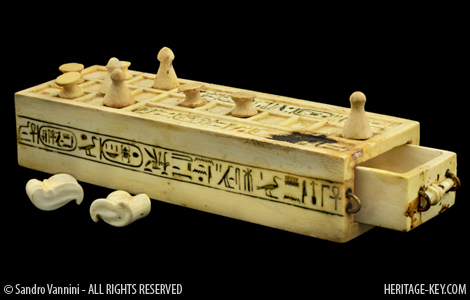
Key Dates 1333 BC 18th Dynasty Key People Tutankhamun and his wife Ankhesenamun There were four senet sets in the tomb of Tutankhamun, some ceremonial and others for day-to-day use. One such daily set was made of solid ivory and was found in a wooden chest with many compartments. Howard Carter comments: ‘From the contents… that were found in the chest it becomes obvious that the chest was made for the knick knacks of a boy’ which could be indicative that this set was probably played with by Tutankhamun. This gaming box is particularly small and therefore portable. On the…
-
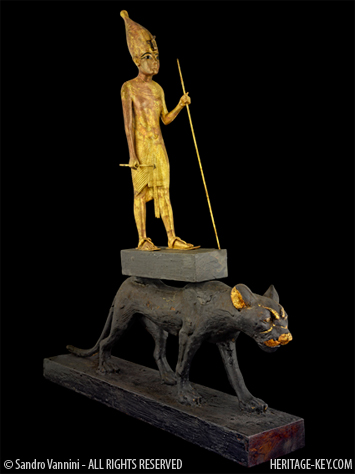
Key Dates 1324 BC The figures date from around the time of the death of Tutankhamun, in 1324 BC. They were discovered, along with the rest of the treasures of Tut’s tomb, in 1922. Key People The figure depicted is 18th Dynasty Egyptian pharaoh Tutankhamun himself. They were found by Howard Carter, who located King Tut’s tomb. Key People: Tutankhamun Howard Carter These small statuettes of the famous boy king Tutankhamun astride a panther came in a pair and were located along with 32 other ritual figures inside a black resined wooden box in the treasury section of Tut’s tomb,…
-

Key Dates 2400 BC The chapel of the tomb of Akhouthotep dates from the Fifth Dynasty, around 2400 BC. It was re-assembled in the Louvre in 1903, by Georges Benedite who was curator in the Egyptian department. Key People Akhethotep was a high dignitary of the latter part of the Fifth Dynasty, succeeding three generations of his family in high office. This chapel from the mastaba (tomb) of Akhethotep was where priests and family of the deceased would have come to offer food and drink to his spirit, and recite texts that would assist him in the afterlife. It is…