When Roman troops led by Aulus Plautius arrived on the banks of the Thames shortly after they landed in Britain (probably on the east coast of Kent or near Southampton) in 43 AD, they would have found little more than a few Iron Age settlements on the banks of a river, with few roads and not much trade to speak of. Within a century the Roman settlers had laid down the foundations of a bustling trade town, which rebuilt itself after numerous attacks, fires and a possible Plague epidemic, with a population peaking between 45,000 and 60,000 by the mid…
-
-
The Explorers Club’s Great Britain Chapter was founded as late as 1977, but its first chairman, Bill Egerton Sykes, was thoroughly invested in one of the great ancient mysteries – Atlantis. A British intelligence officer, Sykes had a lifetime fascination concerning Atlantis. He lectured to the Explorers Club in New York in 1966 on this subject in 1966, and continued to investigate and gather evidence for the existence of this mythical lost continent until his death in 1983. These days, the Explorers Club, which doesn’t have a permanent venue in London but meets in various places four or five times…
-
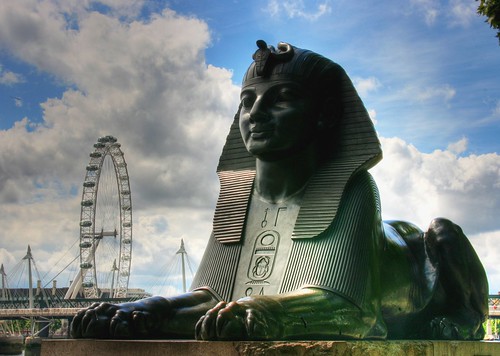
Two iron-cast faux-Egyptian Sphinxes flank the either side of Cleopatra’s Needle in the City of Westminster, London. Although the original intention of the Sphinxes would have been to appear to be guarding the needle, an installation error means they are both facing the needle instead. The right hand Sphinx is visibly damaged after an aerial bombing campaign during the First World War saw a bomb land near Cleopatra’s Needle. To commemorate the event, the shrapnel holes remain unrepaired on the Sphinx to this day. This beautiful photograph by Manju shows one of the Sphinxes were it rests alongside the River…
-
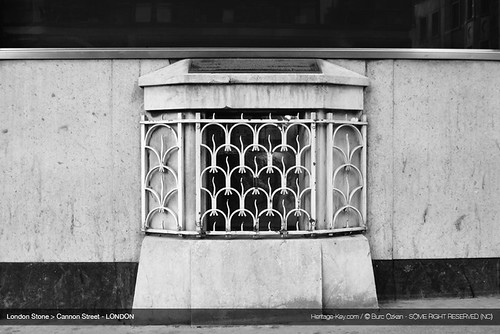
Ever thought you’d been speaking to a brick wall day? Well now’s your chance to try it out for real, as we hook up with the London Stone on Twitter on Monday for what promises to be the masonry equivalent to Frost vs Nixon. And though you can get a huge dose of the stone’s history in our inaugural Ancient World in London video, this is a web event not to be missed. Learn all about one of London’s weirdest treasures at 7pm Monday! As arbiters of ancient info, Heritage Key has managed to bypass the artefact’s hefty entourage for…
-
Venice, with its grumpy gondoliers, and Verona, home to Romeo, Juliet and a pink Roman arena, both have formidable reputations as romantic destinations. But Rome too can more than hold its own when it comes to providing entertainment for lovers of all kinds (whether part of a couple or not). There are several activities and a two-for-one offer on state-owned museums this coming weekend (13 and 14 February) in honour of Saint Valentine’s Day, but there’s plenty to inspire anyone with a yearning for a bit of romance and culture at any time of the year. Some of ancient Rome’s…
-
Attribution: Jon Himoff Key Dates 440 BC Created around 440 BC The statue of Pericles (also known as Perikles) was created by the Greek Sculptor Kresilas who was originally from Kydonia. Pericles was an powerful statesman in Athens through the Golden Age. He lived between 461 and 429 BC, and had a major influence on Athenian society. The Corinthian Helmet over his head symbolises his position as a General in the military. There are also other examples of it in the British Musuem and the Vatican Museum. Origin & Collection Discovered at: Zincirli On display at: Altes Museum, Berlin Physical…
-
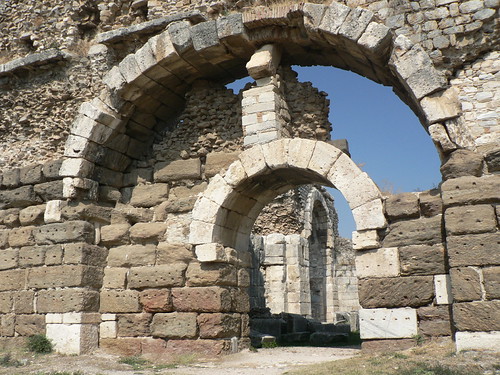
Attribution: Lazy B Millet Turkey Key Dates Miletus was first occupied at around 3500 to 3000 BC. Minoans occupied the area from around 1900 BC. The first settlers from Crete arrived in Miletus at around 1400 BC. The Greeks freed Miletus of Persian rule in 479 BC and famously rebuilt. Alexander the Great seized Miletus in 334 BC. It was annexed by the Romans in 133 BC. The Apostle Paul led his Third Missionary Journey through the city in 57 AD. Miletus’ first excavations commenced in 1873. Key People Hippodamus; the famous Greek architect who built Miletus as the world’s…
-
In need of some last-minute ‘background information’ on the history of Love and Romance, to spice up your Valentine’s Day (or impress a date with your knowledge)? Looking for some ancient Egyptian love poetry to go on the back of a card? After you’ve inceased your ‘Valentine Skills’, it’s time to join our Valentine’s competition:leave the best personal ad or declaration of love here in the comments, and get to choose your favourite book from the Thames &Hudson Spring collecti… errr.. catalogue. Browse our Valentine’s menu below for inspiration, or go win your book. On Heritage Key’s (historical) Valentine’s menu:…
-
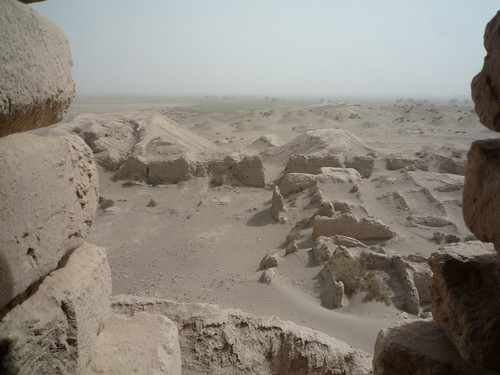
Attribution: whereispavel Nuffar Iraq Key Dates The site of Nippur was first settled around 5000 BC. Several temples were built there in the middle of the 3rd millenium BC, by which point it had become the centre of worship of the Sumerian storm god Enlil. Nippur fell into decline around the 3rd century AD, and was abandoned by 800 AD. It was first excavated, briefly in 1851. A fuller project lasted from 1889-1900. The most recent programme began in 1948, and remains ongoing, although fieldwork has been broken-off since 1990 and the Gulf War. Key People The first person to…
-
We’ve come a long way from the time when Ugg would mutter inanities to Uggetta in the cave, present her with a wad of crushed up flowers and move in for the kiss- and if she resisted he would reach for his club, gives it the old ‘knock on the head and drag away’ routine. Nowadays, for example, we do all the inanities on dating websites or in noisy bars. The rules of romance and courting have been shifting rapidly in the last 50 years and now many people are so clueless as to what they are supposed to do…