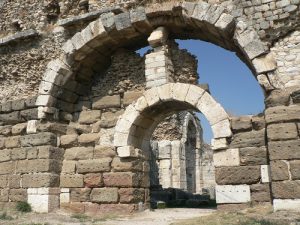
Miletus, on the western coast of Anatolia, in modern Turkey, has been inhabited since around 3500 – 3000 BC, when it was a Neolithic settlement. Minoan settlers arrived at around 1900 BC, and Hittite tribes moved in at around 1400 BC, establishing the city as an important port.
Miletus eventually became one of the twelve cities of Asia Minor, yet the area, Lydia as it was known then, fell to Persian forces around 502 BC. It only took the Greeks until 479 BC to recapture Miletus, however, when it was famous restructured as the world’s first grid-based city by local architect and mathematician Hippodamus. Yet the Persians fought back to retake the city in 402 BC – and it took a decisive victory by Alexander the Great in 334 BC to finally bring the city back under Greek rule.
By 133 BC Miletus and Asia Minor had been swallowed up by the Romans, and it became the scene for Paul the Apostle’s Third Missionary Journey in 57 BC. However by this time the city had already been in sharp decline for some time; the harsh Maeander River ruining its port with huge deposits of silt. The city then lost nearly all of its power, and was merely a pawn in the Byzantine, Turkish and Ottoman occupancy of the area.
The first excavations of Miletus were carried out by Olivier Rayet in 1873, closely followed by German archaeologist Theodore Weigand. Today digs are led by the country’s Ruhr University of Bochum. Its most prominent monument is the Temple of Athena, built in the 5th century BC.