 When Roman troops led by Aulus Plautius arrived on the banks of the Thames shortly after they landed in Britain (probably on the east coast of Kent or near Southampton) in 43 AD, they would have found little more than a few Iron Age settlements on the banks of a river, with few roads and not much trade to speak of. Within a century the Roman settlers had laid down the foundations of a bustling trade town, which rebuilt itself after numerous attacks, fires and a possible Plague epidemic, with a population peaking between 45,000 and 60,000 by the mid second century. Ultimately the Roman city of Londinium fell into ruin some time after the Romans withdrew from Britain in 410 AD, but in the intervening centuries it was the scene of some of the battles, power struggles and personalities that shaped the Roman empire.
The invasion of Britain and subjugation of the British king Caratacus, as well as the establishment of London as a trade hub, was an important part of the emperor Claudius’s foreign policy. Londinium was also the scene of Boudica‘s bloody revenge on Britain’s Roman rulers less than two decades later. Emperor Hadrian visited in the 120s AD but after the Roman city passed its heyday in the mid-second century, it also became the backdrop for political tussles between Septimius Severus and Albinus, and later between Carausius and Allectus. So who were these characters that shaped not only the history of London, but that of the whole Roman empire? And what were the factors behind the rise of London from a small river-crossing to a key Roman trade and administrative hub?
The Invasion of 43 AD
When the Romans landed on the British Isles in 43 AD, London was a marshy and inconsequential smattering of habitations. Camulodunum (modern-day Colchester) was the target for the four Roman legions led by the commander Aulus Plautius, and they probably raced past the Thames-side dwellings, giving it barely a second thought. After first defeating the Britons near the river Medway, the Romans pushed further north and over the river Thames. They would probably have built a temporary bridge or rafts to cross the river (there are also accounts of one legion swimming across), but in their haste to drive back the Britons and reach Camulodunum, the Romans may have taken very little notice of the location that was to become one of the key trading centres.
Although Julius Caesar had landed in southern Britannia in 55 and 54 BC, it wasn’t until Claudius took power, following the disastrous reign of Caligula, that Britannia finally saw a full-on Roman invasion. So why did the stuttering, lame Claudius pursue his foreign policy in the unfriendly northern reaches of the empire? One of the reasons may have been that he was keen to prove his political acuity and judgement – and successfully gaining ground against barbarian tribes was one way of doing this. New territories also brought additional taxes for Rome’s coffers – although some have argued that the taxes Claudius could raise in Britannia were not more than the tribute that was already being paid by some of the British tribes, some of which were already allied to Rome.
However, perhaps Claudius also had his eye on the industry in Britannia, which was rich in natural resources such as gold and silver, as well as being a potential source of animals and slaves. In any case, Rome had already established a trading relationship with tribes in Britannia but when one of the tribes, the Atrebates, were threatened by another, the Catuvellaunians (led by Caratacus, Togodumnus and Cunobelinus), Claudius saw his opportunity to gain a footing on Britannia’s shores. By sending four legions to the aid of the Atrebates, Claudius was also able to establish a Roman presence in Britannia that was to last almost 400 years.
Caratacus the Guerilla Warrior
When Aulus Plautius’s legions killed one of the Catuvellaunian kings, Togodumnus, his brother Caratacus resisted. He is said to have used guerilla tactics against the Romans, and eventually escaped to the north. The Romans had just about gained control of the south-east part of Britain, when emperor Claudius joined the legions and triumphantly entered Camulodunum – he even shipped African elephants over the channel to parade into the oppidum, which must have seemed like quite an amazing and frightening sight to the defeated Britons. When Caratacus was eventually captured and taken to Rome, according to Tacitus’s Annals, he was allowed to give a speech to the senate, in which he impressed his own importance and dignity upon them, asking why they should want to invade other nations, who lived in basic settlements, when they had such wealth in the form of impressive buildings and monuments in Rome. The senate was so impressed by his spirit that his life was spared.
The Beginnings of Londinium 47 AD
However, as they rushed over the Thames to claim their control of Camulodunum, the Romans must have registered the location near the mouth of the river, accessible by sea and with the river to provide transport inland. While Camulodunum was also quite accessible by sea, perhaps the site of Londinium enabled the Romans to gain greater access to the interior of Britannia. In any case, they saw the site as an advantageous location and began to settle there. The remains of what is believed to be the first Roman bridge have been found during excavations in 1981 very near to the modern-day London bridge.
Must-know Facts About Roman London
- Emperor Claudius invaded Britain in 43 AD, and soon settled the town of Londiniu in the marshy ground.
- In 60-61AD, London met one its most ruthless opponents when fellow Brit Boudicca sacked the town.
- The population of London peaked at around 45-60,000 people in 140 AD, before taking a serious hit from the Antonine plague.
- The London wall was built in 190-225 AD, whilst Septimus Severus and Clodius Albinus squabbled over who was the rightful Roman emperor (Severus wins in 197AD).
- In 200 AD, the north/south divide is invented. York is established as capital of the emotively titled “Britannia Inferior” in the north, and London is capital of “Britannia Superior”.
- The second half of the 3rd Century AD is a brutal time for Londinium, with several invasions by Saxon pirates and the murder of emperor Carausius by treasurer Allectus. Roman General Chlorus invades and takes power, but Allectus employs Frankish mercenaries to sack the town, and kill civilians.
- 367-9 AD sees the “Great Conspiracy”, in which Saxons, Picts and Scots all invade Britannia at once. The Roman commander Theodosius puts down the attack, using Londinium as his base.
- In 396 AD, power is transferred from Rome to Britain by the general Stilicho. By 400 AD, the place was practically a ruin! By 500 AD it is uninhabitable, and is left abandoned.
The wooden bridge would have had a typical Roman gate at each end, with the southern gate in today’s Southwark – the gate on the north bank would have been roughly where the old Billingsgate fish market stood. A wooden drain has also been discovered at the site of 1 Poultry, dated to 47 AD – this is believed to be the date of the founding of the Roman civitas of Londinium.
Bridging the Thames must have been a pivotal moment during the early stages of Londinium. The first Roman bridge became a focal point for trade and transport and traders set up their homes and businesses in the area north of London Bridge – much as the same area today is also the financial City’s hub (although some firms have now moved downriver to Canary Wharf). Trade routes were also established to transport goods north and south of the Thames and Londinium would have been emerging as a bustling trading town.
Boudica Attacks
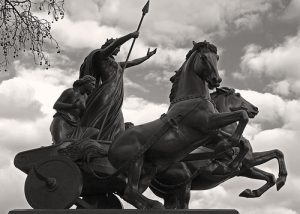
This all came to an abrupt halt in 60-61 AD when trouble from one of the British tribes proved to be a serious set-back for the Roman occupiers of Britain. When Prasutagus, the king of the Iceni tribe, died, his will asked for his kingdom to be divided between his daughters and the Roman emperor.
The Romans, now ruled by the dissolute emperor Nero, ignored his will and Prasutagus’s daughters were raped and his wife, Boudica, was beaten. The latter took revenge on the Roman occupiers by destroying first of all Camulodunum, which had become a Roman colonia, and then Verulamium (St Albans). The Roman governor Suetonius was on a campaign against the Druids in Anglesey when Boudica began her revolt. By the time he got to Londinium, he realised that he didn’t have enough troops to defend the town, and it was left undefended. According to Tacitus, anyone who wasn’t able to leave London was slaughtered and in all, as many as 80,000 people were killed by the Iceni.
Boudica, who became a symbol for rebellion and female strength, finally returned north to face the Romans in the Battle of Watling Street – the exact location isn’t known and while some suggest that the battle may have taken place at the site of modern-day King’s Cross, others believe it’s more likely to have taken place in the West Midlands. The Iceni were defeated in this battle and, depending on whether you believe Tacitus or Cassius Dio, Boudica either took poison to avoid being taken captive or fell ill and died.
Back From the Ashes
Having been destroyed and burnt in 61 AD, the town of Londinium was rebuilt and once again began to attract traders and settlers. When Hadrian visited Britannia in 122 AD, he also passed through London, which was a thriving and growing city again by this point.
Archaeological evidence shows that a large fire damaged the city again soon after Hadrian’s visit, although this isn’t mentioned by classical historians. However, London had been razed to the ground once by Boudica, and the second fire of the 120s didn’t stop the population from re-building and expanding their city.
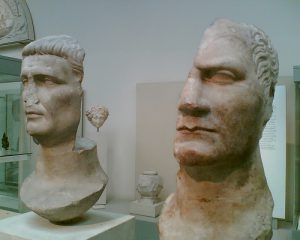
Many public buildings were built around this time – including public baths, a governor’s palace and a large basilica to rival those on the Italian peninsular at that time – in keeping with Hadrian’s policies of constructing major buildings and infrastructure. Statues of the emperor have been found in London dating from this period and it’s possible that these were on public display during and after the emperor’s visit. A bronze head of Hadrian was dredged up from the Thames riverbed in 1834 near London Bridge. Now in the British Museum, the statue is thought to have once stood in a public forum in Londinium. Coins found in London also show Hadrian and are now on display at the Museum of London.
Other objects on display at the Museum of London wouldn’t look out of place in more modern contexts – for example a copper brooch in the shape of a running dog looks strangely familiar and is quite similar to a logo from Walthamstow dog races (now also part of London’s history), while Roman amber and emerald necklaces wouldn’t look out of place around a modern Londonite’s neck in a bar in Soho. A pair of leather bikini bottoms have also been found during excavations in London – they are thought to have belonged to a female dancer or acrobat – but similar pants can probably be seen in some of the city’s night clubs these days too.
During Hadrian’s rule (117-138 AD), the city’s prosperity grew. Archaeologists have found the remains of a port near the original Roman bridge, which proves that Londinium had become an important trading centre, importing and exporting goods and materials. The city’s population rose to between 45,000 and 60,000 by the middle of the second century – making it roughly the size of a modern-day Lancaster. But this was a peak of prosperity that the town wouldn’t see again under Roman rule.
Struggle for the Empire: Albinus and Severus
Something happened to London in the later part of the second century AD, which meant that its size and population dropped. What happened isn’t clear, but it’s possible that the Antonine Plague, which spread through western Europe between 165-190 AD, could have killed some of the population. Another theory is that Londinium’s decline is linked to Hadrian’s policy of stopping the expansion of the empire carried out by his predecessor, Trajan. Trajan overstretched Rome’s military capabilities in the east and bullishly pushed the empire’s boundaries outwards. When Hadrian came to power he quickly reversed some of Trajan’s expansion and concentrated instead on fortifying and defending the frontiers. His decision to stop the northern frontier at Hadrian’s Wall in northern England could have had an adverse effect on trade in and out of London.
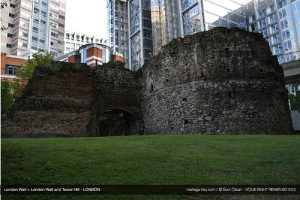
By the beginning of the third century AD, London was a smaller town than its second century self. However, it had rose to prominence in Britannia and in 200 AD it became the capital of the province of Britannia Superior, when Severus divided Britain into two provinces (northern England was Britannia Inferior with Eboracum – York – as the capital, while Wales was part of Britannia Superior). It was at around this time that the city of London was fortified with the London Wall – a massive construction project that reached six metres high and ran around the west, north and eastern edges of the city, with the south of the city flanked by the river.
The construction of London Wall may have been to protect the town from invading Picts in 180 AD, or it may have been built as part of a power struggle in which the governor of Britain, Clodius Albinus, claimed to be the rightful Roman emperor. Albinus was an accomplished military commander and was supported by several legions in Gaul and Britannia. Although he was once an ally to Septimius Severus, by 193 AD Severus had proclaimed himself sole emperor, following the assassinations of Commodus, Pertinax and Didius Julianus in 192-193 AD. This didn’t sit well with Albinus, who still had substantial support in Britannia. He may well have bolstered Londinium’s defences at this time, fearing an attack from the emperor Septimius Severus. In 196 AD things came to a head when Albinus crossed the English Channel and finally faced Severus in the Battle of Lugdunum (modern-day Lyons). Albinus lost and his body was thrown in the Rhine, while his head was sent to Rome as a warning to the senate.
Carausius and Allectus
By the end of the third century AD, another political power struggle was playing out in London. This time it was the gifted military commander Marcus Aurelius Mausaeus Carausius who proclaimed himself to be emperor of Britain (thus refusing rule from Rome). Carausius was probably a charismatic and astute leader of the Britannic Empire from 286 to 293 AD. The third century had been a tough time for the Roman empire and Aurelian had fought to re-unite the empire in 273-4 AD, after the Palmyrene and Gallic Empires broke away between 260 and 274 AD.
When Maximian, Emperor of the Western Roman Empire, came to power in 285 AD, Carausius and the Britannic Empire must have been a thorn in his side, but his attempt to re-conquer Britain in 289 failed, either because of bad weather in the English Channel or, as is more likely, because Carausius’s army couldn’t be beaten.
Carausius is mainly known to us today for the imaginative coins he produced, some of them minted in Londinium. Today some of them can be seen in the British Museum. Gold and silver coins were in short supply in Roman-occupied Britain, so by minting large quantities of quality coins, Carausius was effectively stamping his own authority and identity over the whole of Britannia. It was a very effective PR move, which may have made him a household name, at least among the more wealthy. Carausius was determined to restore the glory of ancient Augustan Rome – but he aimed to establish it in London rather than in Rome itself.
Like many great political ideals, this one fell down in spectacular style. According to Guy de la Bédoyère, an ancient Roman historian and author of Defying Rome, what happened next was “Shakespearian in its climaxes and treachery”. Just as rivalry and a struggle for power between a British leader and his treasurer will sound quite familiar to 21st century Britons, so Carausius too had a treasurer with his eye on the seat of power. But Allectus was not so patient in waiting for his moment to come. In the end, Carausius’s undoing came not from the irate Roman emperor Maximian; instead he was assassinated by Allectus.
Allectus himself ruled the Britannic Empire until 296 AD – coins struck by him in London can be seen in London’s National Maritime Museum. He is thought to have been based in Londinium – according to Guy de la Bédoyère, a large monumental building, whose wood dates to 294, may have been his headquarters, although there is little archaeological evidence to confirm this. In 296 AD, Allectus was killed by Roman troops sent by Constantius Chlorus, who was Caesar of the Western Roman Empire. The Roman troops killed Allectus in battle in the south-east. They then went on to take control of Londinium, before Constantius himself arrived via the Thames. Britannia once again became part of the Roman Empire.
The Trier Medallion, now at the British Museum, commemorates the moment in 296 when Constantius arrived in Londinium. Again, the coins are used very much as a PR tool, with the images minted presenting Constantius as a saviour to London.
Keeping the Barbarians Out
After Britannia’s short-lived independent empire, Roman rule was reinstalled and a period of ‘reconciliation’ followed, at least in London, where new Forum Baths were built in around 300 AD. The forum and baths were around the areas of Gracechurch St and Leadenhall Market. The remains of what are possibly other Roman baths (not necessarily the ones built in 300 though) are visible today near Aldwych – the remains are owned by the National Trust and can be seen at 5, Strand Lane.
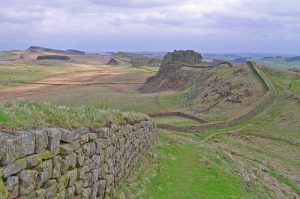
The early fourth century was also a prosperous period for private villas outside Londinium. Those nearest to London include the sites found at Beddington Roman Villa in Sutton, Moor Roman Villa in Hertfordshire, as well as Park Street, Lockleys, Keston and Walton Roman Villas. While some of these are not visitable, Croft Roman Villa, in Orpington, Bromley, is the only Roman villa open to the public in greater London. It’s open between April and October.
The relative peace and prosperity of London during the early fourth century was marred by attacks from the Picts from the north. The threat of attack was present from 340 AD onwards, but by 360, more defensive action was required and emperor Julian the Apostate sent troops to put down the incursion and to bolster London’s city walls. Seven years later, trouble erupted again – this time in the form of a concerted invasion called the Great Conspiracy. In 367 AD, Roman guards stationed on Hadrian’s Wall rebelled and allowed Picts through the famous northern defence line. At the same time, a planned and coordinated attack was carried out by other barbarian tribes landing on British shores.
The Roman emperor at the time, Valentinian I, sent one of his commanders, Count Theodosius, to deal with the insurgency in 368 AD. Count Theodosius (father of the later emperor Theodosius I) marched to Londinium and granted an amnesty to any of the invaders who came forward. Londinium remained a base for Theodosius as he campaigned to wrestle control back from the invading barbarians. Those who remained loyal were killed or driven back outside Britannia’s borders. Finally, control of Hadrian’s Wall was regained and Roman rule was once again re-established in Britannia.
Exeunt Omnes! – The Romans Leave
When the Romans finally left Britain and London in the first decade of the fifth century, there was no momentous revolt or Roman defeat, as had been the dream of leaders such as Carausius and Allectus or tribes such as the Picts and the Alamanni. It may well be that the Roman Emperor of the time simply gave up on the problematic province, whose army periodically rebelled against Roman rule. Again in 407 AD, the army put forward Constantine III as the their leader. Constantine III then declared himself Emperor of the Western Roman Empire, in opposition to Honorius, and crossed the channel, taking most of the Roman troops from Britannia with him.
The abandonment of Britannia wasn’t completely unplanned. According to the Historia Regum Britanniae by Geoffrey of Monmouth, the Roman commanders called the men of Britannia to London in order to train them in tactics, combat and fort-building. However, after the Roman withdrawal, the Britons had few defences and much of the country was overrun by Picts and other enemy tribes.
By this time, many of the urban environments of Britannia were in decline anyway. Many of Londinium’s public buildings had fallen into disrepair. The Empire was in disarray, as the Western Roman Empire declined throughout the fifth century and was subjected to barbarian attacks and encroachments on its borders. Long-distance trade became unsafe again, which meant that a trading town such as Londinium no longer had its economic lifeblood. By 500 AD, the town had become a ruin. The people had gone and the Roman buildings crumbled or were covered with decades, then centuries, of organic matter. It wasn’t until the ninth century that the Anglo-Saxons once again took up residence on the banks of the Thames.
What’s Left Today?
What we can see of Roman London today is only what has survived the years of barbarian attacks and economic decline of the late fourth century, followed by the abandonment and ruin of the next 400 years. Added to that are the settlements of the medieval age and then the unprecedented growth of London since the 17th century, until it became the most populous city in the world by the mid 19th century (of course in the 20th century it’s been outgrown by many other capital cities). What little was left has been thoroughly buried and built upon.
Nevertheless, numerous archaeological excavations have worked on retrieving something of London’s Roman past. In 1981, excavators found the platform that would have supported London’s first Roman bridge, just downstream from today’s London Bridge. At the same time a port was also discerned on the north side of the river near the bridge. In 1988, work beneath London’s Guildhall (Gresham Street, near St Paul’s Cathedral) uncovered a Roman amphitheatre. Nearby, a Roman water-lifting machine were found, while on Fenchurch Street in 2000 a stash of 43 gold Roman coins were discovered – the latter are on display at the Museum of London, while a reconstruction of the water-lifting machine stands at the museum’s entrance.
Other key Roman sites in London today are the London Stone, which featured in the first Ancient World in London video, and the Temple of Mithras (on Queen Victoria Street at Temple Court).