Few people would ever have called Saddam Hussein a god; not even many of his most vehement supporters. But the vainglorious way in which he rebuilt many of Iraq’s most coveted ancient sites seems to suggest he saw himself as some sort of Babylonian deity along the lines of the Egyptian heretic king Akhenaten. However a great number of Saddam’s beloved monuments have fallen into the hands of the US Army since the war in 2003. How are the Americans looking after Saddam’s Mesopotamian masterpieces? And what modern uses are these sites, spearheaded by the vast Ziggurat of Ur, currently enjoying?
The God-King and his Babylon
Like most 20th century tyrants, Saddam’s reign was one based around his cult of personality. But this did not end with the chintzy portraits and billboards hanging from every corner of his home nation. Saddam billed himself as a living incarnation of the ruthless Babylonian king Nebuchadnezzar II (605 – 562 BC); rebuilding parts of his ancient hero’s illustrious city as well as echoing many of his goals and narcissistic traits. In the early 1980s, when Saddam’s conscripted army was fighting on several fronts and his population dying from starvation and disease, the formidable dictator would begin his epoch of restoration in a bid to bridge the gap between his beleaguered nation and its glorious Mesopotamian past. The first of these grandiose undertakings was the rebuilding of the ruins of Babylon. Over 60 million sand-coloured bricks were placed directly on top of their ancient counterparts; each one inscribed with Saddam’s name. One such motif reads, “This was built by Saddam Hussein, son of Nebuchadnezzar, to glorify Iraq.” This directly echoes the work of Nebuchadnezzar, who did exactly the same almost 2,500 years previously.
Saddam would liken himself to his hero’s image in several other ways. He minted coins with his profile transposed on Nebuchadnezzar’s; he placed portraits of them both around the walkways to his new Babylon; and he built two royal palaces – one to Nebuchadnezzar on the site of his ancient original, and one to himself just yards away and dripping with marble and gold; the walls lined with romanticised visions of Ur, Babylon and the much-fabled Tower of Babel.
Its palm-line gardens even echoed popular conceptions of Babylon’s famous Hanging Gardens, Nebuchadnezzar’s wondrous gift to his homesick wife. Rumours abound that Saddam even planned to reprise the infamous biblical tower, though evidence is scarce. As Saddam rebuilt his nostalgic vision of god-like supremacy, however, the archaeological world tore its hair out: For his new fearsome estates were crushing their ancient ancestors, and rather than preserving Nebuchadnezzar’s posterity, Saddam was erasing the few physical remnants of his reign.
So far, so 20th century dictator. Yet Saddam’s megalomania went much further than mere tyranny and ancestral worship. He saw himself as a god-king, much in the likeness of the Egyptian heretic king Akhenaten – and Saddam’s rebuilding of one of Mesopotamia’s best-loved monuments would provide the clearest example of this.
The Ziggurat
The Ziggurat of Ur is one of the showcase relics of the ancient Mesopotamian world. A vast temple spanning the gap between the gods and man, the 21st century BC site was first built by the king Ur-Namma and completed by Shulgi – who declared himself a god on its inauguration. This self-deification was later to be echoed by Akhenaten, who attempted to change the Egyptian faith, and built a new capital city and temple in his honour. Seeing the Ziggurat as a chance to cement his god-like position at Iraq’s helm, Saddam restored much of the temple’s lower ramparts, again inscribing his name upon it. This construction of grandeur, more than any other undertaken during his reign, showed how Saddam not only saw himself as an incarnation of Nebuchadnezzar, but also as a link from his people to god; a power absolute which could never possibly be toppled. Thus by cultivating this cult through the images of Babylon, Nebuchadnezzar and the Ziggurat, Saddam pushed his poverty-stricken people into wars in Iran and Kuwait, and eventually into destruction at the hands of the US-led coalition. He would even share the same ultimate goal as Nebuchadnezzar, by driving the Jews from Jerusalem.
The fall of the God-King
Yet Saddam was to fall spectacularly from his demigod’s burnished throne when the coalition smashed their way into his country’s historic heartland, brushing aside his Ba’athist armies and Imperial Guard with frightening ease. In stark contrast to the glittering tyranny of his rule, Saddam would be found cowering in a tiny cellar in his hometown of Tikrit; shivering and famished with a beard which resembled startlingly the matted web-like beard sported by Nebuchadnezzar in many popular likenesses. In fact, the biblical depiction of Nebuchadnezzar’s downfall seems a more-than-coincidental echoing of Saddam’s own dishevelled fate: “He was driven from mankind; he ate grass like oxen, and his body was washed by the dew of heaven, until his hair grew like eagles’ feathers and his nails were like birds’ claws.” Yet Nebuchadnezzar had been the ‘destroyer of nations’, and Saddam succeeded only in destroying his own. And on December 30, as Saddam was draconically forced to the gallows, what of the Mesopotamian treasures he had strived to restore. Were they being looked after by the prevailing US Army? Or were they being subjected to even more disrepair?
 Since the beginning of the controversial Iraq War, U.S. and coalition forces armies have come under attack from archaeological and historical organisations for their perceived destruction of ancient Mesopotamian treasures. And while any war is hardly likely to lend itself to the preservation of antiquities, the army have come in for some pretty harsh criticisms of their treatment of some of the world’s most important antiquities.
One of the most vocal oppositions has been against the erecting of a helipad at ‘Camp Alpha’ right on ancient Babylonian ruins. Parts of the area’s archaeological site were flattened to make way for the helipad, and a large portion of the replica of the ancient city’s famous Ishtar Gate was razed. At first U.S. officials defended their actions, saying they had diverted a lot more damage from the threat of looters at the site. However, after some time Colonel John Coleman apologised for the helipad, which was originally commissioned by General James T. Convoy.
However much the army’s defences were designed to protect Babylon, its methods have not exactly been subtle. John Curtis, author of the British Museum’s report on the health of ancient Iraq in 2005, said that the U.S. army’s excavation of trenches in and around important historical sites ‘would contaminate the archaeological record of the site.’ He also noticed fuel dumps which would erode artefacts irreparably, and earth brought from outside the site to fill sandbags – which has left the area a mish-mash of foreign stones, turf, sand and broken relics. Even graffiti was found on some of the monuments, left by the American and Polish soldiers who had occupied the ancient city. ‘Miss you, Smoothy!’ is one inscription not identified with Nebuchadnezzar’s cuneiform pieces, for example.
What Next?
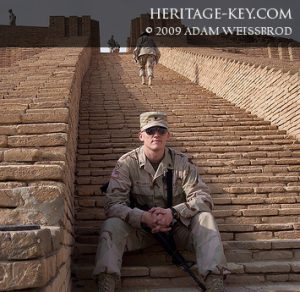
Many foreign and local archaeologists have also accused soldiers of looting artefacts from the city; accusations which will no doubt be left unconfirmed with the sheer number of objects hidden beneath the Iraqi desert. Thus it left for the public to decide, with all the public wrangling between museum curators, archaeologists, army officials and politicians, whether the desecration of the land Saddam sought to rebuild has been a necessary evil of a bloody war; or the shambolic miscalculations of a misguided aggressor. The truth is probably somewhere in the middle, one presumes; yet one thing is for certain – Iraqis are able to enjoy their heritage for the first time in decades thanks to Saddam’s inglorious ousting. The Ziggurat, once cut off from the population as a Ba’ath fortress, is now open to ordinary Iraqis – and was the site of a ceremonial soccer match between U.S. soldiers and Iraqi civilians in 2007. The U.S. Army even runs a tour of Ur’s ancient treasures via the Ziggurat and the House of Abraham.
The oddest chapter in the area’s fascinating history came on June 10, 2007, when a group of U.S. soldiers held ‘Ziggurat Con’ near Ur – a role-playing game convention with the unique accolade of being the only such event held in an active war zone. Thus Iraq and the treasures of ancient Babylon have seen some monumental changes in the past few decades – from its ceremonial augmentation under Saddam Hussein, to the damage and protection meted out by the occupying coalition forces. Some may say the true Babylon has been lost forever beneath sandbags and Ba’athist opulence. But the recent tragedies in Iraq have brought its Mesopotamian heritage to the forefront of the historical world’s imagination – and a democratic Iraq may bring with it a renewed vigour for the restoration of some of the world’s most important artefacts. Nebuchadnezzar may have baulked at Saddam’s self-deification, but there’s no doubt the ancient tyrant would have wanted to see his beloved city live on forever.