• site

    Tassili n’Ajjer

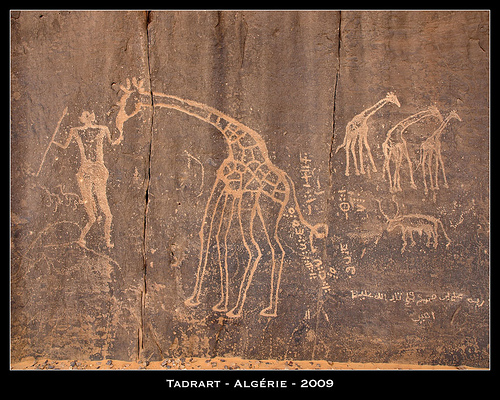
    Attribution: jpmiss Sahara Desert Algeria Key Dates The earliest prehistoric paintings probably date to 9000 BC. The prehistoric rock paintings of Tassili n’Ajjer in the Sahara desert in Algeria, probably date from 9000 BC on.  They were made during a period when the climate was wetter than now and the Sahara was closer to savannah than desert conditions, and therefore able to support greater human occupation as is evident from finds of stone tools and ancient rubbish heaps as well as the rock art itself. The rock art can be classified into the following periods: the Bubalus period (from c.9000 BC), the Roundhead period (c.6000-4000 BC),…

  • world

    Borovo Treasure

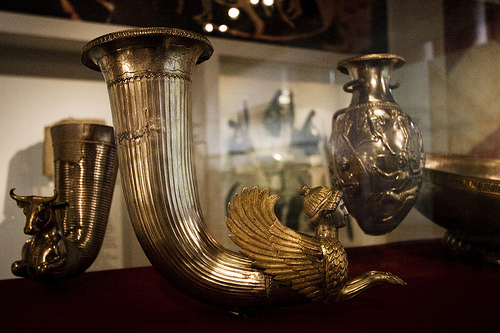
    Attribution: Ann Key Dates 350 BC Key People  King Kotys I The Borovo Treasure was accidentally discovered in 1974, when a field about 2 kilometres from the village of Borovo, Ruse (Bulgaria) was ploughed. Sadly, the plough machine’s cutting implements severely damaged the five silver artefacts, but thanks to great restoration work, nowadays their ‘scars’ are nearly invisible.  No tumulus was found at the location, and why the silver treasure was buried here remains a mystery. The Borovo Treasure is a luxurious five-vessel silver gilted drinking set – decorated with gold. It consists of three rhytons (ending in the protomes of…

  • Ann

    Qatna’s Royal Palace reveals further archaeological treasures

    The ongoing dig at the ancient royal town of Qatna, Syria, has brought some exciting new discoveries to light. Among the skeletal remains, archaeologists have found precious gold jewellery, gemstones, alabaster vases, detailed ivory artefacts, tiny figurines. Since the start of this year’s excavation mid-July, a total of 379 artefacts were recorded in the tomb. The archaeological mission a Syrian-German cooperation between the University of Tubingen and the Syrian governement is further excavating the royal sepulchre that was discovered last year under the northwest wing of Qatna’s royal palace. Among the burial gifts, a number of Egyptian object are of…

  • Ann

    Cyrus Cylinder row resolved: ‘Ancient declaration of human rights’ to visit Iran

    The British Museum has announced that it is lending the Cyrus Cylinder to the National Museum of Iran. Together with two fragments of contemporary cuneiform tablets, it will be the centrepiece of an exhibition that celebrates a great moment in the history of the Middle East. The artefact which is described as ‘an ancient declaration of human rights’ by the United Nations was originally due to arrive in Iran in September 2009. At that time, the British Museum cited the ‘political situation’ in post-election Iran as the reason for the delay. In August this year, the loan was once again…

  • Ann

    Sagalassos Archaeological Project Digs Up Oldest Roman Baths in Asia Minor

    At the ancient city of Sagalassos, Turkey, archaeologists have discovered the oldest Roman baths in Asia Minor known to date. The new find means the Capito Baths in Miletus, built during the reign of Emperor Claudius (41-54 AD),have to concede theirposition as the oldest known Roman bathing complex in Anatolia. Oldest Roman Bathsin Asia Minor The ‘Old Bath’ was discovered at Sagalassos, an ancient city from Hellenistic and Roman times in southwestern Turkey. They were locatedbelow the previously unearthed Imperial Baths, dated to120-165 AD. The newly discovered bathing complex is much older and smaller than the Imperial Baths which have…

  • owenjarus

    2,000 year old burial complex discovered on Jacob’s island, Kawartha Lakes Canada

    A team of archaeologists has discovered a 2,000 year old burial mound complex on Jacob’s Island in Kawartha Lakes Canada. So far the team has discovered 35 burials, although there could be nearly double that at the site. The deceased include a mix of adult men, women, teenagers and young children. “These are community burials, we’re getting a selection of the community being buried here,” said Professor James Conolly of Trent University, who is leading the team. The mound indicates that people in Ontario were living an egalitarian lifestyle at this time – even though they were constructing more elaborate…

  • malcolmj

    Top 10 Facts About Sparta’s Women

    As documented in the article ‘Woman of Sparta: Tough Mothers’, Spartan women enjoyed all kinds of rights not shared by their Athenian sisters – albeit plenty of plights too. Sparta’s unique social system and constitution, which was completely focused on military training and excellence, afforded females a level of freedom and responsibility uncommon in the classical world – as child bearers, they were vital to replenishing the ranks of an army that suffered an almost constant stream of casualties; with so many men constantly away at war, they were crucial to running their households and the community at large. Yet, Spartan…

  • world

    Interview: Fakes & Forgeries Curator Paul Denis on Greek Coins, Zapotec Artefacts and the Internet

    In a conversation with Heritage Key (HK), Paul Denis (PD), the curator of Fakes & Forgeries Yesterday and Today, a newly announced exhibit at the Royal Ontario Museum, talks about how fake ancient artefacts are affecting the museum world. Among the things discussed are: -The emergence of ancient Greek coins as a new hot area for fraudsters. -Why the internet is an awful place to acquire artefacts. -How curators (with a little scientific help) pick out fakes. He also shares some interesting news: of the hundreds of Zapotec artefacts his museum has, about 50 percent are forgeries. He explains how they got duped on such a grand scale.…

  • exhibition

    Divus Vespasianus

    Organized by Filippo Coarelli, the exhibition – whose full title is Divus Vespasianus: the Capitoline Hill and Egypt in the Flavian era – illustrates the major building projects that Vespasian was responsible for on the Capitoline hill, including the reconstruction of both the Temple of Jupiter Capitolinus and the Temple of Isis that had been elevated to public sanctuary status. The entire exhibition pivots around the key role played by Egypt under Vespasian and his sons, and their particular devotion to eastern divinities, which wasn’t limited to buildings on the Capitoline Hill, as the reconstruction of the ancient Iseo on…

  • prad

    Ask Questions to a Museum Curator Today on Twitter

    Museums across the world are participating in the “Ask a Curator” event, which uses social networking service Twitter to let the public ask questions to the people curating some of the biggest cultural establishments across the globe. With over 300 experts participating in 23 countries, you can find out the answer to all those questions you may have been wondering regarding the behind-the-scenes runnings of a museum, such as how big those hidden basements full of artefacts (Check out the Basement of the Cairo Museum in this Video) really are, and how does a museum decide what exhibitions to put…