• world

    Top Ten Cave Paintings

    Cave art is the oldest example of non-portable art in history, and dates back in some cases as far as 32,000 years. It can be found painted, scratched, etched, smudged and pecked onto the walls of caves all over the world, on almost every continent. Here we examine ten of the most famous sets of examples yet discovered. Bhimbetka Rock Shelters, India The spectacular Bhimbekta rock shelters in Madhya Pradesh, central India, contain the oldest traces of human life in the region. The vast selection of cave paintings and other forms of rock art found within them are the first…

  • prad

    Myrtis the 2,500 Year Old Athenian Girl Finds a New Home

    ‘Myrtis‘ has attracted thousands of people across Greece to see her, has appealed to the world leaders to end the spread of disease and now she earns herself a place amongst historic artefacts in the National Archaeological Museum in Athens. All this, and her name isn’t actually Myrtis. It was the name that was given to her by scientists who uncovered her remains, as well as over 150 other skeletons, from an archaeological dig of a ‘plague grave’ at Kerameikos Cemetery dating back between 426-430BC, as reported by ana-mpa. Myrtis’ resurrection some 2,500 years after her death from Typhoid –…

  • prad

    Aerial Photography of Drought-hit Britain Uncovers Hidden Archaeological Sites

    The sunny, dry spells of May and June over Britain were enjoyed immensely by the populace, but it wasn’t just Brits who were taking advantage of the soaring temperatures. Archaeologists were taking to the skies to observe cropmarks which occur when wheat or barley crops grown over ancient buried sites at a different rate. The aerial surveys have produced many new discoveries, including newly-discovered Roman and prehistoric settlements, representing the most successful summer flights since the drought of 1976. Results of the flight have revealed the Roman fort in Newton Kyme, North Yorkshire to be bigger than previously thought, with…

  • prad

    Roman Lantern Discovery by Metal Detectorist Sheds Light on Suffolk’s Ancient History

    The only complete example of a Roman lantern to have been found in Britain was discovered in Autumn 2009 by a metal detector user. Danny Mills found the large bronze object whilst scanning a field near Sudbury, and immediately notified the discovery to the Suffolk Archaeological Unit. The find is significant as only fragments of similar lanterns are held at the British Museum, and the closest complete example was excavated in Pompeii. The interest in the lantern even earned it a feature in the BBCseries “Digging for Britain”! The Roman lantern dates from between 43-300AD, and is similar to a…

  • Ann

    ‘No ceremonial burial for the Iceman’, respond Otzi researchers

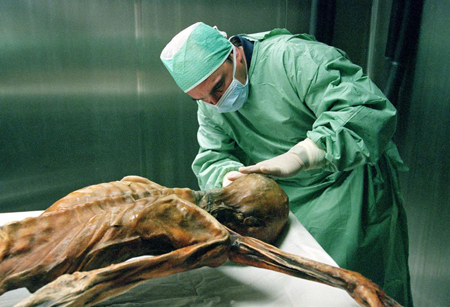
    In his article The Iceman as a burial appearing in Antiquity 84/2010, the archaeologist Alessandro Vanzetti of Romes La Sapienza University and his coauthors reconstruct the position of the Iceman at his place of discovery on the Tisenjoch pass in South Tyrol, Italy. From this and based on his botanical investigations, he draws the conclusion that the Iceman did not die at the site of the incident: rather he died in the spring within his valley community and only later, in September, was brought up to the Tisenjoch and buried there. The team researching tzi has now responded to Vanzettis…

  • owenjarus

    Oldest house in Ontario discovered at 4,500 year old settlement near Lake Huron, Canada

    Archaeologists have discovered a 4,500 year old settlement, on the Ausable River, near the shore of Lake Huron in Canada. The find rewrites the history of the Canadian province of Ontario, proving that people were living a sedentary lifestyle at that time, even though they lacked agriculture and pottery. Among the discoveries is a 4,500 year old house – the oldest ever found in the province. “It’s semi-subterranean – it’s dug partially down into the ground,” said Professor Chris Ellis of the University of Western Ontario. He led the team that made the find. “It’s as old as the pyramids…

  • site

    Peabody Museum of Archaeology and Ethnology

    Attribution: Wally Gobetz Key Dates The Peabody Museum was founded in 1866 by George Peabody and is one of the oldest museums in the world devoted to anthropology. Cambridge United States The Peabody Museum of Archaeology is affiliated with Havard University, and has one of the most comprehensive collections of North American archaeology and ethnology in the world. Founded by philanthrophist George Peabody in 1866, the museum boasts a vast collection numbering over 6 million objects, the majority of which are of archaeological artefacts. The Peabody Museum has played an active part in the history of American anthropology and in…

  • General

    Nicole Alexanian

    Nicole Alexanian Egyptologist Dr. Nicole Alexanian holds a PhD in Egyptology from Universität Heidelberg. Since 2000 she has been directing a German Archaeological Institute project at Dahshur in Egypt. The site is known as the location of several pyramids. These include the Bent and Red Pyramids, constructed by the pharaoh Snefru during the Egyptian 4th dynasty. It is also home to the Black Pyramid, constructed by Amenemhat III during the Middle Kingdom. Dr. Alexanian and her team have been reconstructing what the Dahshur landscape looked like in ancient times, examining its topography, geology and climate. They found that the ground…

  • Ann

    Fiery Pool: The Maya, the Mythic Sea and the Turtle

    After a successful stay at the Peabody Essex Museum, ‘Fiery Pool: The Maya and the Mythic Sea’ opens this weekend at Forth Worth’s Kimbell Art Museum. The exhibition offers a new interpretation of the ancient culture, beyond the traditional view of the Maya as a land-based civilisation. Expect supernatural crocodiles breathing forth rain; cosmic battles taking place between mythic beasts and deities; and art works adorned with shark teeth, stingray spines, sea creatures and waterfowl all part of the new and vivid picture the exhibition paints of the Maya world view: the Maya did not just navigate river and streams,…

  • Ann

    Stonehenge Acoustics: England’s First Ministry of Sound?

    London-based nightclub Ministry’s motto of sound system first, interior design second, lights third made them one of the most famous gathering places for those who worship bass. But how did those conceptualising Stonehenge plan to enchantthe Neolithic congregate? Rupert Till, an acoustics and music technology expert, asserts the stone circle would have created a perfect (early design) amplifier – making Stonehenge the place to be from the Stone Age onwards. Professor Tillsays Stonehenge when it was in perfect shape would have worked perfectly to resonate sound, creating trance-like music which would have aided rituals and worship at the site. To…