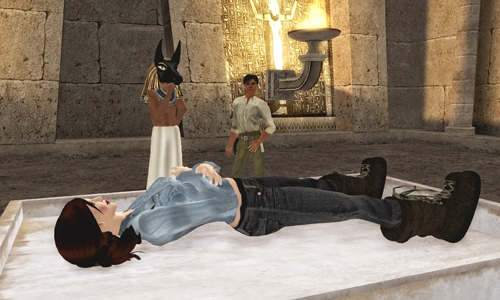
Exploring is more fun now with the new Heritage Key Virtual Quest in the Treasures region! As you land in the Arrivals Area after logging into Heritage Key Virtual, make your way to the teleports where you will see several destinations. Selecting “Treasures” will take you to King Tutankhamun’sGolden Shrine. One of the museum guides will give you the keys that you will need to find the mummy. This is a short quest which will take you into the Golden Shrine. You will slowly open and enter the layers of the shrine and while doing you will get real close…
-
-
Almost 2,000 years after its last native speakers disappeared, the sound of Ancient Babylonian makes a comeback in an online audio archive. The recordings include excerpts from some of the earliest known works of world literature, dating back to the first years of the second millennium BC. Prompted by the enquiries of curious colleagues and friends, Dr. Martin Worthington, an expert in Babylonian and Assyrian grammar from the University of Cambridge, has begun to record readings of Babylonian poems, myths and other texts in the original tongue. In an effort to present users with a variety of voices, the readings…
-
Almost 2,000 years after its last native speakers disappeared, the sound of Ancient Babylonian makes a comeback in an online audio archive. The recordings include excerpts from some of the earliest known works of world literature, dating back to the first years of the second millennium BC. Prompted by the enquiries of curious colleagues and friends, Dr. Martin Worthington, an expert in Babylonian and Assyrian grammar from the University of Cambridge, has begun to record readings of Babylonian poems, myths and other texts in the original tongue. In an effort to present users with a variety of voices, the readings…
-
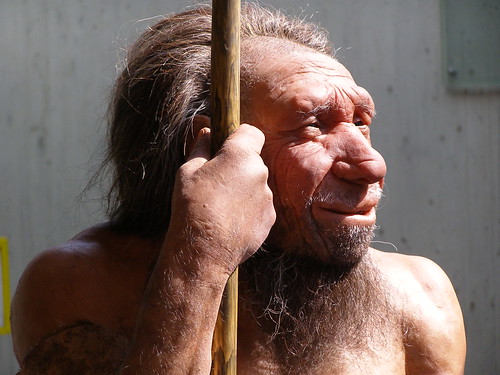
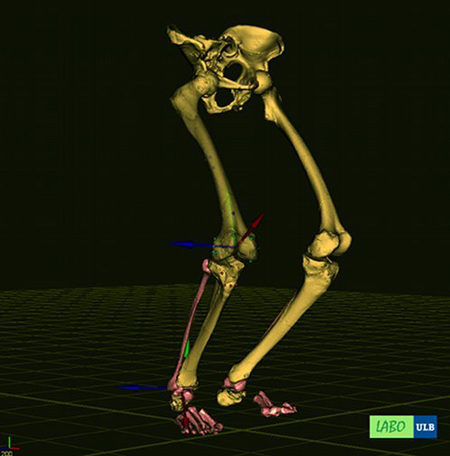
A new research project from the Universit Libre de Bruxelles (ULB) takes us one step further as it comes to understanding Neanderthal locomotion. The Laboratory of Anatomy, Biomechanics and Organogenesis’ (LABO for short) project created a 3D virtual reconstruction of a pair of Neanderthal lower limbs. The skeleton shows the Neanderthals had the same moves as we do and between 5% and 20% more leverage than us. Homonids (that includes all forms of the human lineage, be it extinct or living) started bipedal locomotion (moving by means of your two rear limbs or, in our case, legs) some 6 million…
-
Attribution: Zahi Hawass (on Flickr) Zahi Hawass Secretary General of the Supreme Council of Antiquities 28 May 1947 World-renowned archaeologist Zahi Hawass currently serves as Secretary General of the Supreme Council of Antiquities, and directs ongoing excavations at Giza, Saqqara, and in the Valley of the Kings. Dr. Hawass received his PhD in 1987 from the University of Pennsylvania. He has written numerous scholarly articles and books, and is highly respected as an Egyptologist. Over the course of his long career, he has been presented with numerous awards and honors. In addition, Dr. Hawass is known for his charisma and…
-
Archaeologists excavating a 9,000 square metre area at Angers, in the Loire District, France, have discovered the remains of the first mithraeum a sanctuary dedicated to the Indo-Iranian god Mithras in the west of France. The cave sanctuary, a rectangular building, is dated to the third century AD. The Mithraeum The small, vaulted chapel in which worshippers hosted banquets and sacrifices dedicated to the god, is decorated with a starry sky. The excavations revealed drums of columns perhaps statue bases, but possibly altars. A sort of vestibule allowed worshippers to don their ceremonial robes before entering the sanctuary. The Mithraic…
-
What do you get when you combine the Sphinx with cleavage? You get a video that looks something like this (Watch the Video). YouTube phenomenon Marina Orlova, a former teacher who presents facts with a slightly risqu twist, gives a lesson on the famous monument. According to her bio she holds two degrees in philology (that’s historical linguistics), has just under 400,000 YouTube subscribers and yes she did teach high school, back in Russia. She uses the tag line intelligence is sexy. To be fair to her, the video is informative and while her attire is – eye-catching – it…
-
The links between the Stonehenge area and the Mediterranean have been debated for years. Recent research suggest that some of the people buried in the area duringthe Bronze Age were not local. Rather, they came from both the snow of the Alps and the heat of the Mediterranean to visit Stonehenge. The analysis of the teeth from two males provides new evidence that one dubbed the Boy with the Amber necklace had come from the Mediterranean area, whilst it confirms the Amesbury Archer had come from the Alps. The Amesbury Archer was discovered around five kilometres from Stonehenge. His is…
-
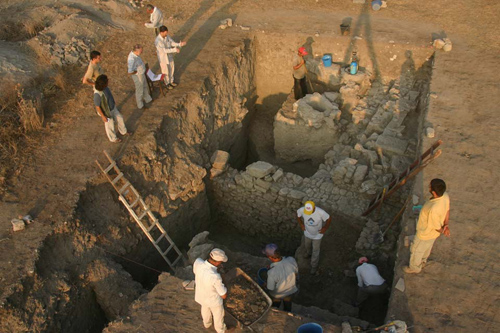
A dig in search of Anglo-Saxon skeletons has instead unearthed signs of a sprawling Roman settlement. The discovery was made last week, on the grounds of Cambridge’s Newnham College. Evidence of a 16th or 17th century farmhouse that could date back to the reign of Henry VIII was unearthed at the site as well. “We knew there was a Roman settlement here before but we had no idea of the size,” said Dr Catherine Hills. “The village has been buried under the gardens for nearly 2,000 years, and may have seen the Roman conquest of Britain and Boudicca’s revolt. The…
-
For decades scientists believed Neanderthals developed ‘modern’ tools and ornaments solely through contact with Homo sapiens, and it is often said that the cavemen weren’t able to adapt their hunting techniques to the changing climate quickly enough to prevent their extinction. A new study nowsuggests these sturdy ancients were well capable of innovating without our help, adding to the growing pool of evidence that Neanderthal man was not a primitive, clumbering caveman. Basically, I am rehabilitating neanderthals, explainsJulien Riel-Salvatore, assistant professor of anthropology at UC Denver. They were far more resourceful than we have given them credit for. Uluzzian Innovation…