Submissions from the public have helped Oxford University academics put together a hoard of Anglo-Saxon treasures. Yet, there is no need to get your metal detectors out. The hoard in question is the worlds largest online archive of material concerning the Anglo-Saxons. The virtual treasure consists of digital objects related to the teaching, study, or research of Old English and the Anglo-Saxon period of history, which will be made available online for free. Project Woruldhord (Old English for world hoard), which called on the public to submit Anglo-Saxon teaching material after being inspired by the level of interest surrounding the…
-
-
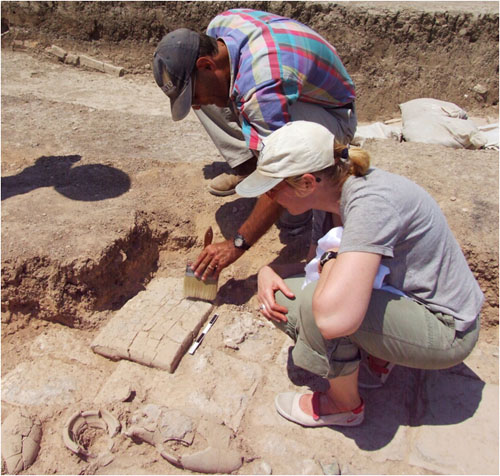
A team of researchers – excavating a 2,700 year old temple at the ancient city of Tayinat in southeastern Turkey – have discovered evidence that its inhabitants prominently displayed a tablet which bore a pledge of loyalty to the heir of an Assyrian king. At their height the Assyrians controlled an empire that stretched from southern Iraq to the Mediterranean coast. In their art and writing, “the Assyrian king was portrayed as supreme ruler of the known world and viewed with absolute authority as the earthly representative and human embodiment of (the Assyrian god) Ashur,” said Professor Tim Harrison of…
-
by Mark Bradley Cambridge University Press (2009) 8/10 When Vergil describes, in his epic poem the Aeneid, the weapons brought by Venus to Aeneas and the breast plate is compared to a blue cloud shining in the sun’s rays in Aen. 8.622 and likewise Vergil’s description of rosey-fingered dawn in Aen. 7.26, none of these images would have been possible without the use of colors and color-terms. Similarly, the elegiac poet Propertius’ landscape in 1.20.38 may not have had the beautiful bucolic background with shining apples hanging from trees surrounded by white lilies mixed with purple poppies. Mark Bradley’ Colour…
-
Here we are at the temple of Amenhotep III. It is the funerary temple of a king who lived during the first half of the 14th Century B.C. It is a time when Egypt is at the pinnacle of its glory, its expansion and its power. During his reign, which lasted 39 years, the king built here, in the Theban area the biggest temple ever seen, which stretched from the Memnon Colossi all the way to the modern road that runs in front of the Antiquities Office for a total length of 700 meters. Compared to the other temples found…
-
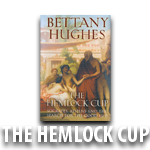
In 399 BC the Greek philosopher Socrates, by then around the age of 70, was executed in his home state of Athens. He was prosecuted for the rather dubious crimes of “not acknowledging the gods the city acknowledges” and “subverting the youth of the city”. His case was brought to court and prosecuted by a man named Meletus Meletou. After a one day long trial (the norm back then) he was found guilty by a jury of 501 peers – and sentenced to death. Modern day historians suspect that this trial was politically motivated. Indeed Socrates is said to have referred…
-
The word “Aryan” has become inseparably associated with the racialist world-view of the Nazis, despite the fact that – far from specifying a blonde-haired, blue-eyed “master race” – it was originally a perfectly innocent self-designator for a tribe of ancient nomadic Indo-Iranians who lived in the region of modern Iran, Afghanistan and India from around 2700 to 350 BC (more about “Aryan’s” passage from a simple piece of linguistic terminology to a racialist rationale for megalomaniacal world domination here). Saturated as they are in misconception, mirth, myth, and wild fantasy, the “Aryans” have become something of a lightning-rod for weird…
-
New research by archaeologists at the University of York suggests that it is beyond reasonable doubt Neanderthals often misrepresented as furry, primitive caveman hobbling about had a deep seated sense of compassion. Dr Penny Spikins, Andy Needham and Holly Rutherford from the universitys Department of Archaeology examined the archaeological record in search for evidence for compassionate acts in early humans. These illustrate the way emotions began to emerge in our ancestors six million years ago,which developed into the idea of ‘compassion’ we know today. We have traditionally paid a lot of attention to how early humans thought about each other,…
-
German archaeologists have made new discoveries at modern day Hisarlik, northwest Turkey ancient Troy. The finds further confirm the area occupied duringthe Bronze Age was not limited to the citadel; Troy VI and VIIwere muchlarger than originally thought. The three year research project at Troy lead by Prof. Ernst Pernicka, from the University of Tubingen‘s Institute of Pre- and Early History sees scholars focus on the analysis and publication of materials found since the university started excavations at the site in 1988. But to investigate and resolve outstanding issues, Project Troia does undertake some smaller excavations. These digs, in combination…
-
Bad news today for ancient history fans in Western Canada. The Terracotta Warriors show now on at the Royal Ontario Museum (ROM) will not be coming to Victoria and Calgary. It had previously been announced that the Terracotta Warriors would visit the RoyalBC and Glenbow Museums, respectively,in 2011/2012. The ROM is the lead partner in organizing the exhibit. A release says that out-of-country loan of Terracotta artefacts from China is unable to be extended beyond one year to Canada. As a result, the museums that planned to exhibit the artifacts during the second year of the tour, Calgary’s Glenbow Museum…
-
Google Translate has added Latin to the ever-expanding list of languages the free service offers – in which the old-fashioned ‘Lorum ipsum dolor’ (or lipsum) is upgraded to a more modern ‘Hello World!’ In apost to the official Google blogtitled ‘Veni, Vidi, Verba Verti’ (which the service translates as ‘I came, I saw, I translated the words’), Igeniarius Programmandi Jakob Uszkoreit correctly points out that althoughit isn’t likely to be used to translate emails (with some exceptions,maybe) the new service is an excellent tool for scholars all over the world as many ancient and medieval works on philosophy, religion and…