
When visiting King Tutankhamun’s tomb – or its virtual counterpart King Tut Virtual – did you ever notice the strange brown spotson the wall paintings? They definitely were not there when Howard Carter discovered KV62 in 1922, and nobody knows what is causing them, not even Dr. Zahi Hawass: “I always see the tomb of King Tut and wonder about those spots, which no scientist has been able to explain.” Now the Getty Conservation Institute – specialised in conservation techniques for art and inparticular forancient sites – in cooperation with the SCA will start a five-year conservation project to determine…
-
-
‘Reclaiming King Arthur’ -avideo produced by the University of Wales, Newport, aims to bring to life the legend of King Arthur, by examining historic evidence and the literary tradition which points to Gwent as the home of this famous character as well as to introduce an international audience to the history of this South Wales site.In thevideo – available for all to see on the University’s Instititue of Digital Learning website -Dr Ray Howell examines the relevance of King Arthur as most widely known through legend, myth, historical evidence, literature and the literary tradition which include explanation of how Caerleon…
-
Modern pyrotechnology has been traced to a cave in South Africa thanks to scientists barbecuing rocks in an experiment worthy of a CSI episode. Archaeologists were puzzled by stone arrowheads found in a coastal cave near Mossel Bay. How did early hunter-gatherers make such fine hunting gear? History’s detectives tried to re-enact the scene and make blades and bifacial tools themselves, but it proved trickier than anticipated. Finally, they worked out that to fashion the tools early modern humans must have mastered pyrotechnology the controlled use of fire 45,000 years earlier than thought. And in Africa, rather than Europe. It’s…
-
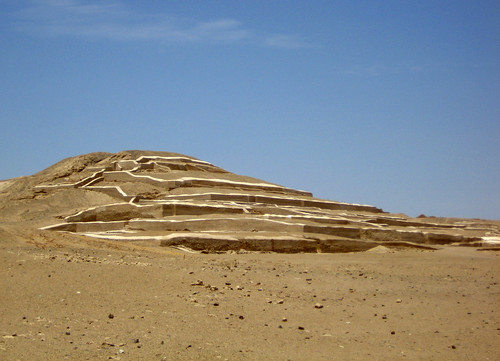
The mummy of a young Nazca priestess has been discovered in the ancient city of Cahuachi, Peru. Italian archaeologist Giuseppe Orefici, director of the Nazca Project, made the startling find in a mini-temple between the mysterious metropolis’ Great and Orange Pyramids. The 300-450 AD woman had been buried beneath ropes and reeds, and covered in finely-woven fabrics with killer whale pattern. Several obsidian arrow heads had also been worked into the weave. The young woman’s face had been painted, and an extra vertebra added to her back. Her arms were also deformed – possibly as a result of having had…
-
by Dr Harry Sidebottom Michael Joseph, a Penguin imprint (2009) 9/10 The continuation of barbarian Marcus Clodius Ballista’s adventures in Roman Syria of the mid-third century AD does not disappoint. Picking up where Fire in the East dramatically left off, Harry Sidebottom takes his story by the scruff of its neck, hurling Ballista and his faithful familia – grumbling ugly-pug Calgacus, the ever-humping bodyguard Maximus and his youthfully winsome Greek secretary Demetrius – into a series of disasters amid a whirligig of political shenanigans; not to overlook several gruesomely described battles. Historical Fiction As It Should Be (Dan Brown, please…
-
An Italian duo have revealed what they claim is the ‘real’ face of Queen Nefertiti. Ethnologist Franco Crevatin, from the University of Trieste, and cosmetics expert Stefano Anselmo, started with a recent CAT scan of the famous queen’s bust, held in Berlin’s newly-reopened Neues Museum. The scan of ‘Nonofret‘ as she’s known in Germany, appeared to show a second face, made of stone, buried beneath the stucco top layer the world has come to adore. Using computer imaging, Crevatin and Anselmo have made what they feel is a faithful reproduction of the hidden face. And though differences are subtle –…
-
Heritage Key takes a trip to explore the British spirit of adventure, where we’ll be meeting with Lord and Lady Carnarvon at Highclere Castle . We are shooting some new video that will dig deeper into information about the man who funded Howard Carter’s work as well as the history of the incredible castle itself. We hope to be able to share new images and more insight into the tomb paintings and key artefacts of King Tut. Let us know if you have any questions – You might get them onto the video. You can use the comments box below,…
-
Iran has taken a step closer to its goal of moving its capital away from Tehran to a new, as yet unbuilt location near the town of Qom. This seems like an extreme move but it’s one that has been repeated throughout history – as far back as the Egyptian dynasties of the Middle Kingdom, in ancient China and many times during the Roman empire. Sometimes there are practical reasons for capital-moving. In Iran’s case it claims that Tehran, a city of 12 million people, sits on 100 seismic fault lines and is therefore a major natural disaster waiting to…
-
Next Saturday Venice will be holding its own funeral. As far as publicity stunts go, it’s quite an unequivocal message that the city is on the brink. Only this time the threat is not from the rising tides and the island city’s subsiding foundations; the danger comes in the form of the rapidly shrinking population it seems that the Venetians are migrating to the mainland faster than you can say ‘just one cornetto’. According to one group of locals members of the online community venessia.com – the population has now fallen below the threshold of 60,000 people (down from about…
-
The recent reopening of Berlin’s Neues Museum has brought back into the limelight one of the ancient world’s greatest treasures. Yet as Thutmose’s masterful Bust of Nefertiti takes centre stage in Germany’s latest collection, the woman behind Egypt’s most famous sculpture remains a conundrum. Heresies, lost kingdoms and mysterious kingships have made Nefertiti more than the ‘most beautiful woman in the world’. But who was she, and how did she become one of the greatest leaders in Egypt’s history? Nefertiti’s origins are a mystery. Born some time around 1370 BC, theories abound that she was the daughter of army general…