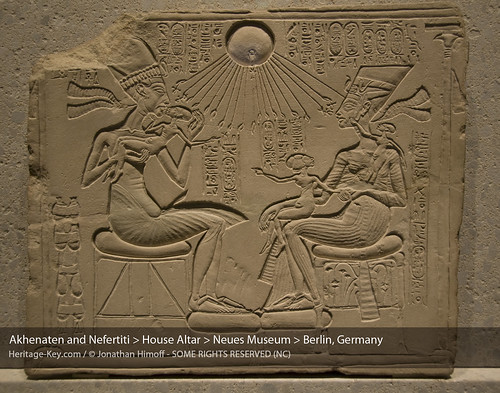
This beautiful stela from Amarna encapsulates the Amarna artistic style and the religion of the Aten in one place. It is not the only one of its kind, but it is one of exceptional workmanship and is in remarkable condition. Along with the bust of Nefertiti, it’s one of the highlights of the newly-opened Neues Museum in Berlin. The stela, or house altar, shows a relief of the royal family, with Nefertiti on the right, sitting opposite and facing her husband Akhenaten, with their three eldest daughters, Meritaten, Meketaten and Ankhesenpaaten, upon their laps. They are all seated beneath the…
-
-
A pair of Italian brothers believe they have at last discovered the lost army of Persian King Cambyses II in the Egyptian desert, some 2,500 years after they are said to have been swallowed up by a vicious sandstorm. The 50,000-strong army was engulfed as it crossed the Great Sand Sea towards Siwa Oasis, to destroy the oracle at the Temple of Amun. Archaeologists have searched for the legendary lost men for centuries – yet Angelo and Alfredo Castiglioni claim that hundreds of human bones and bronze weapons just outside the oasis are the remains of Cambyses’ fateful crew. Greek…
-
A rich Roman town house discovered beneath Canterbury‘s Marlowe Theatre cannot be preserved in its present location thanks to damage from earlier modern building works. The astonishing house, complete with under-floor heating, was discovered by builders working on the famous theatre’s 26.5million redevelopment. Workers immediately got in touch with archaeologists – and work has been halted until the remains can be fully removed. Yet expert James Holden tells the BBC earlier 20th century projects have left the house in a bad state: “A lot of it has been disturbed by earlier buildings, when they built this theatre in the 30s…
-
Heritage Key has premiered a new video with Dr. Zahi HawassThe Riddle of KV63. Again we are treated to the film work of Nico Piazza and Heritage Keys exclusive access to the one person who has unfettered access to all of Egypts mysteries, Dr. Zahi Hawass. The story of KV63 is an epic tale that has been fraught with cliffhangers and surprises since its discovery several years ago. The name KV63 is a result of the naming conventions used in the Valley of the Kings necropolis near Luxor, Egypt. It essentially means that it is the sixty-third tomb discovered in…
-
Egypt threathening to severe ties with the Louvre museum led to five looted Pharaonic steles returning to Egypt and maybe even toTetiki’stomb of which they were illegally removed. But the directory general of the SCA, Dr. Zahi Hawass, is on a quest that he hopes will lead to thehigh-profile “icons of the Egyptian identity” returning to the Cairo Museum. What’s on the wishlist? First and foremore the Rosetta Stone from the British Museum and the Nefertiti Bust from the Neues. But also a statue of Hemiunu, the bust of Anchhaf, the mask of Ka-Nefer-Neferand the painted Zodiac blasted outof theceiling…
-
There have been many great women in the times and study of Ancient Egypt – Hatshepsut and Nefertiti are two great examples. Yet in the era of discovery; the time in which great explorers pioneered the excavation of Egypt’s greatest treasures, one woman sticks out louder than Liberace in a dole queue. Cue Amelia Edwards, a Victorian writer and adventurer who bucked the conservative traditions of her time to help found one of London‘s greatest museums. We meet Petrie Museum curator Stephen Quirke at 10am on a bleak British morning, drizzling rain just about getting our umbrellas out in the…
-
The Lewis Hnefataflmen: doesnt quite have the same ring to it as the Lewis Chessmen, does it? But if what a new paper by a trio of heritage experts is saying is true, the famous 900-year-old set of ivory-carved pieces discovered on a Scottish island in 1831 may not be from a chess set at all, but rather an ancient Viking board game. The study also questions the popular notion of how the hoard came to end up on Lewis, and calls for new excavations at a site near to where they were reportedly found. Hnefatafl, which was popular in…
-
A video featuring Dr Farouk Gomaa was recently featured on Heritage Key as he explains his progress on archaeological excavations being carried out in el-Assasif, Thebes at the site of TT34 – the Tomb of Montuemhat. Dr Farouk Gomaa explains that the search in the tomb continues for the burial chamber of the diplomat Montuemhat, which has yet to be located. The mysteries ofThebes are uncovered in a new book featuring photography from the renown Egyptology photographer Sandro Vannini in the publication “The Lost Tombs of Thebes:Life in Paradise” authored by Dr Zahi Hawass. The excavations at TT34 were photographed…
-
The Christian Monastery of Saint Anthony, or Deir Mar Antonios, is the the first ever monastery, and lies at the coast of the Red Sea, to the east of the Fayum oasis. Dedicated to St Anthony, it was founded in 356 AD immediately after the saint’s death, and is now the oldest Christian monastery still active in the world. Near the monastery (2 km away) there is also St. Anthony’s cave, where he lived as a hermit. This video provides a rare glimpse inside this wonderful monastery, filled with art and the postumous home of a hermit saint, Saint Anthony.…
-
After 3,000 years its appears all but certain that the husband of the mummy of Djedmaatesankh has been found. We know from her coffin that his name is Paankhntof. She was a musician at the temple of Amun-Re in Thebes – he was a doorkeeper at the same temple (actually something of an important position). At the weekend symposium, researchers presented evidence that the mummy of her husband is now located at the Art Institute of Chicago. Heritage Key broke the story a week ago here. The research was presented by Gayle Gibson of the Royal Ontario Museum and Stephanie…