 Key Dates
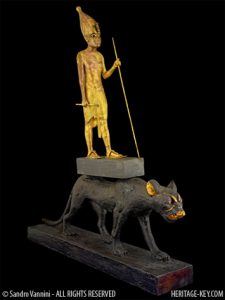
These small statuettes of the famous boy king Tutankhamun astride a panther came in a pair and were located along with 32 other ritual figures inside a black resined wooden box in the treasury section of Tut’s tomb, KV62, in the Valley of the Kings. Like all of the statuettes, they are believed to have had a ritual and religious significance. The ancient Egyptians expected them to aid the young pharaoh’s passage to the afterlife.
King Tut is carved in immense detail out of hard wood, and covered with gold leaf. In one hand he clutches a long staff, in the other a flail which represents his power. The panther is also skilfully and elegantly rendered, with great realism. It is painted black, as an inhabitant of the underworld.
The statuettes are meant to be interpreted not literally, but symbolically. The panther may represent an allegorical image of the sky, while Tut – resplendent in gold – is perhaps being likened to a sun god. The style of the statuettes reflects certain characteristics of the Amarna style of art – particularly the exaggeration of certain physical features. It has been speculated that they may have originally been created as an image of Tut’s father, the “heretic pharaoh” Akhenaten, who founded Amarna.