Wrapped In A Mystery
The Sphinx of Greek myth was a baffling creature. She ambushed unsuspecting travellers, and then ate them when they couldn’t answer her riddles. But the original Sphinx – a colossal statue located at Giza, Egypt – is in many ways more enigmatic, and a riddle in its own right. This Great Sphinx spent most of its history buried up to the neck in sand, giving no clues to the colossal body, and the layers of meaning, lying below.
Tuthmosis IV, the pharaoh of the 18th Dynasty, apparently excavated the Sphinx, as did the Romans. But shifting sands have made modern excavation difficult, and in the 19th century several attempts to uncover it were abandoned. It was only in 1925-1936 that Frenchman Emile Baraize finally exposed its body to modern eyes. Each time the Sphinx was excavated, it needed extensive repairs.
Lions And Gods
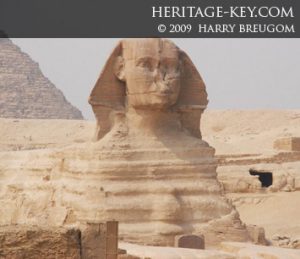 The Great Sphinx crouches alongside the Great s in the Giza plateau, and is thought to be closely associated with them. Archaeologists have observed that the Sphinx’s head is very small in proportion to its body (the statue is 20m high vs. 73m long). This could be because the seam of hard rock was too narrow to make the head any larger, but Dr. Jonathan Foyle recently suggested the Sphinx may have originally depicted a lion in its entirety, and that it was recut later to give it a human head.
The half-human, half-lion motif recurred throughout Ancient Egyptian history, and the Sphinx seems to have had a number of meanings. Firstly, the lion was a symbol of the sun god Re. This is perhaps why the Great Sphinx faces east, towards the rising sun. The lion also represented royal power. So, by combining the god’s symbol and the pharaoh’s features in one statue, the Sphinx made a grand statement about the connection between the two.
Interestingly, an inscription found between the Sphinx’s paws suggests that by the time of Tuthmosis IV, perceptions of the statue had changed. It was now associated with Horus, under the name Horem Akhet (Horus of the Horizon).
Got Your Nose
The Sphinx was originally carved from a single piece of bedrock, on the spot where it still stands. Weathering has had a very uneven effect across its surface, which many attribute to the variable quality of the limestone. The body strata are particularly weak, and a large natural crevasse runs across the back legs. It’s lucky the body spent so much of its existence buried, or it would be even more badly eroded.
The head, meanwhile, is made from more durable stone. That’s why it is relatively intact, while the neck and lower part of the headdress (nemes) are today supported by 1920s masonry. Not that the Sphinx’s face is entirely undamaged. Engravings by European travellers show that the nose was already missing by the 1800’s, and legend has it that Napoleon and his troops shot the nose off during their time in Egypt. Fragments of the Sphinx’s absent beard were found during excavation and are now housed in Cairo and London.
Timing Is Everything
It’s generally agreed that the Sphinx is contemporary with the second of Giza and was built by the same ruler – Khafre – in his own image. Another theory is that it was created for Khafre’s father Khufu, builder of the first . Either way, it would date to approximately 2500 BC.
However, a number of archaeologists and scholars have claimed that the Sphinx actually predates the s by hundreds or thousands of years. Dr. Robert M. Schoch’s studies have led him to conclude that the internal parts of the Sphinx date back to at least 5000BC.
Schoch is backed up by geologists who claim that the type of erosion seen on the body of the Sphinx could only have been caused by water, rather than by desert conditions, concluding that the Sphinx must have pre-dated the arid era of the s. However, opponents claim that the populace in 5000BC would not have had the skills or tools to create the Sphinx.
Map To Atlantis
Theories abound about the Sphinx. Author Graham Hancock believes that the whole Giza complex follows an astronomical plan, with the Sphinx acting as a pointer for the vernal equinox. He and his associates also reckon the Sphinx was deliberately half-buried in sand, to mimic the constellation Leo’s partial concealment below the horizon. Psychic Edgar Cayce led a search for hidden chambers in and around the Sphinx, hoping to find records from Atlantis.
The map to Atlantis is unlikely to be found within the weathered body of the Great Sphinx, but continued attempts to conclusively explain the erosion of the statue will hopefully lead to some interesting discoveries.