Modern Discovery of an Ancient Army
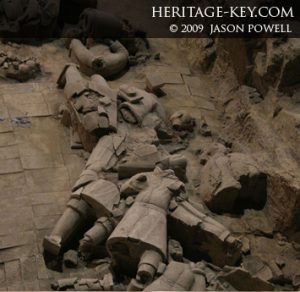
The enigmatic terracotta warriors were unearthed alongside their emperor in Xi’an, in the central province of Shaanxi, in 1974. They were found accidentally when peasants digging a well broke into a pit containing 6000 life-size terracotta figures. Further excavations revealed the terracotta army – footsoldiers, archers, cavalrymen and officers of all ranks. Current estimates of the three pits containing the Terracotta Army are over 8,000 soldiers, 130 chariots with 520 horses and 150 cavalry horses with many still buried in the pits. Discoveries in other pits have continued at the site with horse bones and smaller size figures of grooms and in 1998 terracotta acrobats, musicians and bureaucrats were found.
The magnificent figures are all part of the funerary art buried with the First Emperor of China, Qin Shi Huang, who lived over 2200 years ago. He became the country’s first emperor, unifying the warring states into what is now China. He also instigated the building of the Great Wall of China, and but it was the Emperor’s fanatical fear of death and an obsessive quest for the secret of immortality which ultimately gave us the legacy of the terracotta warriors.
Frighteningly Real
The unique life-size terracotta warriors vary in height (183 – 195cm), uniform and hairstyle according to their rank (the tallest being the generals) and their detail is astounding. Even the body armour rivet heads stand out and fine tread patterns have been mounded onto kneeling warriors the shoe soles.
The size, coloured lacquer finish, facial expressions, and real weapons from battle make them eerily lifelike. And although many of the original weapons were stolen and the colouring has faded greatly, they are still uncannily realistic. Interestingly, the weapons which were found were treated to make them resistant to rust and corrosion so that even after being buried for over 2000 years they were still sharp and ready for battle.
The figures were individually manufactured, by both government labourers and local craftsmen, with the head, arms, legs and torsos being created separately and assembled after firing. To ensure quality control, workshops were required to inscribe their name on items produced and this has helped in verifying which workshops were commandeered to work on the army instead of making tiles and other items.
The most remarkable fact about these figures is that although eight face moulds were most likely used, clay has been added to make each face unique. Once assembled and intricate features added, the figures were placed in the pits in precise military formation according to rank and duty ready to accompany its emperor into immortality.
Secrets Remaining
The Emperor’s tomb, built on Li Mountain, just 30km from Xi’an, has never been excavated. Reports state that more than 720,000 conscripts from all parts of the country were ordered to build the 2 km square grand mausoleum which includes a central underground palace, an inner and outer city, and grounds. Descriptions of the tomb include replicas of palaces and scenic towers, ‘rare utensils and wonderful objects’, rivers of mercury and a domed ceiling made of jewels to represent the universe. Crossbows are allegedly rigged to shoot intruders.
Most of the workmen who built the tomb were killed, but there maybe some element of truth in the mercury legend. Probes have been inserted deep into the tomb and revealed abnormally high quantities of mercury, some 100 times the naturally occurring rate.
Preserving the Warriors
Throughout the ages, the Army has survived fire and looting, but in recent years, they faced a new battle. Raised temperatures and humidity in the buildings led to reports of mould eroding the warriors. Other claims included figures’ arms and noses falling off because of oxidisation with the air. Furthermore, soot found on the surface of the statues was thought to be caused by pollution from coal burning plants, and potentially responsible for the terracotta statues’ decay. These claims were dismissed by officials but recently sections of the pits have been buried to preserve the figures.
In September 2007, a set piece of 120 objects from the mausoleum and 20 terracotta warriors were displayed at the British Museum in London as its special exhibition “The First Emperor: China’s Terracotta Army”. Running until April 2008, this exhibition made 2008 the British Museum’s most successful year ever, bringing in the most visitors to the British Museum since the King Tutankhamun exhibition in 1972. Because the initial batch of pre-bookable tickets to the Terracotta Army exhibition sold out so fast, it was reported that the museum extended the exhibition until midnight on Thursdays to Sundays.
Precious Cargo
China had previously never allowed such a large number of these fragile remnants abroad and only five staff members at the British Museum were deemed experienced enough to handle them. The figures are priceless, but a kneeling archer was said to be insured for £1.6million.
Packing him for his trip overseas involved maneuvering him on to a wooden base. Cushions of Styrofoam molded to fit around his back and knee were then slid into place. Three loops of rope tied him to the custom-built crate. Then more padding was added, filling any spaces inside and holding the ancient archer tight.
The horses – three of them authentic and two replicas – were an even greater challenge. Each brittle limb needed to be protected from bumps and jolts. Once British Museum official said: ‘They are like race horses and they have to be packed so their legs don’t touch the floor of the crate.’
The exhibition is currently being shown at the High Museum of Art Atlanta, Georgia, United States, through April 2009.
With the terracotta warriors having sold out tours perhaps finally, Qin Shi Huang has achieved his dream of immortality.