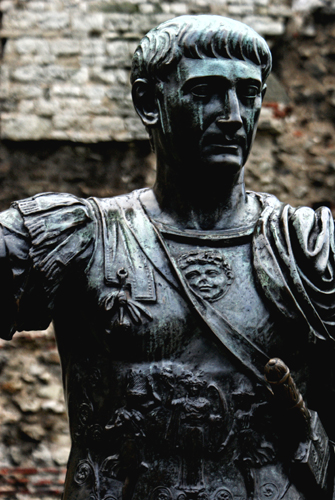
When Roman troops led by Aulus Plautius arrived on the banks of the Thames shortly after they landed in Britain (probably on the east coast of Kent or near Southampton) in 43 AD, they would have found little more than a few Iron Age settlements on the banks of a river, with few roads and not much trade to speak of. Within a century the Roman settlers had laid down the foundations of a bustling trade town, which rebuilt itself after numerous attacks, fires and a possible Plague epidemic, with a population peaking between 45,000 and 60,000 by the mid…
-
-
The Explorers Club’s Great Britain Chapter was founded as late as 1977, but its first chairman, Bill Egerton Sykes, was thoroughly invested in one of the great ancient mysteries – Atlantis. A British intelligence officer, Sykes had a lifetime fascination concerning Atlantis. He lectured to the Explorers Club in New York in 1966 on this subject in 1966, and continued to investigate and gather evidence for the existence of this mythical lost continent until his death in 1983. These days, the Explorers Club, which doesn’t have a permanent venue in London but meets in various places four or five times…
-
As the Director of the Stonehenge Riverside Project, Mike Parker-Pearson recently found himself at the centre of one of the decade’s most exciting and significant discoveries – Bluestonehenge (or Bluehenge in early reports). But this new ‘mini Stonehenge’ is part of a much broader understanding of the area being built up by the Stonehenge Riverside Project as they try to put together a history of the area rather than focusing on individual monuments in isolation. In an illuminating lecture at Wiltshire Heritage Museum, Parker-Pearson revealed some surprising theories about the construction and meaning of the henges. The Stonehenge Riverside Project…
-
It’s more than 4,000 years since people have stood around this grave-site unified by such an electrifying sense of awe and anticipation. Here in the tiny hamlet of Forteviot, nestled in a bend of the River Earn in the floor of a lush agricultural valley six miles southwest of Perth, the lid is about to be lifted on what archaeologists hope is a burial cist in one of the biggest Neolithic monuments in Scotland. We wait in chorus-line fashion, arrayed along the peak of the spoil-heap at the south edge of the trench cut into the ditch of a 250m-diameter…
-
The Riverside Project is the largest archaeological investigation ever carried out at Stonehenge. Its basic hypothesis is simple: that Stonehenge was a monument to the deceased, while the nearby Woodhenge and other timber circles in its vicinity were monuments to those still alive. The River Avon was the sacred connection between the two, “a kind of Styx,” comments Mike Parker Pearson, a professor in the Department of Archaeology at Sheffield University and director of the Riverside Project. “It was a river linking the living and the dead.” The success of the initiative – which first broke ground in 2003 and…
-
Stonehenge may have a history spanning almost 5,000 years, but the last century has been one of its most poignant and fascinating, seeing it restored from its former dilapidated state into one of Britain’s officially most loved tourist sites. An Auspicious Start Before 1901 Stonehenge was in a bad way. Many of the huge stones had sunk out of position; some had fallen over; and much of the land around the monument had been excavated beyond recognition. Seemingly every scholar who wanted to make a name for himself would visit Stonehenge for some reason or another. Even Charles Darwin commented…