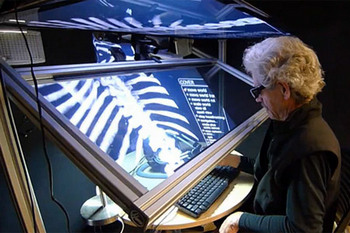
 Imagine getting your hands on King Tut’s mummy? Researchers at the University of California, San Diego, have created a new – relatively – low-cost virtual reality device that allows users not only to see a three-dimensional image, but to ‘feel’ it too (watch the video).
From the same two California Institute for Telecommunications and Information Technology (CALIT2) engineers who created the VR system NexCave comes a new and ‘affordable’ solution for handling three-dimensional virtual objects.
Tom Defanti and Greg Dawe’s heads-up virtual reality device (HUVR in short) combines a consumer 3D HDTV panel with a half-silvered mirror to project any graphic image onto the user’s hands or into the space surrounding them. The person then manoeuvress a touch-feedback – or ‘haptic’ – device to interact with the image, literally ‘touching’ the image’s angles and contours as if it was a tangible 3D object. A head-tracking device determines the user’s position, to make sure the object is rendered in the correct perspective view.
The researchers say HUVR – pronounce it ‘hover’ – is ideal for tasks that require hand-eye coordination and could be used to train and educate future engineers, doctors and… archaeologists. For example, the device could be used to visualize and manipulate a 3D imagine of a patient’s brain derived from an MRI scan, or one of the many artefacts and human remains too fragile or precious to be physically handled.
“By using HUVR’s touch-feedback device – similar to a commercial game control – a physician could actually feel a defect in the brain, rather than merely see it,” explains Research Scientist Tom DeFanti. He adds, “this can be done over networks, sharing the look and feel of the object with other researchers or students.”
HUVR is a less expensive, re-engineered version of 30-year-old technology, and partly based on the 12-year-old PARIS, the Personal Augmented Reality Interactive System. PARIS used a projection technology similar to HUVR, but was low-resolution, too big to move, and expensive. It required the Silicon Graphics, Inc. computers of the time to render the images and cost upwards of $100,000. It is still in operation today, but is now driven by a game PC.
The recent availability of 55” active stereo panel TVs (a $2300 consumer 3DTV) was the key to making HUVR, which is essentially a more lightweight, portable, and – at about $7,000 (without head tracking) – a much cheaper version of the PARIS-based technology. The researchers say HUVR also offers better brightness, contrast, and visual detail than PARIS.
Although passive stereo 3D HDTVs have been available for about a year – allowing DeFanti and Dawe to construct the NexCave (related to the StarCAVE, used for visualisation of archaeological data in this video) – active stereo is needed for HUVR.
Video: Greg Dawe demonstrates the heads-up virtual reality device
Calit2 Virtual Reality Design Engineer Greg Dawe demonstrates the HUVR device, which combines a consumer 3D HDTV panel, a half-silvered mirror, head-tracking and a touch-feedback controller to bridge visual with tactile.. in a (relatively) affordable way.
Active stereo generates separate left- and right-eye images that can bounce off mirrors and are separated into left- and right-eye views by the user’s active eyewear, which blink in synchrony with the 3D HDTV’s 120Hz images.
The polarization used in passive stereo will not stay polarized when reflected off a mirror, hence the need for active stereo in HUVR and its precedents.
The next step in HUVR’s evolution is to create a less expensive, reasonable quality head tracker suited to a desktop device (commercially available trackers currently range from $5,000 to $20,000).
Then all we still need is an innovative museum with solid budget (and/or desire) for a ‘ground-breaking interactive display’ and the full data from Tutankhamun’s hospital visits released? (The 3D printed clone of Tut is awesome, but you still can’t touch.)
May I also suggest a virtual reality cave at the Wiltshire Heritage Museum, to visualise the results from the ‘virtual excavations’ by the Stonehenge Hidden Landscapes Project, and of course, the British Museum would then have to react with a Room 3D: Giza. 😉