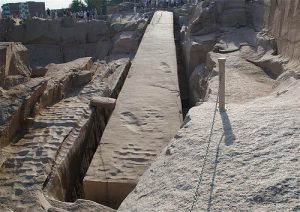
The Unfinished Obelisk is an enormous chunk of carved granite that lies in situ – still attached to the bedrock – at a quarry near Aswan, in Southern Egypt. It was commissioned as a spectacular monument by an Egyptian ruler in the 15th or 16th century BC, (although no one can be certain which one), then abandoned before completion when imperfections were detected in the stone.
Had the obelisk been completed, it would have represented the largest monolithic monument of its kind ever created in ancient Egypt – standing 42 metres tall and weighing around 1,200 tons (that’s at least a third larger than any other Egyptian obelisk). Quarrymen – hammering away with dolite balls – must have had to work at the rock face for many months to cut the deep trench around its sides, base and top, before deep fissures were discovered that rendered the obelisk useless, bringing the project to an abrupt end.
It’s thought the Unfinished Obelisk may have been intended as a kind of sister-monument to the Lateran Obelisk, commissioned by Thutmose III, and originally positioned at Karnak, before being removed to Rome (where it still stands today outside the Lateran Palace).
A partially-worked base for the Unfinished Obelisk has also been discovered at the same Aswan Quarry. Both the base and the obelisk itself are protected monuments, as the quarry has been declared an open-air museum.