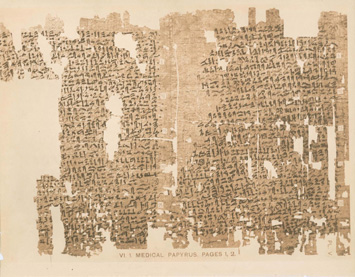
The Edwin Smith Papyrus was this year touted as “the birth of analytical thinking in Medicine and Otolaryngology,” in the medical journal The Laryngoscope. Along with a collection of other fascinating papyri, the script gives an incredible insight into the knowledge, skills, and procedures of ancient Egyptian medicine, and offers some tips on how to treat trauma issues, such as a man with a massive gouge in his head. Much of what we know about Egyptian medicine comes from roughly a dozen medical scrolls that have survived. The oldest one is the Kahun Scroll, dating to 1820 BC, which focuses in Gynaecology. The two…
-
-
Key Dates 330 BC This wooden cult statue of Osiris dates from the Ptolemaic period, around 332-330 BC. One of the most interesting aspects of this life size statue of the god Osiris is that it was quite likely used as a cult statue for worship. It is in wood, finished with plaster or gesso, and was painted; originally, the body of the god was wrapped in linen bands exactly like an Egyptian mummy, so that the statue showed the entombed Osiris as god of the dead or of the afterlife. The eyes are inlaid with glass and stone, giving…
-
Learn all about the Boy King in Heritage Key’s special video series! Famous Egyptologist Dr Zahi Hawass tells us about the life and death of King Tut: VIDEO How did King Tut Die? VIDEO The Curse of the Mummy VIDEO The Robbing of King Tut’s Tomb VIDEO Tutankhamun’s Treasures Director of the Cairo Museum Janice Kamrin takes us on a guided tour: VIDEO The Canopic Jars and Shrines VIDEO Animal Iconography VIDEO Tutankhamun’s Jewellery VIDEO The Funerary Figures You can also watch Lord and Lady Carnarvon explaining the discovery of King Tut’s tomb (KV62) by Howard Carter and Lord Carnarvon. Explore…
-
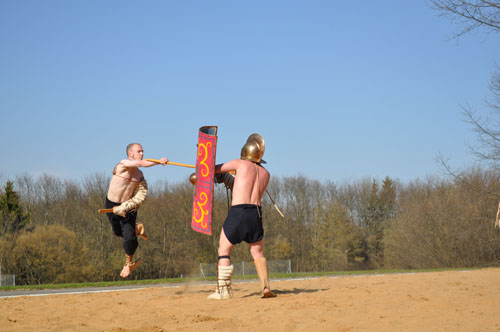
Can a modern couch potato be trained to fight like a Roman gladiator? That’s a question that a group of students and experts in Germany are trying to answer with an experimental archaeology project, using expertise from ancient history together with sports science. Twenty students are being put through their paces to find out how gladiators in ancient Rome might have actually trained for their fights in the arena. The cross-disciplinary project aims to get a different perspective on a fascinating area of history that is in the limelight following the success of films such as Gladiator and the TV…
-
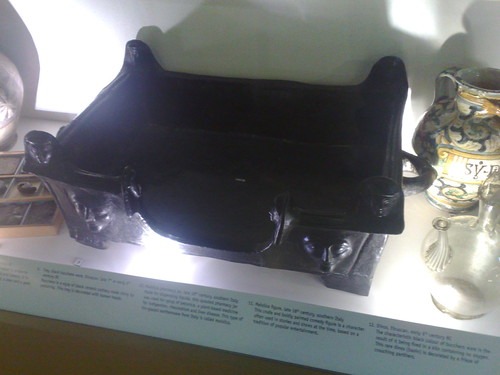
Key Dates 650 BC Created during the Late Period of ancient Egypt (c 700-600 BCE) This Etruscan black bucchero ware tray was made during the late 7th or early 6th century BC. Bucchero is a style of black ceramic pottery made shiny by polishing. The tray is decorated with human heads. Origin & Collection On display at: The Hunterian Museum Images Put your Flickr photos of this object into the Heritage Key group, and tag them with keyobject-1701, to see them here!
-
It might have taken Europeans until the 19th century to make rubber, but Mesoamericans were playing with bouncy balls back in 1,600 BC. And not only were pre-Columbians the world’s first polymer scientists, but new research suggests they fine-tuned their discovery for different uses. According to Professor Dorothy Hosler and Michael Tarkanian of the Massachusetts Institute of Technology (MIT) cultures like the Mexica, Olmec and Maya perfected a chemical processing system to create rubber with varying qualities. Bouncy rubber was used for rubber balls, used during the legendary Mesoamerican ball-game (see more ancient sports), while axe-heads were fastened with a…
-
Finished in 2560 BC, the Great Pyramid of Giza took 20 years to build. 3,000 years on, it doesn’t look like major Egyptian construction projects have hurried up any. It was recently announced that the opening date for the Grand Egyptian Museum – the massive centerpiece attraction of the epic new vision for the Giza plateau, two and a half kilometres from the pyramids – has been pushed back to 2013, after the latest in a long-running series of delays for the building. The project was officially commenced in 1992, which means that even if the GEM does open on…
-
Key Dates 1186 BC The papyrus dates from the XX Dynasty of Ancient Egypt, which lasted from 1186-1069 BC. It was discovered in the early 19th century. Key People It was probably created by a painter from Deir El-Medina village. When French scholar (and translator of the Rosetta Stone) Jean-François Champollion viewed the papyrus in Torino in 1824, he described it in his notes as: “an image of monstrous obscenity that gave me a really strange impression about Egyptian wisdom and composure.” Key People: Jean-François Champollion The Turin Erotic Papyrus is a famous (or rather, infamous) 12th/11th century BC Egyptian…
-
The question of how the Great Pyramid of Giza was built is one of the most hotly-debated topics in ancient history. Maverick French architect and self-styled “Mr Pyramid” Jean-Pierre Houdin is determined that he has the answer – the the 4,569 year-old monument was, he argues, erected from the inside-out, using an internal ramp built into the fabric of the structure. Others are skeptical of his theory, but Houdin is certain he has the proof. Here he gives some exclusive insights into his life and work (a decade-long obsession), launches a broadside at the Egyptology fraternity that he feels still…
-
A 3,000-year-old double limestone granite statue of pharaoh Amenhotep III is discovered near Luxor, Egypt. The statue was found at Kom el-Hittan, at the northern entrance of the funerary temple of Amenhotep III – once one of the largest temples on the west bank of the Nile. Egypt’s Minister of Culture, Farouk Hosni, said that the statue depicts Amenhotep III seated on a throne accompanied by the – now headless – Theban god, Amun. The 18th Dynasty pharaoh – who ruled from about 1410 to 1372 BC – wears the double crown of Egypt, which is decorated with a uraeus. Mr.…