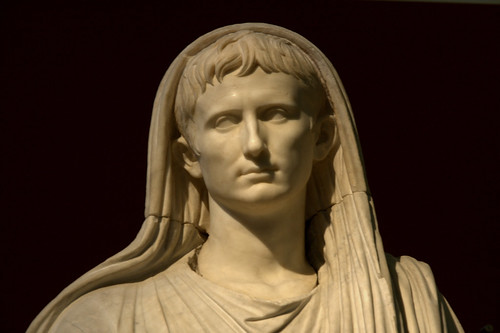
Its been a tense few days on the Heritage Key fantasy election trail. Since the worlds ancient leaders first went to the polls on Saturday, voters have turned out in typical numbers to exercise their right to vote. Early indications show that this years election is a two-horse race: firmly in the lead is Alexander the Great, with Romes Augustus closing in as a close second. Alexander can certain talk the talk. But are the voters swayed by his powers of persuasion and provocative title, or are they actually voting for policies? Is rival Augustus the thinking historians choice, or…

-
-
Augustus may have been a political genius but he was far from being a swaggering military hero like other famous leaders from history. He was a sickly, pale youth, yet he had the staying power and resilience to enable him to outlive his rivals and found the Roman empire. Read on to find out why Augustus was the best leader of all times and deserves to win the Heritage Key Fantasy General Election 2010! He reigned for 41 years and is best remembered as a ruler with extraordinary vision but also as a moderate man committed to peace and family…
-
It’s the end of the Ancient World in London video series! We’ve travelled up and down the country getting the inside line on London’s impressive history, and we’ve seen no small number of ancient wonders along the way. So here’s a video of our best bits and what we thought of them – from the rebellion of Boudicca to the fearsome Maunsell Sea Forts. The series has been much more than the videos, though: we’ve been running bloggers’ challenges, real-world and virtual events, a pub quiz and even a special concert. Of course you can still see Stonehenge, the Valley…
-
A team of archaeologists, led by Professor Vance Watrous and Matt Buell of the University at Buffalo, have discovered a fortification system at the Minoan town of Gournia. The discovery rebukes the popular myth that the Minoans were a peaceful society with no need for defensive structures. That idea arose from work done in the early 20th century by Sir Arthur Evans who proposed that a pax Minoica existed on Crete during their time. Certainly the Minoans were afraid of somebody, Professor Watrous said. The town was originally excavated from 1901-1904 by Harriet Boyd Hawes, a pioneering women who was…
-
King Tut has left Toronto. The Tut exhibition – Tutankhamun: The Golden King and the Great Pharaohs – at the Art Gallery of Ontario wrapped up on Sunday after a blockbuster run. The final visitor total was about 400,000 people an impressivenumber but not as high as the 1979 show that drew 750,000 visitors. That show featured Tuts golden death mask, an artefact that no longer leaves Egypt. Despite the lower numbers the art gallery considers the show to be a success. “King Tut attracted 404,364 visitors, 47 per cent of whom were making their first visit to the AGO.…
-
Archaeologists excavating at Taposiris Magna, 45 km west of Alexandria, have discovered a huge headless granite statue of an as yet unidentified Ptolemaic king, and the original gate to the temple one of fourteen temples said to contain a piece of the god Osiriss body. The monumental sculpture, which is a traditional image of an ancient Egyptian pharaoh wearing collar and kilt, could represent Ptolemy IV, the pharaoh who constructed the Taposiris Magna temple. In a statement issued by the SCA, Dr Zahi Hawass says that the statue is very well preserved and might be one of the most beautiful…
-
At its peak during the 2nd century AD, Roman London (Londinium) had a population of up to 60,000 people and represented a thriving urban centre. But as the Roman Empire declined over the next 300 years, so too did the city. In 410, Britain was cut loose from the Empire altogether, and with it London. Troops and officials departed, and the city was left to fend for itself. Exactly what happened during the immediately ensuing phase in London’s history – which is referred to as the Sub-Roman period, and lasted from approximately 450 until 600 AD – is mysterious. A…
-
‘The Code of Hammurabi’ is a well-preserved ancient law code, created circa 1760 BC in ancient Babylon. It was enacted by the sixth Babylonian king, Hammurabi. The stele containing the Code of Hammurabi was discovered in 1901 by the Egyptologist Gustav Jéquier, a member of the expedition headed by Jacques de Morgan. The stele was discovered in what is now Khuzestan, Iran (ancient Susa, Elam), where it had been taken as plunder by the Elamite king Shutruk-Nahhunte in the 12th century BC. It is currently on display at the Louvre Museum in Paris. Wildside Press (18 Feb 2009)
-
One of the most perplexing mysteries that Egyptologists and Aegean experts are tackling is that of the frescoes of Tell el-Dab’a, also known as Avaris.This site was used as the capital of the Hyksos, at a time when they ruled much of Egypt, from 1640 – 1530 BC. It is on the Nile Delta and would have provided access to the Sinai, Levant and southern Egypt. The site appears to have been abandoned for a time after the Hyksos were driven out. However, by the end of the 18th dynasty (when the Egyptians were back in control of their land), the…
-
London’s skyline today may be better known for a gherkin, a big wheel and Big Ben, but the city’s past has been littered with Egyptomaniacs, bent on saluting ancient Egyptians in Britain’s capital. And who better to lead us on a tour round London’s hidden Egyptian architecture than Dr Jasmine Day, self-confessed Egyptophile and author of TheMummy’s Curse: Mummymania in the English-speaking World. “For me the fascination with ancient Egypt,” says Jasmine, “is the way that it continues to exert its power on us today. We can see the tremendous influence that ancient Egyptians have on our own architecture, our…