
Architecture in Roman Britain by Guy de la Bédoyère The Roman period was Britain’s first great architectural age, though this is difficult to appreciate from the ruinous state of the sites that survive. Understanding the types and range of buildings that existed in Roman Britain depends on careful excavation of foundations and wall footings, together with fragments of windows, roofs and carved architectural decoration discovered among the debris. When this evidence is taken together with examples of better-preserved buildings that still exist in Europe, the Near East and North Africa, it is possible to recreate something of the architecture of…
-
-
What lies behind the legends of King Arthur? Fragments of history, or just wishful thinking? While historians study the ancient manuscripts, modern archaeologists join in the hunt for clues. From Arthur’s ‘birthplace’ at Tintagel to the fabled ‘Isle of Avalon’, we sift through the evidence. Journeying across Arthur’s Britain, we search for Camelot and the sites of his battles. Do the remains confirm or contradict the traditional accounts? Far from providing objective proof, Christopher Gidlow shows how archaeologists’ interpretation of their discoveries reflects the academic fashions of their times. Sites which in the 1960s were used to prove King Arthur’s…
-

People of the Earth An Introduction to World Prehistory by Brian Fagan The 13th edition of this internationally renowned text provides the only truly global account of human prehistory from the earliest times. Written in an accessible way, People of the Earth shows how today’s diverse humanity developed biologically and culturally over millions of years against a background of constant climatic change. Brian Fagan is one of the leading archaeological writers in the world and an internationally recognised authority on world prehistory. He studied archaeology and anthropology at Pembroke College, Cambridge University, and then spent seven years in sub-Saharan Africa working in…
-

The Roman Forum by David Watkin A radically new look at the ruins of the centre of ancient Rome. The Roman Forum may be a highlight of the tourist route in Rome, but many visitors still find it a baffling and unwelcoming place. There can be few more historic places in the world. Caesar was cremated there. Charles V and Mussolini rode by it in triumph. Napoleon celebrated his Festival of Liberty there. David Watkin’s Forum is the site as it was famous for centuries, celebrated in the romantic views of the Grand Tour, not the archaeologists’ building site it…
-

Magic Stones: The Secret World of Ancient Megaliths by Jan Pohribny, Julian C. Richards “Magic Stones” documents, in stunning and evocative photographs, our ancestors’ obsession with stone. Throughout Europe stone has been used to create dwellings for the living and the dead, as a canvas for our earliest art, to celebrate the heavens and in ways that are still, even today, beyond our understanding. From the sun-drenched temples of Malta and the great tombs and alignments of Brittany to the labyrinths of icy Finland, this fascinating book explores these stones in their landscape, as part of nature and as a…
-
Letters from Egypt, 1863-1865 by Lucie Duff Gordon In 1862 Lucie Duff Gordon, the cousin of Harriet Martineau and a friend of Caroline Norton, Meredith and Thackeray, headed to Egypt on a solo trip designed to rid herself of consumption. She spent the next seven years in a ruined house above a temple in Luxor. She integrated quickly, setting up a hospital and welcoming the people of Luxor into her house. Her story is told through her letters. This Elibron Classics book is a facsimile reprint of a 1865 edition by Macmillan. Adamant Media Corporation (6 Dec 2001) 386 pages
-
Uncorking the Past tells the compelling story of humanity’s ingenious, intoxicating quest for the perfect drink. Following a tantalising trail of archaeological, chemical, artistic, and textual clues, Patrick E. McGovern, the leading authority on ancient alcoholic beverages, brings us up to date on what we now know about how humans created and enjoyed fermented beverages across cultures. Along the way, he explores a provocative hypothesis about the integral role such libations have played in human evolution. We discover, for example, that the cereal staples of the modern world were probably domesticated for their potential in making quantities of alcoholic beverages.…
-
Tutankhamun’s Footwear Studies of Ancient Egyptian Footwear by André J.Veldmeijer, Alan J. Clapham, Erno Endenburg, Aude Gräzer, Fredrik Hagen, James A. Harrell, Mikko H. Kriek, Paul T. Nicholson, Jack M. Ogden, Gillian Vogelsang-Eastwood The discovery of Tutankhamun’s tomb by Howard Carter in 1922 is one of the most significant archaeological discoveries of all time. It took Carter and his team 10 years to clear the contents of the tomb and among the objects found was a large collection of shoes and sandals. The footwear is analysed here in detail for the first time since the discovery using Carter’s records and…
-
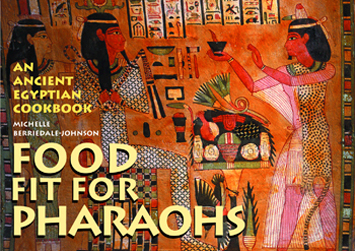
Food Fit for Pharaohs An Ancient Egyptian Cookbook by Michelle Berriedale-Johnson The great River Nile was the source of life for the ancient Egyptians, annually flooding its banks to leave behind some of the most fertile soil on Earth. The favourite dishes of the Egyptian people are some of the oldest and simplest, based on wholesome ingredients such as honey, dates, raisins, nuts, beans, whole wheat grains, cumin, garlic, mint and lemon. This charming small book introduces these dishes. It is beautifully illustrated with full-colour images of food and feasting drawn from original paintings on walls and papyrus. It is…
-
Legions of Rome The Definitive History of Every Roman Legion by Stephen Dando-Collins No book on Roman history has attempted to do what Stephen Dando-Collins does in Legions of Rome: to provide a complete history of every Imperial Roman legion and what it achieved as a fighting force. The author has spent the last thirty years collecting every scrap of available evidence from numerous sources: stone and bronze inscriptions, coins, papyrus and literary accounts in a remarkable feat of historical detective work. The book is divided into three parts: Part 1 provides a detailed account of what the legionaries wore…