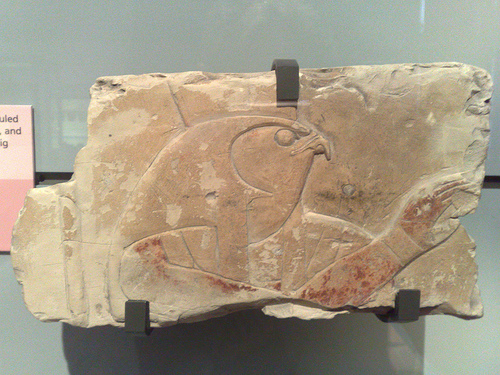
Key Dates 1800 BC Created during the Middle Kingdom 2055-1650 BCE, given to Kelvingrove Art Gallery and Museum 1903 by the Egypt Exploration Fund Key People The Eye of Horus is an ancient Egyptian symbol of protection and royal power from deities, in this case from Horus or Ra. The symbol is seen on images of Horus’ mother, Hathor, and on other deities associated with her. Horus ruled the living and his father Osiris ruled the dead. He protected the reigning pharaohs, and appears as . In this limestone tablet, Horus, the ancient Egyptian sky god, also known as Re…
-
-
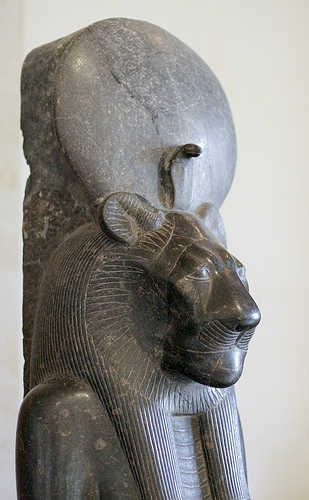
Key Dates This item dates from the 18th Dynasty, circa 1391-1353 BC. Key People An inscription at the bottom of this statue reads, “Amenophis III, beloved of the goddess.” This statue of the Sekhmet is one of many diorite sculptures dedicated to the powerful goddess. Sekhmet is portrayed with a dual personality; she has the body of a woman and a lion’s head. This statue is particularly interesting, however, by virtue of the artist’s great skill in blending the lion’s features with those of a woman; the lions mane morphs into human hair, and Sekhmet wears a dress down to…
-
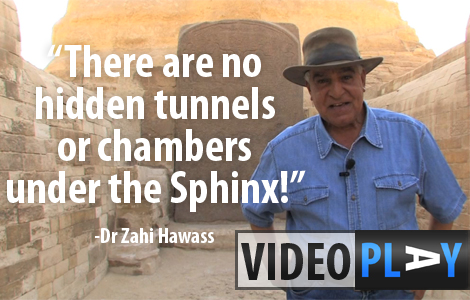
Question – who can completely fill up a cavernous 1,500 seat domed hall on a Saturday night in Toronto? Answer – Dr. Zahi Hawass “I don’t get to introduce rock stars,” said Art Gallery of Ontario CEO Matthew Teitelbaum. Well tonight he did. Forget the critical New Yorker article, the mixed reviews of the new Tut exhibition at the Art Gallery of Ontario, or the fact that local Toronto media largely stayed away from this lecture. The world’s most well-known Egyptologist completely filled Convocation Hall, with people who had all paid a small admission fee (no more than $18) to…
-
A date has now been set for the return of some of the Vindolanda Tablets to the museum at Vindolanda in Northumberland, following an announcement this week that the UK’s Heritage Lottery Fund is to donate £4 million towards the costs. The date now set for some of the tablets to be housed at the Vindolanda museum is spring 2011 – they will come on loan from the British Museum for a period of five years, after which the loan can be renewed. The tablets – a collection of 1,600 documents etched on thin wooden boards – represent the earliest…
-
Key Dates 1800 BC The papyrus is from the Late Middle Kingdom, between 1850 – 1700 BC. Key People Horus, god of the king, sky and vengeance in ancient Egyptian religion. Seth, aka Set, god of storms, chaos and the desert. Osiris, god of the underworld. The Tale of Horus and Seth is an ancient Egyptian myth about Horus and Seth’s rivalry for the Egyptian throne, held in the story by Osiris, Horus’ father and god of the underworld. There are several versions of the story worldwide, but this particular one, held at the Petrie Museum in London, allegedly contains…
-
The ancient Egyptians weren’t the only ones that mummified their dead for the sake of posterity. In more modern times, there have been multiple examples of mummification, using a range of weird and wonderful techniques from simple embalming to submerging the cadaver in a chemical-filled preservation tank, or perfusing it with wax, effectively rendering the corpse a giant human candle. Here we examine ten of the most famous examples of modern mummies, their stories, and some of the methods used to preserve them for eternity. The deceased range from an Argentinean First Lady, a Soviet Head of State and various…
-
How do you keep the Great Sphinx’s paws dry? With a lot of work, that’s how! The latest Heritage Key video clip of Dr Zahi Hawass highlights his collaborative effort with Dr Mark Lehner in protecting the Sphinx from the danger of rising ground water, an issue that is threatening Egyptian heritage sites from Nubia to the Giza Plateau. The problem is as large as global warming and as local as sewage and agricultural runoff, but the insidious threat coming from below—the changing of the water tables—requires innovation as recent as cutting-edge mining technology and as ancient as divining water…
-
The Great Pyramid of Giza is one of the world’s oldest and most iconic ancient structures – a 4,500 year old mass of more than 2.3 million limestone blocks, built as tomb for Fourth dynasty Egyptian Pharaoh Khufu. Reaching 138.8 meters into the sky, for thousands of years it was the tallest man-made structure on earth. The Great Pyramid has attracted explorers and tourists by the bus load for decades. But not all of its secrets have yet been revealed. One set of features that remains a source of bafflement to experts are the two narrow shafts – each about…
-
Curator specializing in King Tut Dr. David P. Silverman serves as the curator, advisor and academic content creator for the exhibition Tutankhamun and the Golden Age of the Pharaohs. This exhibit truly completes a full circle for him; in 1977, he was in charge of curatorial content for the exhibition Treasures of Tutankhamun at Chicago’s Field Museum. He also co-authored the text panels and labels that traveled around the United States with the exhibition, which attracted an unprecedented 1.8 million visitors in its run at the Metropolitan Museum of Art in 1979 and inspired the phenomenon known as ‘Tutmania’. A…
-
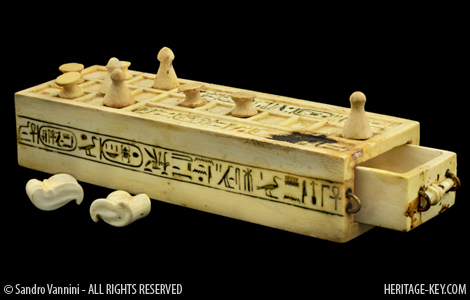
Key Dates 1333 BC 18th Dynasty Key People Tutankhamun and his wife Ankhesenamun There were four senet sets in the tomb of Tutankhamun, some ceremonial and others for day-to-day use. One such daily set was made of solid ivory and was found in a wooden chest with many compartments. Howard Carter comments: ‘From the contents… that were found in the chest it becomes obvious that the chest was made for the knick knacks of a boy’ which could be indicative that this set was probably played with by Tutankhamun. This gaming box is particularly small and therefore portable. On the…