
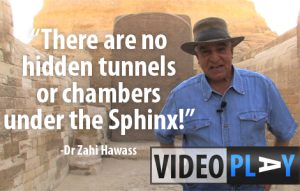
 How do you keep the Great Sphinx’s paws dry? With a lot of work, that’s how! The latest Heritage Key video clip of Dr Zahi Hawass highlights his collaborative effort with Dr Mark Lehner in protecting the Sphinx from the danger of rising ground water, an issue that is threatening Egyptian heritage sites from Nubia to the Giza Plateau. The problem is as large as global warming and as local as sewage and agricultural runoff, but the insidious threat coming from below—the changing of the water tables—requires innovation as recent as cutting-edge mining technology and as ancient as divining water in the desert.
The first clear and present danger to the Great Sphinx was pools of water that began appearing around Khafre’s Valley Temple just south of the Sphinx Temple, and southeast of the Sphinx enclosure itself. In 2008, the Supreme Council of Antiquities put Cairo University’s Engineering Center for Archaeology and Environment to work assessing the threat. Four holes were drilled 20 meters into the bedrock of the Sphinx enclosure, into which cameras and other sensory equipment were lowered. What they discovered was troubling indeed.
The water had reached 15.6 meters above sea level, and was rising. Although not yet high enough to cause damage, Dr. Hawass was determined that where the Sphinx was concerned no amount of risk was acceptable. “I decided that it would be best to go ahead and address this threat before it could become more acute” (Zahi Hawass’ Blog, Keeping the Great Sphinx’s Paws Dry).
Eight pumping stations were installed around the Sphinx and its associated temples that continue to remove 7,000 cubic meters of water every day. Since its activation the system has reduced the groundwater level by about a meter, nearly eliminating the water that had gathered around Khafre’s Valley Temple and reversing the threat. Efforts to eliminate the threat altogether continue.

In the video we see Dr. Hawass and Dr. Lehner at work with the team from Cairo University. Recorded in July of 2009, the clip shows a hole being bored next to the left paw of the Great Sphinx at angle that takes it directly under the monument. Dr. Lehner shows us some of the core samples of the 50 million year old limestone and explains that the deeper samples are more dense and clay-like than the more porous layer above, which explains why the water is being wicked up toward the Sphinx’s nether regions.
Understanding the strata beneath the Sphinx is vital to knowing how to protect it. Pumping the groundwater away has helped in the short term, but the only way to assure the Guardian of Giza meets the rising sun for another 4,500 years is to figure out how to divert the seeping menace completely away from the Sphinx. Fortunately, rescuing Egypt’s temples and monuments from environmental threats is what the Engineering Center for Archaeology and Environment does best.
On a side note, we are also informed of what the team did not find. Dr. Lehner tells us that, despite the hopes and sometimes insistence of some members of the New Age community, no secret tunnels, hidden rooms, or Halls of Atlantean Records were located, despite many holes drilled from a multitude of angles. In fact, it is probably no accident we were allowed to witness the drilling under the left paw, as one of the more popular legends has a secret compartment hidden beneath the Sphinx’s paws.
(You can read the transcription of this video here.)
Related Videos 
Interview with Dr Mark Lehner about the Lives of the Pyramid Buiders

Dr Zahi Hawass about the restoration works at the Jewish Synagogue.
And who could be more appropriate to break the unfortunate (for who wouldn’t like to find a secret room filled with the Wisdom of Thoth?) news than Mark Lehner? Dr. Lehner originally came to Egypt in 1974 to study anthropology at the American University in Cairo on a scholarship from the Cayce Foundation, an organization as responsible as any other group or individual for legends of a subterranean world beneath the Sphinx. It was during this formative year that he first met a rather skeptical young archaeologist named Zahi Hawass.
The two gentleman scholars took an instant liking to each other, and a mere three years later they were giving joint lectures in the United States, by which time Dr. Lehner had forsaken his New Age inclinations (Zahi Hawass’ Blog, Mark and Me). More than three decades later the duo continues to collaborate in their efforts to protect the Sphinx and its legacy.
But lest we close on a dry note, even the pragmatic Dr. Hawass insists that the wonder of the Sphinx hasn’t been diminished in the slightest by the recent work. “I always believe that the myth and the mystery of the sphinx will always continue,” he states.
