 One of Israel’s leading archaeologists has publicly condemned the Israel Antiquities Authority’s failure to object to a plan to construct a part of the Western Wall Heritage Center over a site where a well-preserved ancient Roman road was recently excavated. The construction area has been designated for religious purposes since Israel took control of the Western Wall in 1967. The building would include a 4,800-square meter, three-story museum and educational institute that would display the Roman road on the ground floor, but Yoram Tsafir told Haaretz.com even the most amazing architect will not be able to avoid damaging the find and visitors need to be able to see the entire road – not just a fragment – to appreciate it.
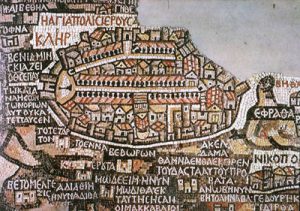
The street known as the Eastern Cardo or the Valley Cardo appears on the Madaba Map – dated to 565Ad one of the oldest detailed cartographic documents in the world – and began at the Damascus Gate in the north and led south, running the lenght of the channel in the Tyropoeon Valley. Excavated in 2007, the colonnaded street was paved with large flagstones that were set in place diagonally, in the customary method of the Roman world, which was probably meant to prevent wagons from slipping. A drainage system was installed below the flagstones.
The Roman-Byzantine road in the Western Wall plaza is indeed an important find according to archaeologist Guy Stiebel: “One of the amazing things discovered is that the Romans, and not the Byzantines, laid the foundations for Jerusalem.”
At an archaeological conference in Jerusalem, Tsafrir – a former archaeology professor at the Hebrew University of Jerusalem – argued that the construction is being approved because the findings are not from a period of Jewish rule over Jerusalem. “One day, we can hope, the entire length of the road might be revealed,” he said. “That will be able to happen when more enlightened groups run the city and the country and the cultural treasures that are in it – those that understand that even monuments that aren’t Jewish have significance.”