greece

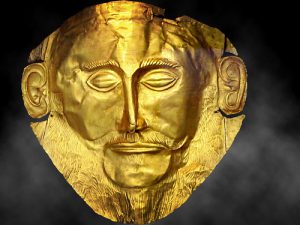
Mask of Agamemnon

Key Dates
1500
BC

The Mask of Agamemnon is an artifact discovered at Mycenae. The mask is one of ten discovered in the shaft graves at Mycenae, three in Grave V and two in Grave V.

It is now housed in the National Archaeological Museum in Athens.

Key People

The mask was discovered in 1876 by Heinrich Schliemann a German archaeologist, an advocate of the historical reality of places mentioned in the works of Homer, and an important excavator of Troy and of the Mycenaean sites Mycenae and Tiryns.

Schliemann believed that he had discovered the body of the legendary Greek leader Agamemnon, and from this the mask gets its name. However, modern archaeological research suggests that the mask is from 1550-1500 BC, which is earlier than the traditional life of Agamemnon. In spite of this, the name remains.

This so-called mask of Agamemnon is the best known of Schliemann’s finds from the royal tombs at Mycenae. The graves are certainly royal. The faces of the men are not all covered with masks. That they are men, and warriors, is indicated by the weapons in their graves. The quantities of gold and carefully worked artifacts surely denote honor, wealth and status.

A death-mask, it was made from a thick sheet of metal hammered against a wooden background, with the details chased on later with a sharp tool. It illustrates the dignified image of a man with an oblong face, wide forehead, long fine nose and tightly closed thin lips. The eyebrows, mustache and beard are indicated with parallel lines. Two holes near the ears were used to hold the mask in place with twine over the deceased’s face. The five gold masks discovered in Mycenae’s Grave Circle A were probably made for rulers. This one, the only mask showing a bearded man, stands out for its elegance and the intensity of the facial characteristics.


Origin & Collection
Additional information on display location:
Exhibition Hall 4
Reference Number:
624
Physical properties
Width:

17.00cm

Height:

25.00cm

Weight:

168gram

Materials:

Gold