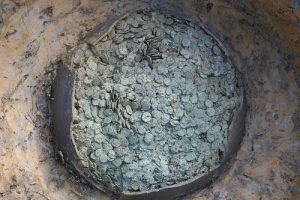
A metal-detector enthusiast has found one of the biggest ever hoards of Roman coins. It is the biggest hoard ever found in a single vessel in Britain, numbering 52,500 Roman coins of varying denominations.
The finder was Dave Crisp, who was out with his metal detector in a field near Frome, in Somerset, when his machine alerted him to what turned out to be an earthenware pot full of coins from the third century AD.
The coins were contained in a large earthenware jar and altogether weighed 160kg. It is estimated that they would have been worth the equivalent of four years’ pay for a Roman legionary soldier.
According to Anna Booth, Somerset finds liaison officer, the find was initially made towards the end of May and since then the site has been excavated and the British Museum has begun the conservation process. A total number for the coins was only reached last week.
Responsible Detecting
The team of heritage experts who have been involved in the site’s excavation have nothing but praise for the finder of the hoard.
Anna Booth said: “The discovery at Frome stands out as a story, mainly because Dave Crisp reported it immediately to his local coroner.
“This meant we got to excavate the site in its original, undisturbed state. Mr Crisp took part in this process with us, even going to the extent of camping there one night with his grandson, to make sure that the site was safe over night.”
The coins were discovered inside a ceramic pot, about 50cm in diameter, made of black burnished ware.
It would have been placed in the ground towards the end of the third century AD.
Anna Booth described it as a ‘coarse, average type of vessel’. She added that although the pot was intact in the ground, it had been cracked, making it easier to get the coins out.
“The pot was enormous, there is no way that anyone could have carried it, which we think makes it unlikely that the money was hidden by someone who intended to return to it. The pot has been carefully placed in the ground using packing material such as reeds and grass, so we think it could be a ritual offering.”
Video: Excavation of the Frome Hoard
This time-lapse video created by Anna Booth shows the layer-by-layer removal of the Roman coins.
The story of the excavation will also be featured in a new BBC Two archaeology series, Digging for Britain, presented by Dr Alice Roberts, to be broadcast in August.
Treasure Trove
Somerset’s coroner will hold an inquest on 22 July to rule on whether the find is be classed as treasure or not. Under the 1996 Treasure Act (for England, Wales and Northern Ireland), objects that might be considered treasure or are more than 300 years old must be reported to the local coroner within 14 days of discovery.
In the case of coins, if there are more than 10 coins from the same hoard with a silver or gold content of at least 10 per cent, then it is classed as ‘treasure’ and must be offered for sale to a museum (the British Museum has first refusal) at a value determined by the Treasury Valuation Committee.
If the hoard is declared to be treasure, and it seems certain it will, then Somerset County Museum Service has declared its interest in buying it and a reward would be shared between the finder, Dave Crisp, and the owner of the field.
How Much are They Worth?
Anna Booth said: “I can’t comment on the value of the coins, partly because I don’t know and also because there are just too many variables. It will depend on how many rare coins there are and the condition they’re in.”
The hoard will eventually go on display at Taunton Museum, which is undergoing refurbishment and will be reopened in spring 2011. The coins will be displayed there when the conservation process has been completed.
Other large hoards of Roman coins have been found at Cunetio in Wiltshire, where 54,951 coins dating from 270-274 AD were discovered in 1978, while 47,909 radials were discovered at Normanby in Lincolnshire in the 1980s. More recent, 10,000 Roman coins were found in Shropshire.
Third Century Economic Crisis
Whatever the value of the coins on today’s antiquities market, they are of great historical interest and include coins minted by 21 emperors as well as three emperors’ wives.
Some of the emperors are Gallienus, Diocletian and Maximian, while some of the rarer coins feature a notorious British emperor.
In fact 766 of them feature Carausius, the usurper emperor who ruled Britain and part of northern Gaul independently from the Roman empire during 286-293 AD. Coins of Carausius are rarely found in hoards.
Carausius struck his own coins and reinstated an old denomination, the silver denarius. There are as many as 10 of these coins in the hoard.
The second half of the third century was a time of trouble for Britain, with Carausius’s play for power causing political instability. It was also the tail-end of the third century crisis, during which the empire was hit by disease, unrest and economic depression.
It is possible that this large amount of coins were actually deflated in value at that time and this could explain why such a large number of them were buried in this way.