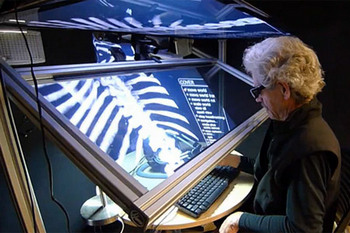
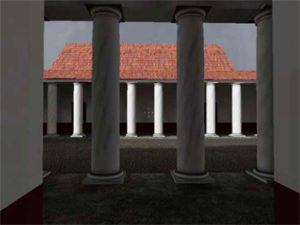
 A pioneering research project to recreate Roman Leicester with an interactive virtual world is unveiled today at the official launch of Phoenix Square film and digital media centre in the city’s emerging cultural quarter. Members of the public will see a showcase of a range of IOCT – Institute of Creative Technologies – projects including taking an interactive on-screen tour round Roman Leicester 210AD; which takes them inside some of the 3D buildings including the Merlin Works Baths, Mithraum, the Temple of Jupiter and the Basilica and Forum.
Using a skill known as architectural forensics, and working with archaeologists from the University of Leicester, Dr Douglas Cawthorne and Researcher Assistant George Watson have brought to 3D life, buildings known to have existed in the city, the first tage of the ‘Virtual Roman Leicester’ project.
Dr Cawthorne said: “This project seeks to digitally recreate Roman Leicester (Ratae Corieltauvorum). The first stage, currently underway, is creating highly accurate digital models of the known buildings and artefacts.”
He adds: “This will lead on to populating the town with virtual ‘Romans’. These characters will be programmed with all the social, cultural and environmental factors that would have influenced the lives of the actual people of the period (roughly 1st to 4th centuries AD). A game-like element will give users the opportunity to enter virtual Roman Leicester to observe, trade and interact.”
Video: Virtual Roman Leicester
A project from the Art and Design faculty, De Montfort University, Leicester. Funded by Professor Andrew Hugill of the Institute of Creative Technologies (IOCT) at DMU and carried out by Dr Douglas Cawthorne of the Leicester School of Architecture and Mr George Watson of IOCT and advised by the University of Leicester Archaeological Services Unit.
Virtual Roman Leicester is not only a user interactive exploratory environment but also demonstrates the recreation of long vanished buildings from very minimal archaeological evidence using a technique Dr Cawthorne has described as ‘Architectural Forensics’. The technique has suggested new interpretations of the means of construction, the history and use of the Roman buildings and has also indicated potential areas for further investigation.
In case of the Merlin Works Roman Baths, the digital reconstruction has indicated the probable scale and visual appearance of the building and reveals a complex small building with many of the attributes of a provincial and probably military bath house of this period.
This ‘architectural forensics’ is closely related to ‘procedural modelling’; as just 0.01% of Roman Leicester is there to work with, researchers had to use other roman architecture sources as reference model. “If we know the diameter of a column base we can have a pretty shrewd guess what the column itself was like,” Dr. Cawthorne says.
We just can’t wait to go and see Virtual Roman Leicester (and while we’re there anyway, the ‘non-virtual’ Roman Leicester too). But if you prefer Ancient Egypt over Roman Britain, you should definitely give King Tut Virtual a try! For NPC’s – non-player characters, the programmable characters Dr. Cawthorne mentions – you’ll have to wait for the upcoming Stonehenge Virtual (see here for a preview).