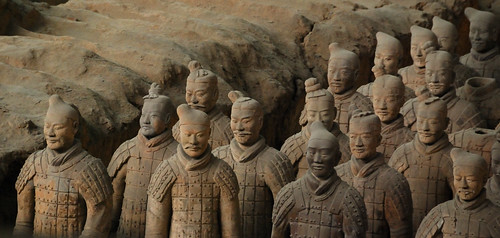
 Come to Xian, and youll no doubt head straight to see the citys famous Terracotta Warriors exhibit, or the mausoleum of Chinas first emperor, Qin Shi Huang. You might make the trip out to the Big Wild Goose Pagoda or Maoling Mausoleum, and check out a couple of the museums, such as the Shaanxi History Museum, Xi’an Banpo Museum and the Xian Museum.
But theres a lot more to Xian than these, admittedly stunning, sites. The ancient capital also has a stash of hidden treasures. Heres a handful of my favourites.
Tomb of the Second Emperor
So much has been said of China and its first emperor Qin Shi Huang . But what about his immediate successor?
Historical records say little about Chinas second emperor, Qin Er Shi . Following his fathers death, the young emperor ruled for a mere three years from 210 to 207 BC before committing suicide. Shortly thereafter, the Qin dynasty collapsed.
Although his reign seems like only a footnote to history, the tomb of this obscure emperor can still be found in Xian.
The site is just south of the Qujiang Pool in Xians Tang Paradise Park. A road leads up to the tomb, which is surrounded by an old-style Chinese courtyard home.
The place is small, and has largely been untouched by the citys modernization. Untamed trees and brush cover much of the area, with the foo-lion statues at the entrance nothing but slabs of worn marble rock. At the tomb are a few dusty exhibits detailing the history of the emperor, as well as the actual grave site.
Local caretakers, however, have said that plans are in place to begin renovating the area soon.
Temple of the Eight Immortals
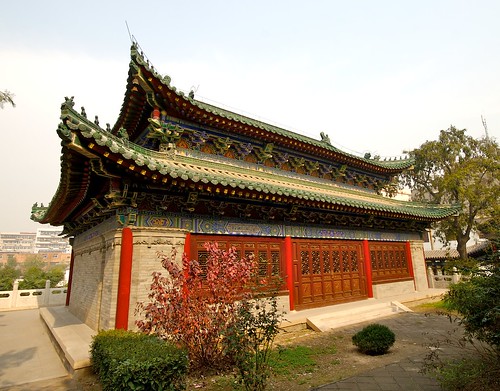 Located not far from the eastern side of the inner city wall is Xians largest Taoist temple. Ba Xian An, or the Temple of the Eight Immortals, was built in Chinas Song Dynasty (960 to 1279 A.D.) and has been continually expanded on throughout the centuries.
In Taoism, the Eight Immortals are major figures that symbolize prosperity, and have been commonly featured in Chinese traditional art. This temple is dedicated to them. Legend has it that the place was built after a Song dynasty scholar met the Eight Immortals.
Many statues of the immortals along with engraved Taoist artworks can be found at the well-preserved temple. Originally, it was built on the ruins to a Tang dynasty palace. Other dynasties such as the Yuan, Ming and Qing have also made contributions to the temple, with many of the Qing buildings now taking up most of the site.
The temple can be best found by exiting from one of the inner citys gates at Dong Xin Street or . Head east; after about three blocks, the temple will be on your left.
Da Xing Shan Temple
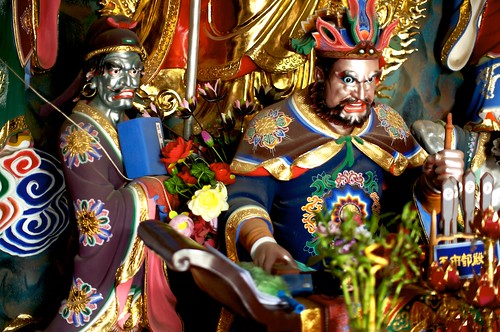 Another place of religious importance in Xian is the Daxing Shan temple, located in the south of the city. This Buddhist temple is the citys oldest, having been built in the Western Jin Dynasty period (265 to 316 A.D.)
Its significance dates back to the Tang dynasty when Buddhist monks from India came to the temple. There they worked to translate and promulgate Buddhist texts, with the place eventually becoming a major center for Buddhist culture. Because of its role, the temple has been considered a birthplace for Chinese Buddhism.
However, in the later Tang dynasty, the temple was desecrated during the reign of the emperor Wuzong, who persecuted the Buddhist religion. Since that period renovations have been made off and on to the temple, some of the most prominent additions coming during the Qing dynasty and the last several decades.
The temple itself is separated into different halls that stretch across a vast courtyard. Visitors can find it along Changan street heading south, down next to the cross street at Xing Shan Temple West road.
Epang Palace
Whether or not this place truly existed is still unknown. But according to legend, Xian was once the site for perhaps the largest palace ever conceived by man.
In 212 BC, Chinas first emperor ordered the palaces construction, making it so large that it had its own climate. Luxuries filled its confines, with beautiful women and treasures abound. But according to historical records, during the decline of the Qin dynasty, the palace was burned to the ground in a revolt.
To unravel the mystery, archeologists have worked on digging up ruins of the palace in sites just west of Xian. Discovered evidence suggests that the palace was never completed, and that it was not burned down as once thought.
The site of the actual palace can be found about 13 km west from the center of the city. An exhibit of the ruins is being built and is planned to be opened in 2010. A replica of the palace, completed in 2000, is nearby and has now become a tourist attraction in the city.