Where and when?
The term Neolithic refers to the period in ancient European history when characteristic Neolithic technology became prevalent – certain types of farming implements, tools, pottery and weapons. Encyclopedia Britannica describes the Neolithic period as a whole as the “final stage of technological development or cultural evolution among prehistoric humans.”
The Neolithic era originated in South East Asian villages such as the famous Banpo in China, circa 9000 BC, artefacts from which are displayed in Xi’an‘s Banpo Museum. It then gradually spread west. It lasted from approximately 7000 BC (around the time of the first farming societies in Greece) until circa 1700 BC, when the Bronze Age – basically the use of bronze implements – reached Northwest Europe.
It covers the whole of Europe, from the Balkans to Scandanavia, with acknowledgment of some differences in duration from place to place. Cultural changes moved from the south east to north west at a rate of about 1km/year, so while in southeast Europe the Neolithic period lasted approximately 4000 years (7000 BC-3000 BC), in Northwest Europe it lasted just under 3000 years (4500 BC-1700 BC).
Characteristics
 Neolithic communities were usually fairly small in Britain, with around 50 to100 people, although some communities in southeastern Europe, such as Sesklo in Greece, were heavily fortified settlements of up to 3,000-4,000 people.
People would have lived quite well in the egalitarian, family-oriented structure of Neolithic society. They would have benefitted from a diverse diet – there is evidence the cultivation of crops, and farming of animals, supplemented by wild foods, fishing and some hunting. They would have used stone tools, shaped by scraping or grinding into slightly more sophisticated implements than those wielded by their Stone Age predecessors. They were also skilled at weaving and pottery.
They may have eaten well, but it’s unlikely that their dinner party conversation was up to much – there is no existing evidence of any languages spoken by Neolithic people. However, this may be due to the fact that there are no records from Neolithic times. The existance of a verbal language is possible.
Sites Around Europe
Sesklo in modern day Greece is a site crucial to the study of the Neolithic period. Located in an Aromanian village near the city of Volos in Thessaly, its was discovered at the end of the 19th century, with the first excavations made by Greek archaeologist Christos Tsountas in the early 20th century. Fragments found there, which date the settlement’s development as far back as circa 6850 BC, are on display at The Archaeological Museum of Volos.
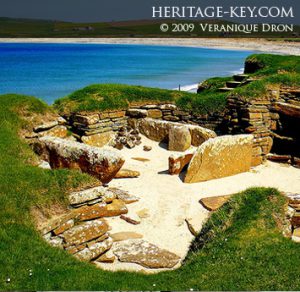
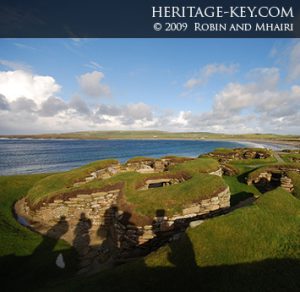
Northern Europe’s best preserved Neolithic village is Skara Brae on the Orkney Islands, Scotland. It was discovered in the winter of 1850, when wild storms ripped the grass from a high dune and exposed an immense refuse heap and ruins. At 5,000 years old, it was inhabited before even the Egyptian pyramids were built. Not just the structures of the buildings, but even the furniture in some of the houses, have survived over all those centuries.
However, the most famous Neolithic site is probably Stonehenge. The first stones of its iconic megaliths may have been laid as early as 3000 BC and the last as late as 1600 BC (so, on the cusp of the Bronze Age), while its surrounding circular earth bank and ditch – which constitute the earliest phase of the monument – have been dated to about 3100 BC. Conventional techniques using Neolithic technology have been demonstrably (if crudely) effective at moving and placing stones of this size. The henge is just one of many Neolithic constructions in the area, including several burial mounds on the surrounding Salisbury Plains, and the Avebury Stones.
 Religion
It’s impossible to be certain what sort of religious beliefs people held due to an absence of records, but the many burial chambers and cairns that can still be seen today suggest that there was belief in some kind of an afterlife. Britain in particular is home to many Neolithic burial sites, including the cairns at Blackhammer and Cuween on Orkney, Arthur’s Stone in Shropshire, Wayland’s Smithy in Oxfordshire and Belas Knap in Gloucestershire.
The building of complex henges and stone circles, such as Stonehenge (and at other notable locations such as Castlerigg in Keswick, Avebury in Wiltshire and Brodgar on Orkney), suggests a high level of understanding of astronomy, and some sort of religious or ritual association with the influence of the stars on human life.
Neolithic man left us no written records from which to understand the nuances of their culture. But the very construction of these monuments – which must have taken so much energy and effort considering the primitive technology available – is proof alone that Neolithic man felt he was labouring in the service of some kind of higher power. Whether that was dragons, aliens, science or God, we are yet to find out.
Skara Brae photo (top) by Veranique Dron, Skara Brae photo (bottom) by Robin and Mhairi. All rights reserved.