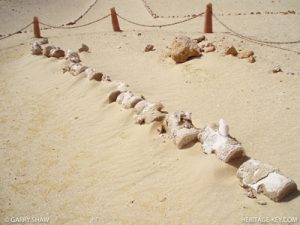
The key find in this highly significant paleontological site was hundreds of fossils of an early, now extinct form of whale, named archaeoceti. Although not the earliest examples to be discovered in the world, the concentration of these remains and their level of preservation, which enabled scientists to study their stomach contents, has contributed to our understanding of the early stages of life on earth immeasurably. Unlike other fossils found elsewhere, some of the archaeoceti in Walid al-Hatin had skeletons with back legs and feet, providing a compelling picture of the evolutionary stages the whale went through as it changed from a land to sea mammal. Alongside these early whales, fossils of fifteen species of wild mammals, 19 reptiles and 36 breeds of bird have been found on the site, enabling paleontologists to construct a detailed picture of the environment of the time.