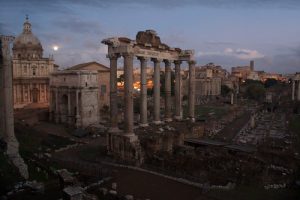
If Rome is the centre of the ancient world, then the Forum Romanum could lay claim to being the centre of Rome. Lying between the Palatine hill – home to many of the Roman elite – and the Capitoline hill – home to many of her gods – the forum was the judicial, political and economic centre of the Roman Republic.
Given its importance, it’s hardly surprising that successive generations of Roman senators (and later emperors) put their stamp on the Forum Romanum by erecting impressive temples, basilicas, arches and so forth, while the area’s prominence in the religious and political life of the republic is reflected in the presence of the Curia (Senate House), Rostra, Regia and the hosue of the Vestal Virgins. The forum boasted temples to Castor and Pollux; Saturn, Vesta, Venus and Roma, Titus and Vespasian; Antoninus and Faustina; Caesar and Concord, as well as playing host to the Basilica Aemilia, Basilica Julia and, later, the Basilica Maxentius and Constantine. Meanwhile, the forum was also adorned by the arches of Augustus, Tiberius, Titus and Septimius Severus… and less pleasantly Rome’s chief prison, the Tullianum.