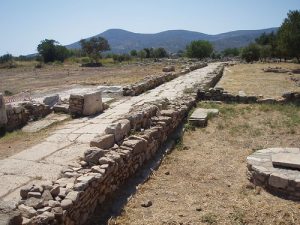
Many civilisations have inhabited the small Greek island if Samos since the 3rd millennium BC. The Pythagoreion and Heraion of Samos are the remains of two impressive classical architectural structures.
The Pythagoreion was an ancient fortified port with Greek and Roman monuments. It holds the Tunnel of Eupalinos, also known as the Eupalinian aqueduct. It is a tunnel 1,036m long, and built in the 6th century BC.
The Heraion of Samos was a sanctuary on the southern region of Samos. The Heraion of Samos was the first of the gigantic Ionic temples, but it stood for only about a decade before it was destroyed, probably by an earthquake.
Many construction phases are known, the first dating to the 8th century BCE. A much larger temple was built by the architects Rhoikos and Theodoros ca.570-550 BC stood opposite the cult altar of Hera in her sanctuary. After the destruction of the Rhoikos temple, an even larger one was built approximately 40m to the West. This temple has the largest known floor plan of any Greek temple and is known as the Polycrates Temple, named after a tyrant of Samos. One of the giant statues from the Heraion survives in the Samos Archaeological Museum.