
This richly illustrated book is about codebreakers, a unique group of people who dedicate their professional lives to unravelling the mysteries of ancient scripts. It proved to be an interesting and educational read. The book defines the difference in the roles of the epigrapher and the cryptanalyst, who are both deciphers. The epigrapher works with a script not originally designed to baffle the reader, and an underlying language which the reader may or may not know. The cryptanalyst tackles a code or cipher designed from the outset to baffle him or her, but an underlying language – such as German,…
-
-
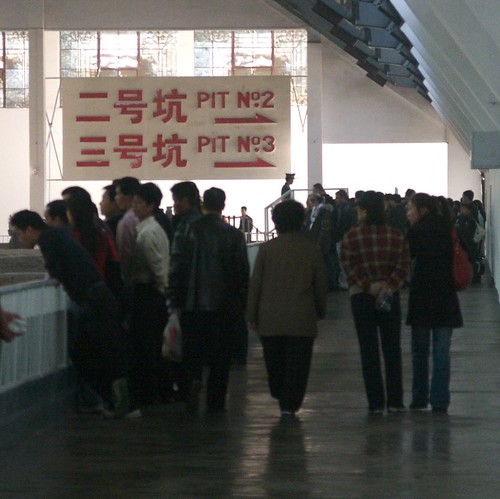
114 Terracotta Warriors, and several artefacts, have been discovered in the mausoleum of Chinas first emperor, Qin Shi Huang. The warriors were discovered in No 1 pit, the largest pit, and retained some of the richly-coloured paint that all of the warriors would have displayed originally. They also showed signs of man-made fire damage, prompting speculation about who may have harmed the warriors. In an article by China Daily News, Xu Weihong, head of the excavation team, said: “The total area of the excavation was some 200 sq m and we were pleasantly surprised to find rich colors on Terracotta…
-
Using NASA laser technology, researchers have discovered thousands of new structures and illustrated the complex urban centres built at the ancient Maya city of Caracol, Belize. The equivalent of 25 years worth of data (if gathered through machete-wielding means) was gathered in only four days using a technique of emitting laser beams from a plane to penetrate the thick canopy that covers the site. LiDAR (Light Detection and Ranging) equipment brought aboard a small Cessna 337 bounced laser beams to sensors on the ground, penetrating the thick tree canopy to see ‘beyond the rainforest’, allowing for the detecting of many…
-
Dr Michel Baud of the Louvre Museum in Paris gave an interesting lecture last week about his excavations of a pyramid at Abu Roash. The monument was badly preserved and its stone had been quarried in Roman times, but the certain details, such as its apparent solar connections, were still discernable. Earlier, Vassil Dobrev stated that the pyramid may actually be a solar temple. However, Baud dismisses these claims…. Nearly 4,500 years ago, in the time of the Old Kingdom, the pharaoh Khufu built one of the greatest monuments on earth – the Great Pyramid. His pyramid was actually a…
-
As a wise man once said, “Education costs money, but then so does ignorance.” The first part of the maxim isn’t so true any more as online resources and information proliferate, making it free and easy for everyone to learn online if they want to. There are now a number of courses online on Roman history and architecture too and they’re from respected universities, given by well known experts in their field. Brought to my attention by the Free Technology for Teachers blog, Yale offers its online course Roman Architecture 252, a series of 24 lectures available to download to…
-
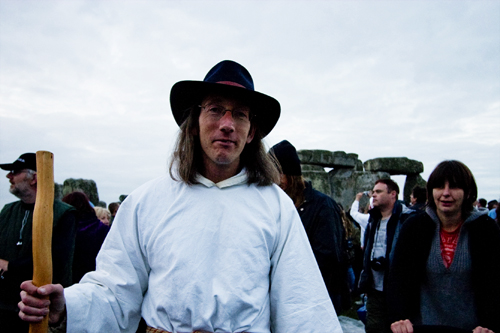
Britain’s pagan policemen and women have been given the right to take time off to celebrate their ancient festivals. The Pagan Police Association (PPA) has been recognised as a ‘diversity staff support organisation’ by the Home Office, a move which has polarised the force. The PPA is thought to have up to 500 members, including Wiccans andDruids. Co-founder Andy Pardy has hailed the group’s progress, which will see members allowed time off to observe dates like the recent Beltane Fire Festival and Spring Equinox at Stonehenge. “The recognition of paganism is a slow process, but the progress is evident,” he…
-
Archaeologists working at the Avenue of Sphinxes in Luxor, Egypt, have uncovered the remains of a fifth century Coptic church and a Nilometer, a structure used to measure the level of the Nile during floods. According to a statement released by the SCA, the church’s remains were found on the second of five sections of the ancient religious path leading to the Karnak temple. Thechurch was built with limestone blocks originally belonging to the Ptolemaic and Roman temples that once stretched along the Avenue. The blocks are well preserved, with many of them bearing depictions Ptolemaic and Roman kings offering…
-
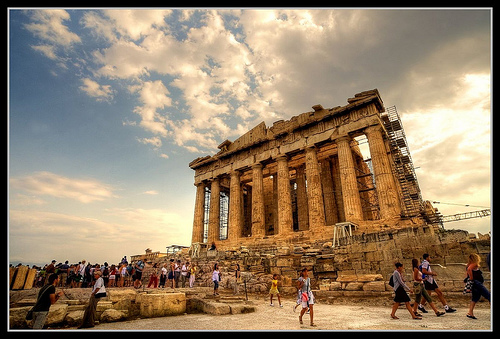
Attribution: Lluís Sala Athens Greece Key Dates The first Parthenon on the site dated back to 570 BC. The existing Parthenon was built between 447 and 438 BC to replace Parthenon II. In the 5th century it was transformed into a church, before becoming a mosque under Turkish rule in the 1460s. The building was attacked and almost destroyed in 1687 during Morozini’s siege of the Acropolis. Lord Elgin caused more damage when he looted it in the 19th century, subsequently selling much of its contents to the British Museum. The Parthenon underwent restoration from 1896-1900 and from 1922-1933. A…
-
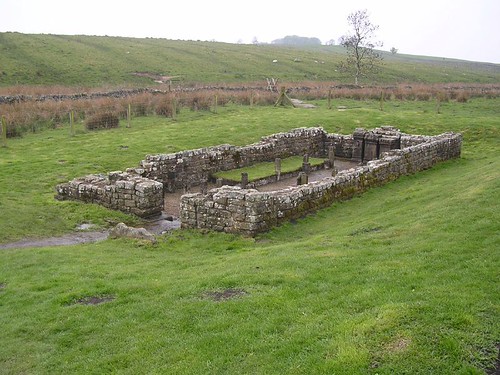
Attribution: The Armatura Press Newcastle United Kingdom Key People Mithras A Mithraeum is a place of worship for the followers of the mystery religion of Mithraism. The Mithraeum was either an adapted natural cave or cavern or an artificial building imitating a cavern. Mithraea were dark and windowless, even if they were not actually located in a cave. The Carrawburgh Mithraeum lies south-west of the Roman fort at Carrawburgh, Brocolitia. The site of the temple was first discovered in 1949 and was excavated in 1950 by Sir Ian Richmond and Mr J.P.Gillam. The first mithraeum to be built on the site…
-
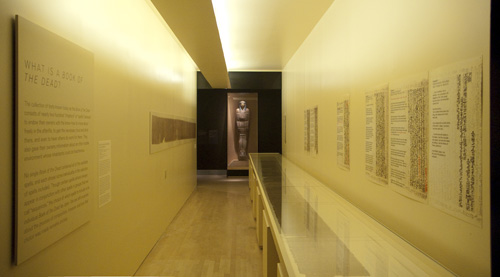
Brooklyn Museum have sent us some of the first pictures from their brand new long-term exhibit The Mummy Chamber, an exploration of afterlife beliefs and rituals in ancient Egypt, which as we blogged opened to the public on Wednesday. Featuring 170 pieces from the museums extensive Egyptian collection, it highlights the elaborate and often strange lengths sometimes gone to in the land of the pharaohs in order to ensure that a deceased individual had the most pleasant and trouble-free experience possible after passing on into the mysterious realm of the dead. That means displays of everything from mummies, coffins and…