
Excavations at a Colonial Period site on the North Coast of Peru have revealed the first traces of a lost language. Sometime in the early 17th century, a Spaniard jotted down some notes on the back of a letter. Four hundred years later, archaeologists dug up and studied the paper, revealing how Peruvian natives used numbers. The find is significant because it offers the first glimpse of a previously unknown language and number system, says Dr. Jeffrey Quilter, director of the archaeological project at Magdalena de Cao Viejoand curator at the Peabody Museum Harvard. It also points to the great…
-
-

A BBCFour series presented by historian Michael Wood will be examining “The English Story”, which will be exploring the history of England not through monarchs and aristocrats, but through ordinary people. The programmes will be centred around the old parish of Kibworth, Leicestershire in the heart of England, which has a history rooted in Roman occupation, and found itself on the frontline between the Saxon and Viking territories. The series will explore the people of Kibworth’s past through letters, diaries, censuses, medieval tax rolls and the Domesday Book (Find your own past on the Online Domesday Book here), as well…
-
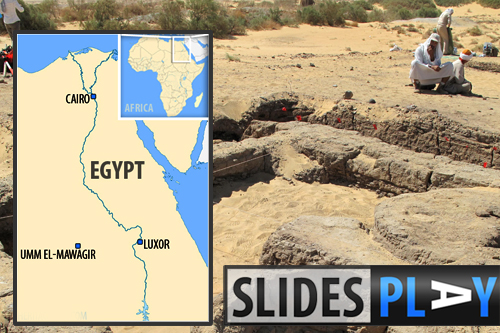
Archaeologists have stumbled upon what appears to be the remains of a substantial ancient settlement at Umm El-Mawagir in Kharga Oasis, Egypt. Dated to the Second Intermediate Period (1650 to 1550 BC), the newfound city is at least a thousand years older than any of the other major surviving ancient remains in the area. The ancient town lies along the bustling caravan routes connecting the Nile Valley of Egypt and the El-Kharga oasis with points as far as Darfur in western Sudan. The discovery was made by an American-Egyptian archaeological team from Yale University that is systematically searching the area…
-

Archaeologists have discovered a large structure – to the northeast of the 4,600 year old Bent Pyramid – which may be the remains of an ancient harbour. It connects to one of the pyramid’s temples by way of a 140 meter long causeway. The discoveries were made by a team from the Cairo department of the German Archaeological Institute, and the Free University of Berlin. The team used magnetic survey and drill cores soundings to make the finds. The structure is mostly unexcavated and only a portion of the causeway has been unearthed. The structure itself is U-shaped, 90 meters by…
-
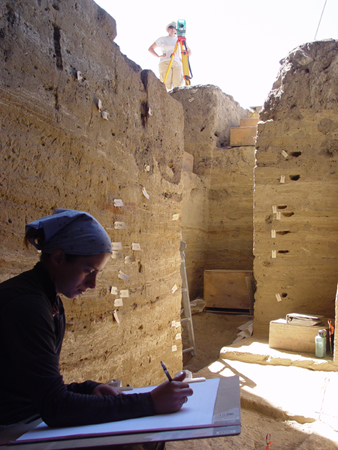
Almost 10,000 years ago, in Utahs Escalante Valley, a new recipe was added to the prehistoric cookbook: mush cooked from the flour of milled sage brush seeds.In those times,what else would the early chefs put on your plate..err… rock? Archaeologists from the Brigham Young University are publishing what they’ve learned from five summers of excavations at the ‘North Creek Shelter’. The site,on the northern Colorado Plateau in southern Utah,has been occupied by humans on an off for the past 11,000 years, and is one of the oldest of such archaeological sites in Utah. In the upcoming issue of the journal…
-
Key Dates Built between 160 and 174 BC. First archaeological digs commenced in the 1850s; performances started to be staged there again from 1867 and continue to be staged there to this day. The seats and stage were replaced in the 1950s. Athens Greece Key People The Odeon was built by the wealthy Greek rhetorician Herodes Atticus in memory of his wife, Aspasia Annia Regilla. Originally constructed as a music venue, the Odeon of Herodes Atticus – which lies on the southern slope of the Acropolis of Athens – is a spectacular 80-metre diameter ancient amphitheatre. Its steep stepped slopes…
-

An interesting concept powers a new website launched by the BBC called Dimensions, which uses data from historical sources to map the area of ancient sites such as the Long Walls of Athens, Stonehenge and the Great Library of Alexandria. The outline of these heritage sites can then be overlayed on top of any other area, so you can see the size of the ancient cities relative to where you live yourself! In a similar sort of scheme as the recent oil spill disaster in the Gulf of Mexico (which saw the British Museum targetted as part of a protest…
-

Attribution: 469 BC – 399 BC Relationship People Associated Plato, Xenophon Despite the fact that he left no literary legacy of his own, Socrates is still considered to be the founding father of Western Philosophy. Born in 469 B.C.E he took an early interest in science, studying under Archelaus. He gave up on the examination of the physical world, however, to concentrate on the exploration of morals and humanity. Socrates invented the conception of philosophical dialogue and spent much of his time in discussion with the aristocratic youth of Athens. He was greatly respected by the younger generation and during his time as a teacher to…
-

Though not quite as pretty and detailed as the famous Terracotta Warriors in Xi’an, a new discovery of statues in Guizai Mountain, Hunan, China outnumbers the Qin Emperor’s army of stone soldiers, and date back over 5,000 years -over 2,500 years earlier than Qin Shi Huang’s Terracotta Army. Located on what is an ancient worship site, the discovery of over 5,000 statues arespread over 15 square kilometres and the vast majority are believed to have been carved before the Qin dynasty era. The anthropoid stone statues range from 30cm to 100cm in height, and take the form of several ranks…
-

Following years of restoration and development, the Marina el-Alamein archaeological site on Egypt’s Mediterranean coast will open to tourists mid-September. The Marina el-Alamein archaeological site a Hellenistic-Roman town is locatedabout 5km east of el-Alamein. The ancient city was accidentally discovered in 1986, when construction started on the Marina El-Alamein resort. The archaeological area spans a section that is more than 1km long and about 0.5km wide and is the largest archaeological site on Egypt’s north coast. Minister of Culture, Farouk Hosni, announced that the site will be opened to tourists mid-September complete with a high-tech lighting system throughout the entire…