Evidence of early Iron Age settlements and Roman remains have found at Sutton borough, south London. The infant burials and animal remains uncovered across the site are believed to be over 2000 years old. The discoveries were made by workmen laying the foundations for the new Stanley Park High School on the former site of Queen Mary’s Hospital. The site lies less than 100m to the northwest of one of the largest 150m in diameter Late Bronze Age hilltop enclosures in southeast England, discovered in the early 20th century. The archaeological remains are typical of a late Iron Age and…
-
-
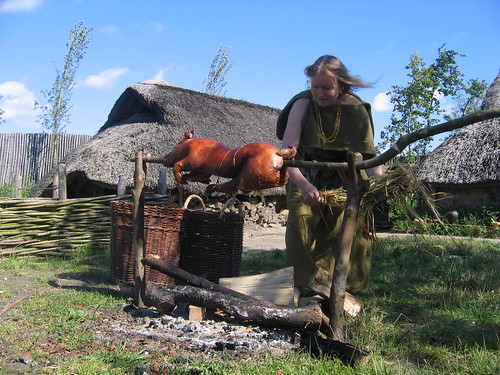
This Saturday, as part of the Iron Age Open Days, Cheshire celebrates the opening of its brand new prehistoric Roundhouse at Burwardsley. The replica Iron Age Roundhouse, built by Chris Park from Acorn Education, will act as a teaching aid helping to bring archaeology to life for children. The free event will include demonstrations of Iron Age techniques such as making fire, bread and Iron Age jewellery, with an opportunity to have a go yourself. Round Houses were the dominant building style of late prehistoric Britain and would have been common to Cheshire throughout the Iron Age. Archaeological remains of…
-
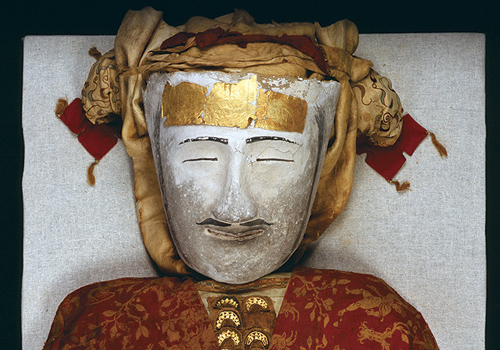
Tickets go on sale today for “Secrets of the Silk Road” a landmark exhibition from China making its only East Coast stop at the University of Pennsylvania Museum of Archaeology and Anthropology (Penn Museum) in Philadelphia February 5 through June 5, 2011. The exhibition aims to reflect the wide extent of the Silk Road trade and cultural interchange (see some of the highlights in this slideshow). Despite of what its name suggests, the Silk Road isn’t one single route. Rather, it is an extensive interconnected network of maritime and overland trade routes extending from Southern Europe through The Arabian Peninsula,…
-
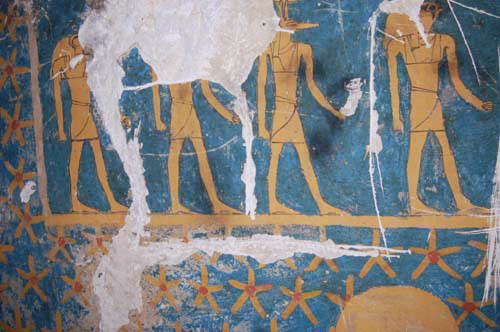
Archaeologists have rediscovered the ‘lost’ tomb an ancient Egyptian priest at the Theban Necropolis in Egypt.It was announced today by Egypt’s Minister of Culture, Farouk Hosny, that the team excavating and conservating the tomb has now cleared the burial shaft of tomb and reached its burial chamber. The tomb is located at Qurnet Murai, south Assasif, on the west bank of the Nile opposite to Luxor, and belonged to a priest named Karakhamun. It dates to the 25th Dynasty (the Reign of Shabaqo, circa 700BC) and is referenced as TT223 (Theban Tomb 223). The el-Assasif area is a well known…
-
Earlier this year, an astonishing Roman cavalry helmet was discovered in Cumbria. The helmet found complete with face mask is only the fifth known example discovered in the United Kingdom. Next month, the parade helmet will go on auction at Christie’s London, with Carlisle’s Tullie House Museum as one of the eager bidders for the 200,000 artefact. Crosby Garrett Helmet Discovery The helmet was discovered damaged it was broken in 67 pieces but near-complete by a metal detectoristat Crosby Garrett in Cumbria, in May 2010 (images of the headpiece in its discovery state can be seen on the Portable Antiquities…
-
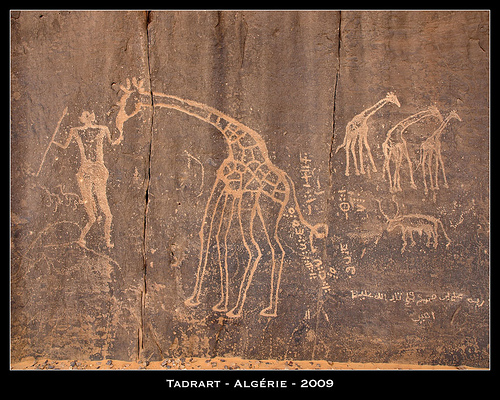
Attribution: jpmiss Sahara Desert Algeria Key Dates The earliest prehistoric paintings probably date to 9000 BC. The prehistoric rock paintings of Tassili n’Ajjer in the Sahara desert in Algeria, probably date from 9000 BC on. They were made during a period when the climate was wetter than now and the Sahara was closer to savannah than desert conditions, and therefore able to support greater human occupation as is evident from finds of stone tools and ancient rubbish heaps as well as the rock art itself. The rock art can be classified into the following periods: the Bubalus period (from c.9000 BC), the Roundhead period (c.6000-4000 BC),…
-
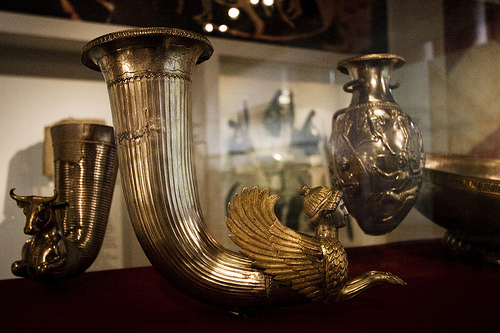
Attribution: Ann Key Dates 350 BC Key People King Kotys I The Borovo Treasure was accidentally discovered in 1974, when a field about 2 kilometres from the village of Borovo, Ruse (Bulgaria) was ploughed. Sadly, the plough machine’s cutting implements severely damaged the five silver artefacts, but thanks to great restoration work, nowadays their ‘scars’ are nearly invisible. No tumulus was found at the location, and why the silver treasure was buried here remains a mystery. The Borovo Treasure is a luxurious five-vessel silver gilted drinking set – decorated with gold. It consists of three rhytons (ending in the protomes of…
-
The ongoing dig at the ancient royal town of Qatna, Syria, has brought some exciting new discoveries to light. Among the skeletal remains, archaeologists have found precious gold jewellery, gemstones, alabaster vases, detailed ivory artefacts, tiny figurines. Since the start of this year’s excavation mid-July, a total of 379 artefacts were recorded in the tomb. The archaeological mission a Syrian-German cooperation between the University of Tubingen and the Syrian governement is further excavating the royal sepulchre that was discovered last year under the northwest wing of Qatna’s royal palace. Among the burial gifts, a number of Egyptian object are of…
-
The British Museum has announced that it is lending the Cyrus Cylinder to the National Museum of Iran. Together with two fragments of contemporary cuneiform tablets, it will be the centrepiece of an exhibition that celebrates a great moment in the history of the Middle East. The artefact which is described as ‘an ancient declaration of human rights’ by the United Nations was originally due to arrive in Iran in September 2009. At that time, the British Museum cited the ‘political situation’ in post-election Iran as the reason for the delay. In August this year, the loan was once again…
-
At the ancient city of Sagalassos, Turkey, archaeologists have discovered the oldest Roman baths in Asia Minor known to date. The new find means the Capito Baths in Miletus, built during the reign of Emperor Claudius (41-54 AD),have to concede theirposition as the oldest known Roman bathing complex in Anatolia. Oldest Roman Bathsin Asia Minor The ‘Old Bath’ was discovered at Sagalassos, an ancient city from Hellenistic and Roman times in southwestern Turkey. They were locatedbelow the previously unearthed Imperial Baths, dated to120-165 AD. The newly discovered bathing complex is much older and smaller than the Imperial Baths which have…