• Ann

    Amazonian Dark Earth points to large amount of pre-Columbian settlements in North Brazil

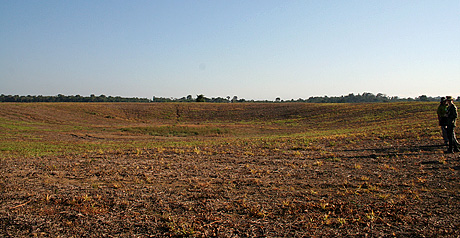
    The pre-Columbian Indian societies that once lived in the Amazon rainforests may have been much larger than researchers previously realized. Archaeologists have located the remains of about 90 settlements in an area south of the city of Santarm, Brazil. Traditionally archaeologists have thought that these inland areas in northern Brazil were sparsely populated before the arrival of the Europeans in the 16th and 17th centuries. One reason for this assumption is that the soil found in the Santarm area is generally quite infertile; another reason is that far away from all the major watercourses, the access to water in the…

  • Ann

    Tomb of ancient Egyptian priest Rudj-Ka discovered at Giza

    Egyptian archaeologists discovered a 4400-year-old tomb, south of the cemetery of the pyramid builders at Giza, Egypt. In a statement, Egyptian Minister of Culture Farouk Hosny, said the ancient Egyptian tomb was unearthed during routine excavations supervised by the Supreme Council of Antiquities (SCA) near the pyramid builder’s necropolis. The recently discovered tomb belongs to a priest named Rudj-Ka (or Rwd-Ka), and is dated to the 5th Dynasty – between 2465 and 2323 BC. Dr. Zahi Hawass, Secretary General of the SCA, said that Rudj-Ka had several titles and would have been an important member of the ancient Egyptian court. Rudj-Ka was…

  • Ann

    Hoard of 10,000 Roman Coins found in Shropshire

    A massive haul of more than 10,000 Roman coins crammed inside a buried clay pot has been unearthed by an amateur metal detecting enthusiast – on his first ever treasure hunt, and this only a few days after it was announced the Vale of York Hoard was purchased by the British Museum. The silver and bronze ‘nummi’ coins, dating from between 240 AD and 320 AD, were discovered in a farmer’s field near Shrewsbury, in Shropshire, last month. Experts say the coins have spent an estimated 1,700 years underground. The stunning collection of coins, most of which were found inside the…

  • Ann

    Excavations start at unique 5,000-year-old Tirnony Dolmen

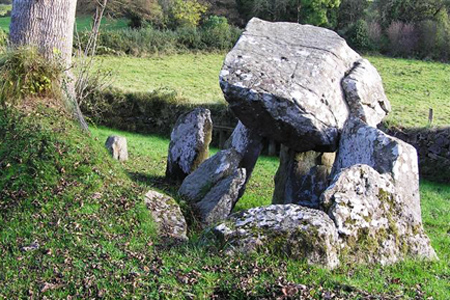
    Archaeologists from the Northern Ireland Environment started excavating the 5,000-year-old Tirnony portal tomb near Maghera – an extraordinary ‘archaeological treat’ – and the public is invited to drop by, with an ‘open dig’ every Friday. Quick update: Neolithic knife find hints at undisturbed burial The Tirnony Portal Tomb, also known as the Tirnony Dolmen, is a single-chamber megalithic tomb, estimated to be about 5,000 to 6,000 years old.  The capstone is – or rather, was – supported by three of six upright stones, two of which form the portal. In April this year, the burial tomb’s massive capstone fell off, severely damaging one…

  • Ann

    Woruldhord, a massive Old English and Anglo-Saxon treasure hoard – to be discovered on the web

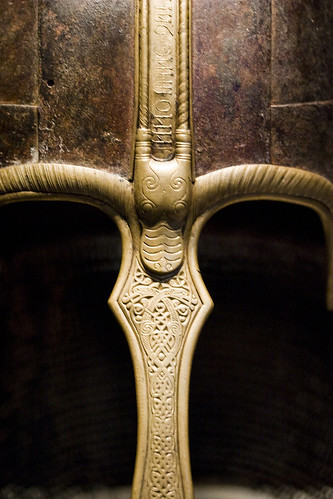
    Submissions from the public have helped Oxford University academics put together a hoard of Anglo-Saxon treasures. Yet, there is no need to get your metal detectors out. The hoard in question is the worlds largest online archive of material concerning the Anglo-Saxons. The virtual treasure consists of digital objects related to the teaching, study, or research of Old English and the Anglo-Saxon period of history, which will be made available online for free. Project Woruldhord (Old English for world hoard), which called on the public to submit Anglo-Saxon teaching material after being inspired by the level of interest surrounding the…

  • owenjarus

    The oath on the platform – 2,700 year old temple at Tayinat had royal loyalty oath prominently displayed

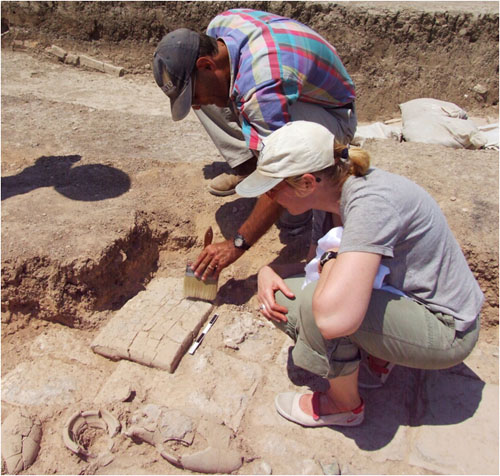
    A team of researchers – excavating a 2,700 year old temple at the ancient city of Tayinat in southeastern Turkey – have discovered evidence that its inhabitants prominently displayed a tablet which bore a pledge of loyalty to the heir of an Assyrian king. At their height the Assyrians controlled an empire that stretched from southern Iraq to the Mediterranean coast. In their art and writing, “the Assyrian king was portrayed as supreme ruler of the known world and viewed with absolute authority as the earthly representative and human embodiment of (the Assyrian god) Ashur,” said Professor Tim Harrison of…

  • review

    ‘Colour and Meaning in Ancient Rome’ reviewed by Rachael Goldman

    by Mark Bradley Cambridge University Press (2009) 8/10 When Vergil describes, in his epic poem the Aeneid, the weapons brought by Venus to Aeneas and the breast plate is compared to a blue cloud shining in the sun’s rays in Aen. 8.622 and likewise Vergil’s description of rosey-fingered dawn in Aen. 7.26, none of these images would have been possible without the use of colors and color-terms.  Similarly, the elegiac poet Propertius’ landscape in 1.20.38 may not have had the beautiful bucolic background with shining apples hanging from trees surrounded by white lilies mixed with purple poppies.  Mark Bradley’ Colour…

  • Video

    The Mortuary Temple of Amenhotep III (Featuring Dr. Hourig Sourouzian)

    Here we are at the temple of Amenhotep III. It is the funerary temple of a king who lived during the first half of the 14th Century B.C. It is a time when Egypt is at the pinnacle of its glory, its expansion and its power. During his reign, which lasted 39 years, the king built here, in the Theban area the biggest temple ever seen, which stretched from the Memnon Colossi all the way to the modern road that runs in front of the Antiquities Office for a total length of 700 meters. Compared to the other temples found…

  • owenjarus

    Top 10 Socrates Quotes to Reflect Upon

    In 399 BC the Greek philosopher Socrates, by then around the age of 70, was executed in his home state of Athens. He was prosecuted for the rather dubious crimes of “not acknowledging the gods the city acknowledges” and “subverting the youth of the city”. His case was brought to court and prosecuted by a man named Meletus Meletou. After a one day long trial (the norm back then) he was found guilty by a jury of 501 peers – and sentenced to death. Modern day historians suspect that this trial was politically motivated. Indeed Socrates is said to have referred…

  • malcolmj

    Top 10 Crazy Aryan Theories – It’s not just the Nazis

    The word “Aryan” has become inseparably associated with the racialist world-view of the Nazis, despite the fact that – far from specifying a blonde-haired, blue-eyed “master race” – it was originally a perfectly innocent self-designator for a tribe of ancient nomadic Indo-Iranians who lived in the region of modern Iran, Afghanistan and India from around 2700 to 350 BC (more about “Aryan’s” passage from a simple piece of linguistic terminology to a racialist rationale for megalomaniacal world domination here). Saturated as they are in misconception, mirth, myth, and wild fantasy, the “Aryans” have become something of a lightning-rod for weird…