• nigel-hetherington

    Missing the revolution but making the party!

    I have spent the majority of the last 6 years working between Egypt and London; during this time my archaeological career has changed track somewhat from working on heritage protection strategies in Luxor to assisting media production companies in producing documentaries set in the historical realm. The journey from archaeologist to televising producer has enabled me to travel both metaphorically and physically between the worlds of the media and archaeology while attempting to be part I hope of both, a sometimes difficult undertaking. Generally I spend most of the year, some eight or nine months in Egypt during the archaeological…
  • nigel-hetherington

    Nigel Hetherington’s blog

    I have spent the majority of the last 6 years working between Egypt and London; during this time my archaeological career has changed track somewhat from working on heritage protection strategies in Luxor to assisting media production companies in producing documentaries set in the historical realm. The journey from archaeologist to televising producer has enabled me to travel both metaphorically and physically between the worlds of the media and archaeology while attempting to be part I hope of both, a sometimes difficult undertaking. Generally I spend most of the year, some eight or nine months in Egypt during the archaeological…
  • michael-kan

    110,000-year-old Chinese Fossil Poses Challenge to ‘Out of Africa’ Theory

    Dating back to 110,000 years ago, a human fossil found in China could provide evidence disputing the theory that all modern day humans originally came from Africa. Last week, China’s Institute of Vertebrate Paleontology and Paleoanthropology announced the discovery. Comprising of a human jawbone fragment, the fossil was found a year ago in southern China’s Guangxi pronvince. Jin Changzhu, a researcher with the institute, said the find was especially important since very few human fossils from this evolutionary period have been found in China. He added that the jawbone is that of an early modern human, but it also bears…

  • britain

    Genetic Britain: How Roman, Viking and Anglo-Saxon Genes Make up the UK’s DNA

    Who are we? The genetic make-up of the British people is a hotly contested subject in academic and political circles. Britain has a tumultuous history that includes Anglo-Saxon, Norman and Roman invasions, but what legacy of these settlers and invaders remains in the DNA of Brits today? The BNP’s Nick Griffin, who has recently gained a foothold in British politics, claimed recently to represent the “indiginous people” of Britain, comparing modern English, Scots, Irish and Welsh with the indiginous populations of North America and New Zealand. But today’s Brit is a complex melting pot of influences. A revealing Channel 4…

  • Ann

    Royal Artefacts – Including King Tut’s Golden Trumpet – Returned to Egyptian Museum Cairo

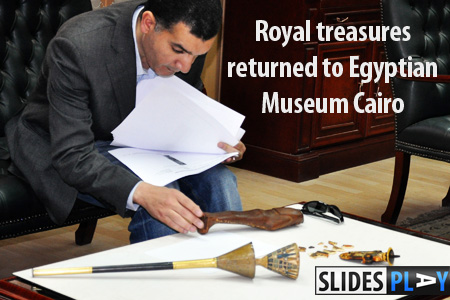
    Four ancient Egyptian artefacts belonging to Tutankhamun, and missing from the Cairo Museum since the January Revolution have been returned, announced Dr. Zahi Hawass, Minister of State for Antiquities, in a statement to the press. The objects returned include the gilded wooden statue of Tutankhamun standing on a skiff throwing a harpoon (JE 60710.1), part of King Tut’s burial treasure. As can be seen in the photos below, the statue suffered damage; a small part of the crown is missing as well as pieces of the pharaoh’s legs. The boat itself never left the Cairo Museum, and the artefact will…

  • britain

    Boudica

    Key Dates Led the Iceni revolt against the Romans in 60-61 AD. Relationship People Partners Prasutagus Boudica, also known as Boudicca and Boadicea, was a queen of the Iceni tribe which was based in the modern county of East Anglia in England (Watch the Ancient World in London video about Boudicca). VIDEO: Episode 6: Boudicca, Warrior Queen Her husband, Prasutagus, was king of Iceni and was an ally of the Roman occupiers of Britain. When he died, his will stipulated that his kingdom should be divided between his daughters and the Roman empire. The Romans flouted this completed by raping…

  • Ann

    SCA releases full list of treasures missing from the Cairo Museum

    A month and a half after the Cairo Museum break-in, Egypt’s Supreme Council of Antiquities has posted online a listing of sixty-three objects that were found to be missing following the looting. Amongst the missing Ancient Egyptian treasures are ritual statues and a fan belonging to King Tut, Yuya’s shabtis, amulets, as well as amulets and jewellery. Final List of Objects Missing from the Egyptian Museum, as released by the SCA, March 15th 2011: Gilded Wooden Figure of Tutankhamun on a Skiff, Throwing a Harpoon (the figure) – Carter no 275c? Gilded Wood Statue of Tutankhamun Wearing the Red Crown…

  • egypt

    Sacrificial chamber of the tomb of Akhethotep

    Key Dates 2400 BC The chapel of the tomb of Akhouthotep dates from the Fifth Dynasty, around 2400 BC. It was re-assembled in the Louvre in 1903, by Georges Benedite who was curator in the Egyptian department. Key People Akhethotep was a high dignitary of the latter part of the Fifth Dynasty, succeeding three generations of his family in high office. This chapel from the mastaba (tomb) of Akhethotep was where priests and family of the deceased would have come to offer food and drink to his spirit, and recite texts that would assist him in the afterlife. It is…

  • Ann

    Petrie Museum celebrates the extraordinary life of Amelia Edwards

    On March 8th, International Woman’s Day is celebrating its centenary, and the Petrie Museum is joining in by honouring Victorian writer Amelia Edwards, for without her, there may have never have been a ‘Petrie Museum’. Amelia Edwards was a novelist and travel writer, as well as an Egyptologist. After visiting for the first time in Egypt 1873, she wrote a vivid account of her adventure in A Thousand Miles up the Nile. She was the driving force behind the establishment of the Egypt Exploration Fund (now the EES) in 1882 to promote the scientific exploration of Egypt and its monuments.…

  • Ann

    New Face for 5,300-year-old Otzi the Iceman

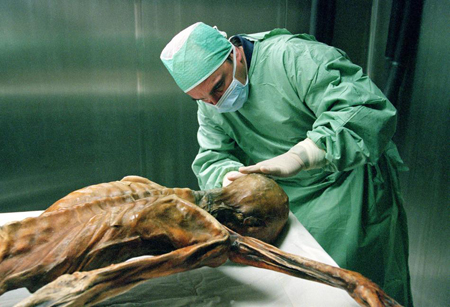
    About 5,300 years ago, a man travelling the Alps was hit by an arrow. Roughly 5,280 years later, two German tourists exploring the Italian-Austrian border discover the world’s oldest and best preserved mummy. Since, Ötzi has been examined by innumerable scientists and has received almost three million visitors. To celebrate the natural mummy’s twentieth year as a global sensation,  the South Tyrol Museum of Archaeology in Bolzano is dedicating a special exhibition to the Iceman. The show’s highlight – besides a peek at Ötzi’s refrigerated corpse – is a new, naturalistic reconstruction of how Ötzi would have looked, based on…