
More than two thousand Egyptophiliacs lined up outside Clowes Memorial Hall for what Director of Operations Karen Steele informed me was a sold-out house. Even as funding for the arts is being cut, an event like this sells out in days.” It would not be too much of an exaggeration to say Zahi Hawass’s lecture, The Mysteries of King Tut Revealed, had the feel of a rock concert. We were there to see a star. What secrets would he reveal tonight? What announcements would he make? The evening began with a brief introduction by Mark Lach, Senior Vice President of…
-
-
If you were planning on including a bit of Roman heritage in your Summer travel plans, then it’s worth bearing in mind that you don’t have to make the trip all the way to Rome to see something as impressive as the Colosseum. South eastern France was annexed by the Romans as early as 125 BC and the region is rich with a wide variety of monuments dating from the empire that brought it aqueducts, villas, wine and roads more than 2,000 years ago. Here is a look at some of the main Roman heritage sites to discover in the…
-
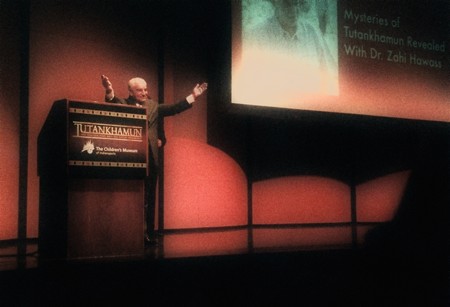
The treasures of King Tut are currently making their rounds of the US and Canada in one of the most eagerly-anticipated tours in recent years. In an exclusive interview for Heritage Key, I caught up with Dr Zahi Hawass, Secretary General of the Supreme Council of Antiquities in Egypt, after his lecture in Indianapolis on Friday, where the exhibition Tutankhamum: The Golden King and the Great Pharoahs is currently running. We got some very special insights into current issues in Egyptology, including the newly opened tomb of Horemheb, the legacy of King Tut, and Dr Hawass’s own plans for book releases and retirement.
-
You know something’s in vogue when it pops up on The Onion, the world’s best-known satirical newspaper. And so it was this week that immortality-seeking First Emperor of China Qin Shi Huang made the grade following the ‘discovery’ beneath Disney World in Orlando of a “legion of terra-cotta Mouseketeers”. According to the spoof article which was kindly sent to us by one of our Heritage Experts, Ethel Davies a Disney World maintenance crew discovered more than 8,000 ‘Mouseketeers’ underneath Cinderella Castle. The statues were thought to date back to 300BC. It was likely constructed during the Pre-Eisnerian period, one of…
-
Egyptology researcher Paula Veiga, author of Health and Medicine in Ancient Egypt: Magic and Science is fascinated by the ancient Egyptians’ concepts of health and medical practice. We caught up with her to chat about religion, medicine and magic, and what lessons health professionals can learn from studying the ancient world. HK: Your background is in tourism – how did you go from tourism to religion, infectious diseases, medicine and magic in Egypt? PV: I have been attracted to ancient history since I was a child, and I collected all those National Geographic editions on ancient civilisations – my favourite…
-
A single human bone found in a cave in Devon may prove that early Britons were cannibals. The arm bone carries seven cut marks made deliberately with a stone tool which are consistent with the act of dismemberment. Scientists believe the bone is evidence that Britons from the Mesolithic period – some 9,000 years ago, between the end of the last Ice Age and the start of farming – engaged in complex burial rituals and possibly cannibalism. They think that because the markings are in the same place, they would have been used to remove muscle from the bone while…
-
“Death will come out of it! No-one will escape! I am done!” It may sound like the death-knell of a tragic big screen hero, but it’s actually the desperate pleas for help of an ancient Assyrian leader, as his city awaits destruction at the hands of bloodthirsty Babylonian armies. The words have been discovered inscribed on a cuneiform tablet at the site of Tushan – an Assyrian city near Diyarbakir, SE Turkey. The tragic epsiode was written by Mannu-ki-Libbali in 630 BC, as a final call-to-arms for allies in the region – yet experts believe the tablet never met its…
-
This recent entry on Blogging Pompeii is a good reminder that tramping around a dusty, dry forum or the streets of Pompeii under a hot mid-day sun is not the only way to get to see a bit of history this summer. How about visiting some Roman ruins in a rather cooler, shadier location but you’ll need your snorkelling mask and flippers. Naples is full of tourists at this time of year – most of them head to the crowd magnets of Pompeii, Herculaneum, the historical centre of Naples with its museum and the island of Capri. But to the…
-
A rare find has emerged at the excavation of Vindolanda: a stone altar dedicated to an eastern god, Jupiter of Doliche. The third-century AD altar forms part of a ‘unique religious shrine’, which was uncovered near the north gate of the fort last month. Vindolanda is a former Roman fort and garrison, forming part of the heritage site of Hadrian’s Wall, running from Carlysle to Newcastle-upon-Tyne in the north of England. The altar, weighing about 1.5 tons, was dedicated by a prefect of the Fourth Cohort of Gauls. The words are inscribed on the altar are: I.O.M. Dolocheno Sulpicius Pu…
-
A few weeks ago, I speculated that Jeff Koons’ statue Michael Jackson & Bubbles was inspired by Tutankhamun. With his deathmask-like face and opulent gilding, Koons’ Michael seemed eerily reminiscent of the boy king. One extremely expensive burial featuring in-your-face-Tut’esque golden coffin later, the parallels between the two icons started adding up. Now, an ancient Egyptian statue in Chicago’s Field Museum has been seen to show a shocking similarity to the face of the late Michael Jackson. The Chicago Sun-Timespointed outthat Jacksoncould have actually modelled himself on the limestone statue: The limestone bust, which went on public display in 1988,…