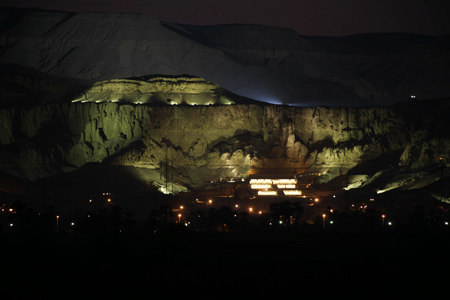
Egyptian Minister of Culture, Farouk Hosni, announced that with a total of 922 units the installation of the new lighting system on Luxors west bank has been completed, allowing for people to visit the tombs in the evening. Dr. Zahi Hawass, Secretary General of the Supreme Council of Antiquities (SCA), said that the aim of this project is to preserve the tombs and temples located on Luxors west bank. The thousands of tourists that daily visit the heritage site will now be distributed throughout the day, from 7:00 am to 8:00 pm. This, he continued, will reduce the level of…
-
-
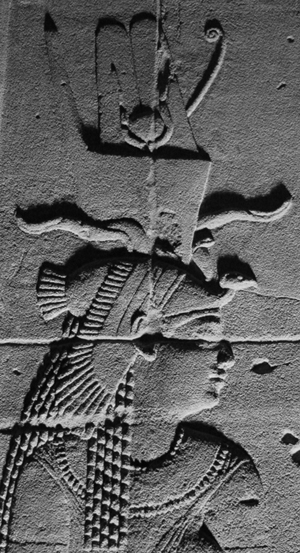
A unique queen’s crown with ancient symbols combined with a new method of studying status in Egyptian reliefs forms the basis for a re-interpretation of historical developments in Egypt in the period following the death of Alexander the Great. In the thesis ‘The Crown of Arsinoë II’, Maria Nilsson shows that Cleopatra VII was not the only Ptolemaic female pharaoh – Queen Arsinoë II came first, 200 years earlier. Nilsson argues that Arsinoë (316-270 BC) should be included in the official pharaonic king list as Ptolemy II’s co-regent; her royal authority should be considered equivalent to Hatshepsut, Tawosret and Amenirdis…
-
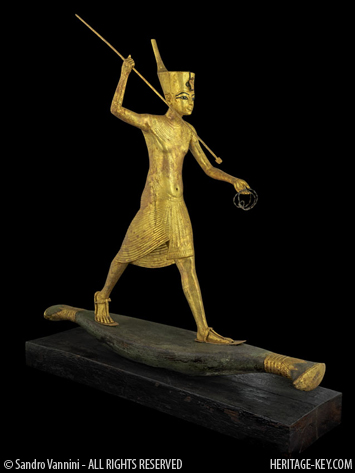
Last week I visited the ‘Tutankhamun: His Tomb and His Treasures’ exhibition in Manchester with Mary-Ann Craig (video), and well… saw wonderful things, and everywhere, the glint of gold. The moment I marvelled at the recreation of the set-up used to remove Tutankhamun’s sarcophagi from his tomb, any doubts still left about the power of replicas disappeared, and I would strongly suggest you visit the touring exhibition before it leaves the UK. Yet, if you want an expert opinion the matter (as well as a great introduction to your visit), watch our Heritage Key video with Robert Partridge, editor of…
-
Researchers have discovered that 19 objects in New Yorks Metropolitan Museum of Art are from King Tuts tomb, and an agreement has been struck that will see them be returned to Egypt. The research indicates that Howard Carter kept a few pieces which were bequeathed to the Met after his death in 1939. The artefacts are quite small and at the time it was not known that they were from the tomb itself. Fifteen of the 19 pieces have the status of bits or samples, read a Supreme Council of Antiquities Press release. The remaining four are of more significant…
-
New research on a 2,400 year old star table shows that the Ancient Egyptians kept close tabs on the Big Dipper, monitoring changes in the constellations orientation throughout the course of an entire year. The Big Dipper is composed of seven stars and is easily viewable in the northern hemisphere. Its shape looks like a ladle with a scoop attached. Ancient Egyptians represented it as an oxs foreleg. If a personwere to observethe constellationat the exactsame time every night they would see it gradually move counter-clockwise each time they saw it. Professor Sarah Symons, of McMaster University in Hamilton Canada,…
-
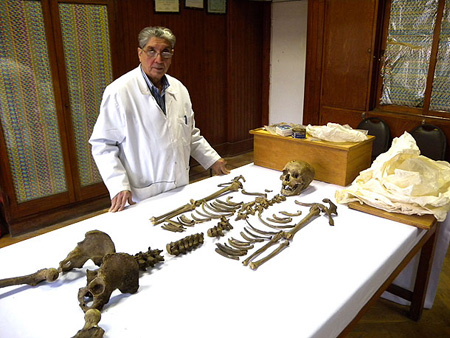
A new study shows that Tutankhamun, Egypts famous boy-king who died around the age of 18, suffered a massive crushing tearing injury to his chest that likely would have killed him. X-rays and CT scans have previouslyshown that the pharaohs heart, chest wall, the front part of his sternum and adjacent ribs, are missing. In Ancient Egypt the heart was like the brain and removing it was something that was not done. The heart, considered the seat of reason, emotion, memory and personality, was the only major organ intentionally left in the body, writes Dr. Robert Ritner in the book…
-
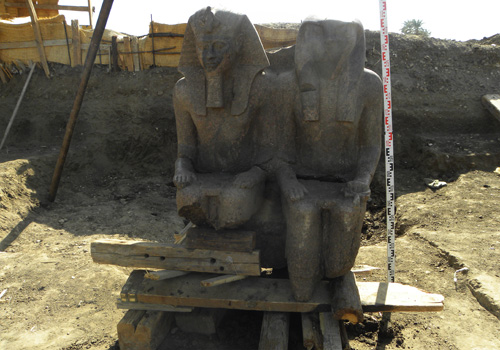
Archaeologists today discovered the upperportion of a statue of Egyptian Pharaoh Amenhotep III at Luxor, Egypt. The find part of a double statue featuring King Amenhotep III with the falcon-headed sun god Re-Horakhti was made at the pharaoh’s funerary temple, locatedon the west bank of the Nile. In a press statement, Egypt’s Minister of Culture, Farouk Hosny said that the discovery was made during routine excavations at Amenhotep III’s mortuary temple carried out by the Supreme Council of Antiquities (SCA). The dig issupervised byDr. Zahi Hawass, who thinks of the newly discovered statue as one of the best of the…
-
A new discovery made by Dr. Zahi Hawass and his team shows that an ancient pharaoh made serious efforts to save the Sphinx. At Giza his team found the remains of a mudbrick enclosure wall that would have surrounded the Sphinx, perhaps protecting it from sand blown by wind. Made of mudbrick, the first section runs to the east of the Sphinx for 86 meters north-south and is 75 cm tall. The second section is 46 meters long, 90 cm in size, and runs east-west along the perimeter of Khafre’s valley temple. The two sides converge in the southeast. Archaeologists are already aware…
-
The royal tomb of Pharaoh Psusennes I is said to be one of the most spectacular discoveries ever made in Egypt. So, why hasn’t the world heard about it? And what does it reveal about Ancient Egypt? Find out in ‘Secrets of the Dead:The Silver Pharoah’, premiering this Wednesday. Tanis, Egypt, circa 1939. An excavation team led by French archaeologist Pierre Montet unearthed an intact royal burial chamber (NRT III), which containedtreasures that (almost) rivals the riches found in Tutankhamuns tomb almost two decades before. One of the most spectacular discoveries inside the crypt was the exquisite silver sarcophagus of…
-
Toronto is the place to be this week for fans of ancient Egypt. Especially if youre interested in the gruesome ways that two of its pharaohs might have died. King Tut: Death by Hippo? This Wednesday, at 7 pm at theU of Tcampus, Dr. Benson Harer of California State University at San Bernardinowill argue that King Tutwasmauled to death by a hippo his lecture istitled”What really killed King Tut: The Hippo Heresy.” Dr. Harer is a medical doctor and adjunct professor of Egyptology atCalifornia State so he brings a unique perspective to this issue. Indeed, the death of King Tut…