• publication

    Legions of Rome: The Definitive History of Every Roman Legion

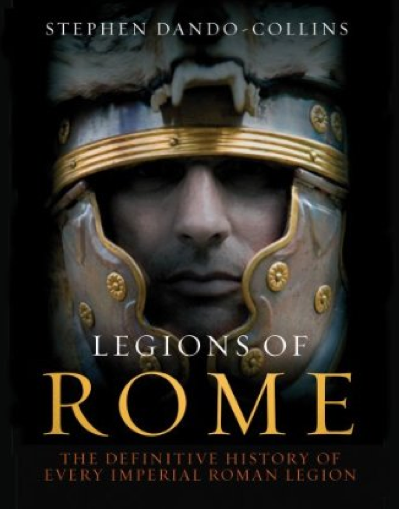
    Legions of Rome The Definitive History of Every Roman Legion by Stephen Dando-Collins No book on Roman history has attempted to do what Stephen Dando-Collins does in Legions of Rome: to provide a complete history of every Imperial Roman legion and what it achieved as a fighting force. The author has spent the last thirty years collecting every scrap of available evidence from numerous sources: stone and bronze inscriptions, coins, papyrus and literary accounts in a remarkable feat of historical detective work. The book is divided into three parts: Part 1 provides a detailed account of what the legionaries wore…
  • owenjarus

    The oath on the platform – 2,700 year old temple at Tayinat had royal loyalty oath prominently displayed

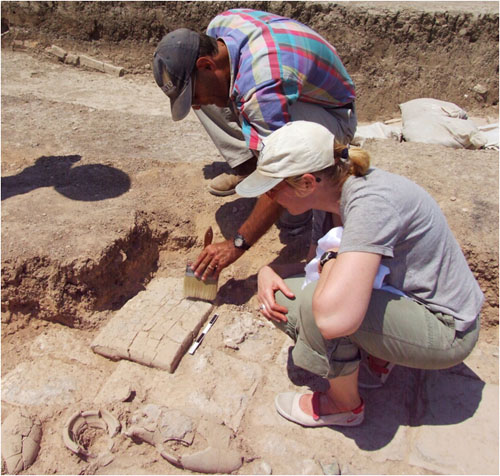
    A team of researchers – excavating a 2,700 year old temple at the ancient city of Tayinat in southeastern Turkey – have discovered evidence that its inhabitants prominently displayed a tablet which bore a pledge of loyalty to the heir of an Assyrian king. At their height the Assyrians controlled an empire that stretched from southern Iraq to the Mediterranean coast. In their art and writing, “the Assyrian king was portrayed as supreme ruler of the known world and viewed with absolute authority as the earthly representative and human embodiment of (the Assyrian god) Ashur,” said Professor Tim Harrison of…

  • owenjarus

    Top 10 Socrates Quotes to Reflect Upon

    In 399 BC the Greek philosopher Socrates, by then around the age of 70, was executed in his home state of Athens. He was prosecuted for the rather dubious crimes of “not acknowledging the gods the city acknowledges” and “subverting the youth of the city”. His case was brought to court and prosecuted by a man named Meletus Meletou. After a one day long trial (the norm back then) he was found guilty by a jury of 501 peers – and sentenced to death. Modern day historians suspect that this trial was politically motivated. Indeed Socrates is said to have referred…

  • malcolmj

    Top 10 Crazy Aryan Theories – It’s not just the Nazis

    The word “Aryan” has become inseparably associated with the racialist world-view of the Nazis, despite the fact that – far from specifying a blonde-haired, blue-eyed “master race” – it was originally a perfectly innocent self-designator for a tribe of ancient nomadic Indo-Iranians who lived in the region of modern Iran, Afghanistan and India from around 2700 to 350 BC (more about “Aryan’s” passage from a simple piece of linguistic terminology to a racialist rationale for megalomaniacal world domination here). Saturated as they are in misconception, mirth, myth, and wild fantasy, the “Aryans” have become something of a lightning-rod for weird…

  • Ann

    Ticket sale starts for ‘Secrets of the Silk Road’ at the Penn Museum – Exhibition Preview

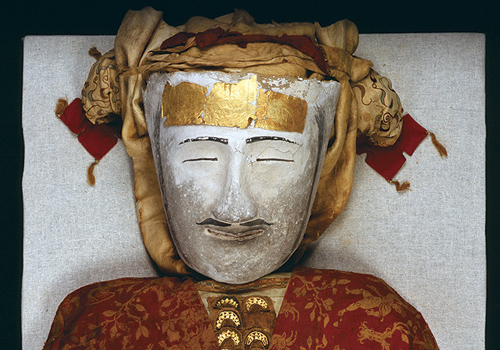
    Tickets go on sale today for “Secrets of the Silk Road” a landmark exhibition from China making its only East Coast stop at the University of Pennsylvania Museum of Archaeology and Anthropology (Penn Museum) in Philadelphia February 5 through June 5, 2011. The exhibition aims to reflect the wide extent of the Silk Road trade and cultural interchange (see some of the highlights in this slideshow). Despite of what its name suggests, the Silk Road isn’t one single route. Rather, it is an extensive interconnected network of maritime and overland trade routes extending from Southern Europe through The Arabian Peninsula,…

  • world

    Borovo Treasure

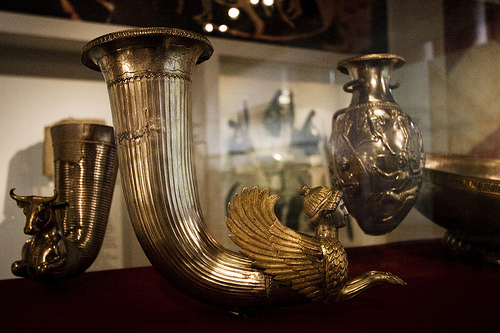
    Attribution: Ann Key Dates 350 BC Key People  King Kotys I The Borovo Treasure was accidentally discovered in 1974, when a field about 2 kilometres from the village of Borovo, Ruse (Bulgaria) was ploughed. Sadly, the plough machine’s cutting implements severely damaged the five silver artefacts, but thanks to great restoration work, nowadays their ‘scars’ are nearly invisible.  No tumulus was found at the location, and why the silver treasure was buried here remains a mystery. The Borovo Treasure is a luxurious five-vessel silver gilted drinking set – decorated with gold. It consists of three rhytons (ending in the protomes of…

  • Ann

    Qatna’s Royal Palace reveals further archaeological treasures

    The ongoing dig at the ancient royal town of Qatna, Syria, has brought some exciting new discoveries to light. Among the skeletal remains, archaeologists have found precious gold jewellery, gemstones, alabaster vases, detailed ivory artefacts, tiny figurines. Since the start of this year’s excavation mid-July, a total of 379 artefacts were recorded in the tomb. The archaeological mission a Syrian-German cooperation between the University of Tubingen and the Syrian governement is further excavating the royal sepulchre that was discovered last year under the northwest wing of Qatna’s royal palace. Among the burial gifts, a number of Egyptian object are of…

  • Ann

    Cyrus Cylinder row resolved: ‘Ancient declaration of human rights’ to visit Iran

    The British Museum has announced that it is lending the Cyrus Cylinder to the National Museum of Iran. Together with two fragments of contemporary cuneiform tablets, it will be the centrepiece of an exhibition that celebrates a great moment in the history of the Middle East. The artefact which is described as ‘an ancient declaration of human rights’ by the United Nations was originally due to arrive in Iran in September 2009. At that time, the British Museum cited the ‘political situation’ in post-election Iran as the reason for the delay. In August this year, the loan was once again…

  • malcolmj

    Top 10 Facts About Sparta’s Women

    As documented in the article ‘Woman of Sparta: Tough Mothers’, Spartan women enjoyed all kinds of rights not shared by their Athenian sisters – albeit plenty of plights too. Sparta’s unique social system and constitution, which was completely focused on military training and excellence, afforded females a level of freedom and responsibility uncommon in the classical world – as child bearers, they were vital to replenishing the ranks of an army that suffered an almost constant stream of casualties; with so many men constantly away at war, they were crucial to running their households and the community at large. Yet, Spartan…

  • exhibition

    Divus Vespasianus

    Organized by Filippo Coarelli, the exhibition – whose full title is Divus Vespasianus: the Capitoline Hill and Egypt in the Flavian era – illustrates the major building projects that Vespasian was responsible for on the Capitoline hill, including the reconstruction of both the Temple of Jupiter Capitolinus and the Temple of Isis that had been elevated to public sanctuary status. The entire exhibition pivots around the key role played by Egypt under Vespasian and his sons, and their particular devotion to eastern divinities, which wasn’t limited to buildings on the Capitoline Hill, as the reconstruction of the ancient Iseo on…