
This week the film The Twilight Saga: New Moonis being released, fuelling vampire mania around the world. While teenagers go completely nuts over the film’s hunky vampire Edward (Robert Pattinson) one wrote ‘bite me’ on her face as she queued with 5,000 others to see him in London last week other die-hard fans of the Twilight books, written by Stephenie Meyers, are also descending on the small hill-top town of Volterra, in Tuscany, where some of the action of the film is set (even though filming actually took place in Montepulciano, 70 miles away). As a result, hordes of teenagers…
-
-
Iran has taken a step closer to its goal of moving its capital away from Tehran to a new, as yet unbuilt location near the town of Qom. This seems like an extreme move but it’s one that has been repeated throughout history – as far back as the Egyptian dynasties of the Middle Kingdom, in ancient China and many times during the Roman empire. Sometimes there are practical reasons for capital-moving. In Iran’s case it claims that Tehran, a city of 12 million people, sits on 100 seismic fault lines and is therefore a major natural disaster waiting to…
-
Next Saturday Venice will be holding its own funeral. As far as publicity stunts go, it’s quite an unequivocal message that the city is on the brink. Only this time the threat is not from the rising tides and the island city’s subsiding foundations; the danger comes in the form of the rapidly shrinking population it seems that the Venetians are migrating to the mainland faster than you can say ‘just one cornetto’. According to one group of locals members of the online community venessia.com – the population has now fallen below the threshold of 60,000 people (down from about…
-
When it comes to our roots, most of us think we know where our early ancestors came from the continent if not the country. Most people have clear ideas on their nationality and they see it as a defining part of themselves and their identity. The Genographic Project, launched by National Geographic, IBM and scientist Dr Spencer Wells, seeks to challenge what we think we know about our very distant past – and our very notions of who we are. Studies of DNA have suggested that all humans today are descended from one group of ancestors who lived about 60,000…
-
The seas off the coast of Montenegro are largely under-explored by archaeologists, but a school-boy’s discovery could put one site near the city of Bar on the archaeological map once and for all. When 16-year old Michael Le Quesne, from Buckinghamshire, was snorkelling at the bay of Maljevik in September, he came across what looked first of all like some round stones two metres below the surface. Many people might have thought nothing of it and would have snorkelled happily on, preferring to look for fish instead. But Michael had obviously learned a thing or two about old ‘stones’ at…
-
A management plan has been published that maps out how the World Heritage Site of Hadrian’s Wall will be conserved, researched and made accessible to visitors and local communities over the next five years. The wall was built in the 120s AD during the reign of the Roman Emperor Hadrian as the northern frontier of Roman-occupied Britannia. The site today is one of Britain’s most outstanding historical monuments; it recently came second in a list of favourite British sites as voted by the UK’s children – beaten only by Stonehenge. It’s also of educational, environmental and economic value to many…
-
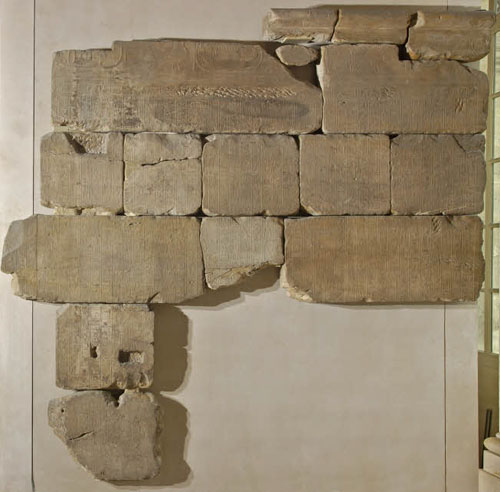
Everyone makes them (some of us more compulsively than others): scribbled on post-it notes, or kept mentally in our imaginations we all make lists. And we’re not the only ones either; lists have been around for a long time possibly since the first writing systems and certainly since Sumerian scribes began to keep accounts in the fourth millennium BC in Mesopotamia. So what is it about the beauty of a list its numerical order, hierarchy, completeness that makes them such a part of how we like to categorise, order and understand the world? An exhibition opening at the Louvre on…
-
Ancient artworks from Jordan some of them never before seen outside Petra and Amman – are going on display today at Rome’s Quirinal Palace. The star attraction at the exhibition is a statue found at the site of Ayn Ghazal near Amman dating from 7500 BC, one of the oldest surviving statues of its kind and size. The exhibition has been organised by the President of the Italian Republic in honour of the state visit of the King Abdullah II and Queen Rania of Jordan. Sixty items will be on display in the ‘Sale delle Bandiere’ at the Palazzo del…
-
While London’s tube had much of its 12 lines and 250 miles of track in place well before the mid 20th century, Rome is still struggling to add its third metro line. The problem is an age-old one: the metro runs deep underground and is deep enough so that the tunnels themselves do not interfere too much with Rome’s layers of buried civilisations. The stations and air vents, however, need to come to the surface and, much to the frustration of the construction company, they more often than not strike valuable archaeological areas. The first line (the unchronologically-named line B)…
-
A fourth skeleton has been unearthed at the site of York University’s proposed new campus at Heslington East, 3.5 km outside the city of York. The skeleton is well preserved and was found laid with feet pointing north to south, rather than the east-west direction common in Christian burials of that time. It was discovered buried next to a less well-preserved skeleton in a separate grave. So far little is known about the individual except that it is male. Cath Neal, Field Officer for the Heslington East archaeological project, hopes that the good condition of this skeleton will enable them…