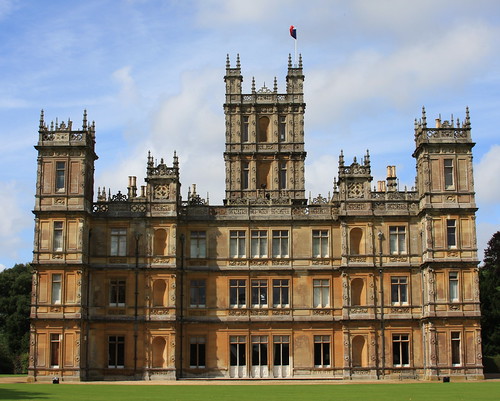
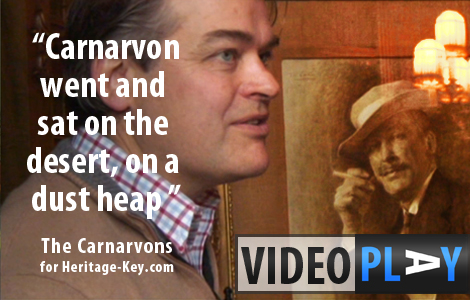
“There is a bit of an Indiana Jones style to that portrait of my great-grandfather, and it rather sums up his character.” George Herbert, 8th Earl of Carnarvon looks up at the image of his namesake forebear admiringly. A dashing 5th Earl of Carnarvon looks playfully down the barrel of a cigarette, rogueish grin etched upon his face. No wonder he’s smiling: George Edward Stanhope Molyneux Herbert, 5th Earl of Carnarvon is an archaeological legend – the man who alongside Howard Carter unlocked the 3,200-year-old secrets of Tutankhamun, Egypt’s boy-king. Adventure, it seemed, was in Carnarvon’s blood. Born into immense…
-
-
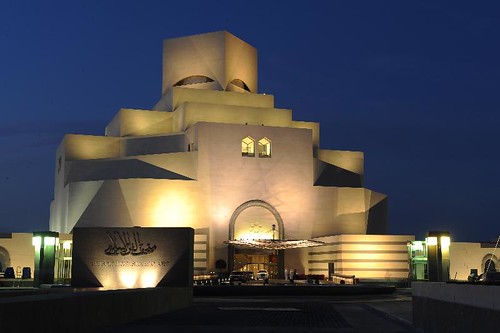
The Arabian peninsula has been suffering recently. Yemen has been accused of harbouring terrorists by the West, and the gargantuan Burj Tower in Dubai was unveiled last week amid a haze of economic uncertainty. Yettiny Qatar, an outcropwith a population barely toppingone million,continues to buck its diminutive stature with world-beating business and heady ambitions. And the Museum of Islamic Art in capital city Doha may just be Qatar’s most impressive structure. In this Heritage Key video, Museum Director Dr Oliver Watson shows us some of the treasures of the museum, and explains the far-reaching importance of Islamic art. The striking…
-
Two large tombs have been discovered at the ancient Egyptian necropolis of Saqqara – one of which is the largest ever found at the site. The 26th Dynasty tombs, likely robbed during the Roman era, are nonetheless filled with important arefacts including coffins, skeletons, pottery and mummified eagles. The tombs, discovered by an Egyptian archaeological mission from the Supreme Council of Antiquities, are at the Ras El Gisr area of Saqqara, near the landmark’s entrance. Both tombs are cut into the hills of the region: the larger first tomb is hewn from limestone while the other is mud-brick. The larger…
-
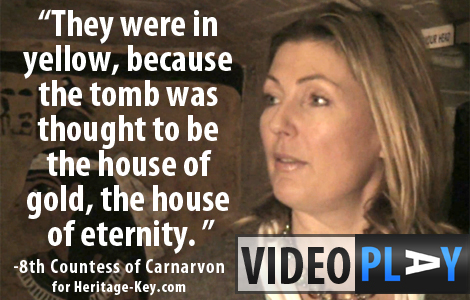
“In most Egyptian tombs you’ve either got the wall paintings or the coffin.” Fiona, 8th Countess of Carnarvon says, stressing the uniqueness of Tutankhamun’s tomb, the greatest discovery in history. Its treasures may be well documented, less so the incredible wall paintings that greeted Howard Carter and Lord Carnarvon when they burst through in 1922 (Watch a special video on the discovery here). Lady Carnarvon, herself a two-time author on the Tutankhamun phenomenon withCarnarvon& Carter(click here to buy) and Egypt at Highclere: The Discovery of Tutankhamun(click here to buy), seems totally engrossed in the walls she and husband George Herbert,…
-
The discovery of a ‘Jesus-Era’ man buried outside Jerusalem, Israel, has cast doubt on the famous Turin Shroud. The man, who is thought to have suffered from both tuberculosis and leprosy, was buried in a cave called the ‘Tomb of the Shroud’, part of the ‘Field of Blood’ (Akeldama), a 1st century AD cemetery in the Lower Hinnom Valley (Gehenna) near Jerusalem. The preservation of bodies in the region is extremely rare, thanks to high humidity levels underground. The man’s location in the Valley, beside high priest Annas (6-15 AD) – the father-in-law of Caiaphas, the high priest who betrayed…
-
London is one of the world’s best cities to see ancient culture. You can ramble round Roman London, see Seti’s sarcophagus at the Soane, explore the hidden pleasures of the Petrie Museum, or get lost in the British Museum, where you’ll see amazing artefacts from all over the world – including the Elgin Marbles, Rosetta Stone and great Mesopotamian relics. But what about the wonders lying just outside the city limits? There are Roman villas dotted all round London, and ancient treasures are never more than a short train journey away. One of the best days out can be had…
-
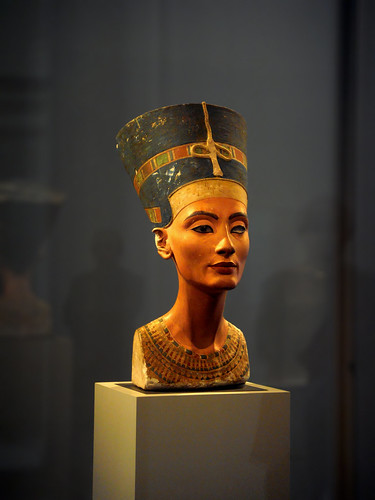
Yesterday saw Dr Zahi Hawass, Egypt’s Antiquities chief, travel to Berlin to discuss the future of the Bust of Nefertiti with the director of the Neues Museum, her current home (watch a slideshow about the move). Yet statements released by both parties today appear to disagree on what was to be said at the showdown. The Bust of Nefertiti (or Nofretete in German) has long been in the crosshair of Dr Hawass’ quest to repatriate Egypt’s showcase artefacts. Yet despite her place as one of his ‘famous five’ targets, the Neues Museum insists no formal approach was to be made…
-
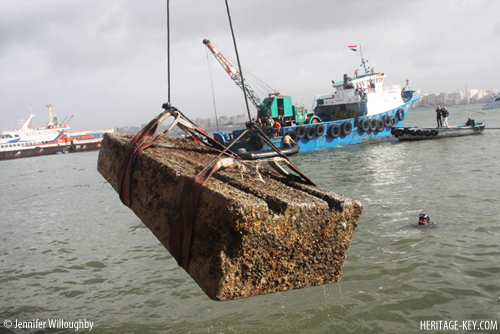
A huge granite block, believed to be part of a temple belonging to Egyptian queen Cleopatra, has been lifted from the sea at Alexandria. The nine-tonne stone, quarried in Aswan some 700 miles south of the city, is expected to be transported to a new museum celebrating the sunken city. The block is thought to have been the pillar of a temple to Isis at Cleopatra’s palace. Alexandria became a centre of commerce and education during antiquity, but was razed by a 4th century AD earthquake. The stone is one of a series of underwater discoveries made by the Greek…
-
“The whole discovery of Tutankhamun needed both ingredients to make it work. It wasn’t all Howard Carter, certainly not only Carnarvon. But it needed the two of them.” George Herbert, 8th Earl of Carnarvon, ebbs deeper into the bond which drove two of archaeology’s greatest characters to the biggest discovery of all time. But how did the two men, so different in background and expertise, even forge such a strong relationship? Lord Carnarvon – or to give him his full tongue-twisting title, George Edward Stanhope Molyneux Herbert, 5th Earl of Carnarvon – was an aristocratic explorer and adventurer of the…
-
Today’s religious folk may be gearing up for the pious festive season, but it seems the ancient world just keeps on getting filthier: alongside gay Graeco-Roman pornography and rude Roman graffiti, one Athens museum has decided to celebrate all things raunchy in Ancient Greece. Starting today and ending on the 5th April next year, “Eros: From Hesiod’s Theogony to Late Antiquity” at the Goulandris Museum of Cycladic Art will treat visitors to a cornucopia of ancient smut, from orgies and prostitution, to paedophilia and even beastiality. And while it may seem at loggerheads with today’s relatively constrained society, museum director…