It’s a tantalizing story that’s been taught as fact for nearly 50 years. It goes like this:
Qumran, the site where the Dead Sea Scrolls were found in caves, was a monastic settlement, dating from the end of the 2nd century BC to the time of the revolt against the Romans (68 AD). The area was inhabited by a group called the Essenes. They were male, celebate, and lived their lives according to a strict interpretation of Jewish law and religion. They wrote most, if not all, of the Dead Sea Scrolls and carefully stored them away in caves for safekeeping.
The problem is, that according to the latest archaeological research, this story is simply not true.
On Thursday, Yuval Peleg, a senior Israeli Antiquities Authority archaeologist, gave a lecture at the Royal Ontario Museum in Toronto. His excavations at the site, working with fellow archaeologist Yitzhak Magen, ran mainly from 1993-2004. Since then he has spent his time analyzing the remains and preparing the results for final publication (expected within the year).
At his Toronto lecture he delivered an unequivocal message. There is no evidence to support the idea that the site was an Essene settlement. In fact, the archaeological remains found at the site say that its purpose was anything but.
He provided a detailed explanation as to what the site was and how it evolved over time – effectively rewriting the story of how the Dead Sea Scrolls came to be.
I was at that lecture, obtained a copy of a preliminary report that has been released, and interviewed Peleg briefly. This is what I found out.
The First Settlement
The first people to live at Qumran settled around 700 BC, long before the scrolls, which date 2nd century BC to 1st century AD. It was one of numerous small settlements set up in Judaea and the Jordan Valley. The people were likely refugees from Samaria. After the Assyrians conquered Samaria in 720 B.C. they exiled the Jewish population driving them into the deserts around Qumran.
The settlement these people created was very small – a handful of clay and wooden huts. There may have been a stone tower or public building in the center of it that has since vanished. There were no large ritual pools and its people may have only inhabited it seasonally during the winter and spring. When the Babylonians conquered the area in 586 B.C. the site was abandoned and was not reoccupied for nearly 500 years.
Qumran Reoccupied
Peleg believes that Qumran was used as a small military post for scouting and communications by the Hasmonean military, when it was reoccupied in the early first century BC. The Hasmonean dynasty was an independent Jewish kingdom that ruled over modern day Israel and much of Jordan. They came to power after a successful rebellion against Seleucid rule. Their dynasty lasted for about 100 years (140 BC – 37 BC).
Qumran was one part of a chain of garrisoned forts that was built along the eastern frontier of the Hasmoneans which included Alexandrion-Sartaba, Hyrcania and Masada. While Qumran was an outpost, it was not a fort, and would not have been used for serious fighting. “It’s not a fortress, it’s a small site with small units,” said Peleg. “All its purpose was was to see that no enemy army was coming to the Dead Sea shores, climbing the cliffs towards Jerusalem.”
He said that the Hasmoneans kept a larger force five kilometres away in Hyrcania. Once the soldiers at Qumran spotted enemy units they would go to the larger garrison and alert it. Peleg admitted that he cannot say for sure what religious background the soldiers were from. The Hasmoneans faced a labour shortage and used mercenaries to help fill their ranks, so many of them may not have been Jewish.
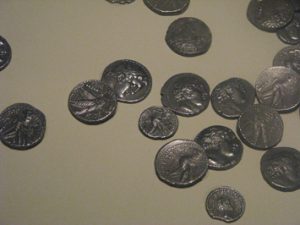
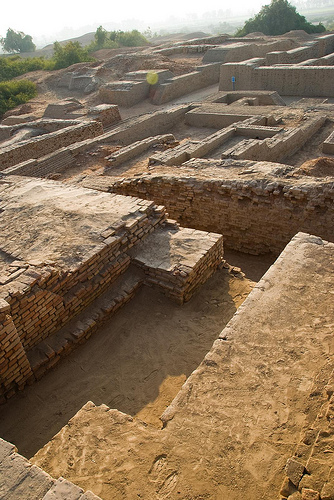
Among the finds dating to this time period was a stable, indicating that a small cavalry force was stationed there. There was also a square building with about a dozen rooms and a courtyard, as well as a tower built in the northwest.
The Hasmoneans chose Qumran for several reasons. One reason was tactical – its location near the Dead Sea would have allowed soldiers advance warning of enemy units making an amphibious attack or going around the coast. The second was reason was that the topography of the site would protect it from flooding.
Finally, it also had access to drinking water, an important consideration in the desert. The archaeologists found a narrow passage that linked a flow basin to the west part of Qumran, allowing some of the water from desert floods to be collected for the personal use of the soldiers.
Civilian Use
In 63 BC the Romans conquered the area around Qumran. Their vast conquests in the Near East meant that Qumran did not have to be garrisoned. The site, according to the researchers, appears to have transitioned from military to civilian use.
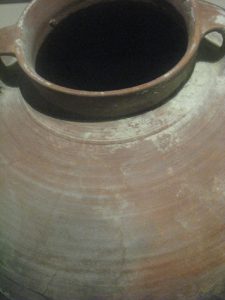
Peleg said at the lecture that salt, dates and possibly perfume were exported by its inhabitants. But, the most important thing they traded appears to have been pottery.
The team excavated an aqueduct system, which would have brought water from higher ground and deposited it into numerous newly created pools.
Until the team’s work was done it was believed that these pools were created for ritual purposes. Their idea was that a growing Essenes community required more water for their ritual baths. But, as Peleg’s team went about their work, they became certain that the pools could not have served this purpose.
For starters most of the newly created pools violate the rules required for a Jewish ritual bath. A ritual bath cannot be fed by water from a sedimentation basin, something which rules out many of the pools (although a few do qualify).
Another problem is that, while the number of pools grew, the number of rooms did not. In fact some of the pools replace residential space.
So, if there were a growing number of Essenes why would they create so many ritual baths that violated religious rules? Also where would they stay and store their food?
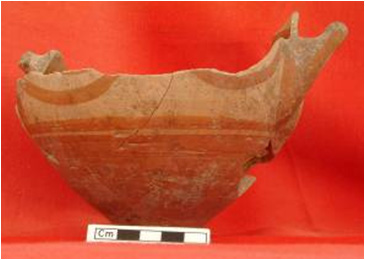
The real use for the pools, according to the researchers, was in creating potters clay. The team found an abundant amount of it at the bottom of two of the pools and more in a refuse dump. The water from the aqueduct system would have dumped the clay in the bottom of these pools.
To test their idea out the team took some of the pottery clay they found and gave it to a modern day potter to work with. The result was first class pottery. “The inhabitants of the site took the clay,” said Peleg, “just like we did.”
Conspicuously Absent
What the team did not find at the site also helped shape their conclusions. One thing they did not find was cooking facilities capable of feeding hundreds of people. Peleg and Magen both point out in their preliminary report that feeding hundreds of people, in a growing sect, would require numerous ovens and foodstuffs.
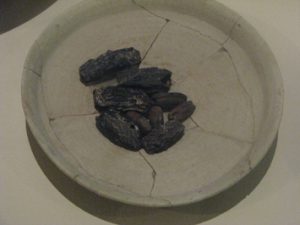
“Were we to accept the claim that the sect lived here at Qumran for 170 years we would expect to find hundreds of cooking and baking ovens at the site as well as thousands of cooking pots. In fact no such quantities of pots were found and only a small number of ovens,” they say in their preliminary report.
The lack of residential quarters is another major problem for those who believe that a large, growing, Essene sect lived there. It’s difficult to imagine more than a few dozen people living at Qumran.
Some scholars have proposed that the people slept outside or lived in caves, an idea that Peleg finds to be very problematic. For one thing the floods would have posed a mortal danger. To illustrate this Peleg showed the people at the lecture a video of a modern day flood in the desert. After a minute of watching the video, there seemed to be little doubt in the room that the water was quite capable of sweeping someone away. “The amount of water is huge,” Peleg said.
Caves, Peleg adds in his argument, had their own problems. There was a wide variety of predators in the Qumran area including hyenas and leopards. Sharing a cave with them would not have been tenable. “You don’t want to share a cave with a hyena.” he assured me.
There is also the fact that the only artefacts in the caves date from the first century AD, the time the scrolls were put there. Peleg said that the people at that time wouldn’t have occupied the caves for more than a few weeks, just long enough to hide the scrolls away.
How the Scrolls Got to Qumran
Peleg and Magen’s theory is that the scrolls were deposited in the Qumran caves, in great haste, by refugees fleeing the Roman army. In 70 AD the Romans laid siege to, and eventually captured, Jerusalem. Peleg believes that the refugees would have fled south towards the desert, just like the Jews from Samaria did hundreds of years earlier.
When they left they took only their most important goods, some money, food and their religious scrolls. Peleg points out
that scrolls were found in every major Jewish community at this time. Naturally, these would be considered to be of great importance, something worth taking before fleeing the Romans.
The ancient road system and topography means that many refugees would have gone by the area of Qumran. When asked by Heritage Key why the refugees didn’t carry the scrolls beyond Qumran, Peleg replied that the terrain, past this point, would have made it impossible.
“Qumran is the last station,” he said. “The water came to the cliffs after Qumran. You have to go through the water, through the Dead Sea, in order to go south. Or climb the cliffs.”
As further evidence Magen and Peleg point out in their preliminary report that numerous copies of some of the scrolls were found in the caves. This includes 20 copies of Genesis, 16 copies of Exodus and 27 copies of Deuteronomy. If the scrolls were written by Essenes, living at Qumran, then the two scholars question why their library would require so many copies of biblical texts.
Peleg believes that the refugees stored the scrolls in hopes of returning for them, but for whatever reason, they were not able to. This is made more puzzling because, according to the team’s findings, there is no evidence that the Romans kept a garrison at Qumran after the Roman-Jewish war. In fact there is little evidence to support the idea that anyone was living at Qumran afterwards.
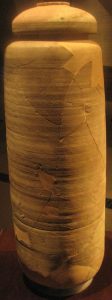
Peleg pointed out that we don’t know what happened to these people or where they went. “There was war, there was chaos, maybe they went to Egypt, and they lost, they died, who knows, who knows.” Indeed no human being saw these scrolls again until 1947, when a Bedouin, said to be searching for a lost goat, re-discovered them, and made one of the most incredible finds of the decade.