Key Dates
Ostia is believed to have been founded by Rome’s fourth king, Ancus Marcius, in the 7th century BC, although only archaeological evidence from the 4th century BC has been found. It was expanded in the first century AD under the rule of Tiberius.
By the 2nd century AD, more than 50,000 people lived there, with that number growing further to 75,000 a century later. By the time Constantine I took reign, the town had started evolving from a port into a popular holiday destination for Roman aristocrats.
When the Roman Empire fell, the town fell into decline, and was abandoned altogether in the 9th century after repeated attacks by Arab pirates.
The Papacy started intitial explorations of the site under Pope Pius VII, while Mussolini’s government instigated large-scale excavations 1938-1942. The first results of this work came out in 1954 with the publication of Scavi di Ostia , which concentrated on the topography of the area and was compiled by Italian archaeologist Italo Gismondi. This work continues today. Some two-thirds of the town has been rediscovered.
Key People
Ancus Marcius and Tiberius are both credited with building Ostia into an important port for Rome.
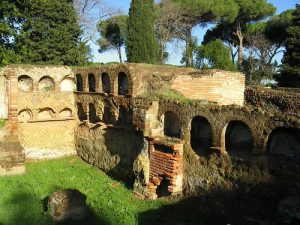
Ostia Antica, 30km north-east of the Italian capital, was the harbour city for Ancient Rome. It now lies some 3km inland thanks to a number of factors, including a fall in the sea level and problems associated with silting. In ancient times the city was at the mouth of the river Tiber; today it sits by its side (‘Ostia’ in Latin means ‘mouth’).
The site’s ancient buildings have been beautfully preserved, as have its frescoes.
Related Structures
Material deriving entirely from Ostia was used to build the Leaning Tower of Pisa.
Admission Fee
Eur6.50 per person; free for over 65s and under 18s; closed on Mondays
Related Websites