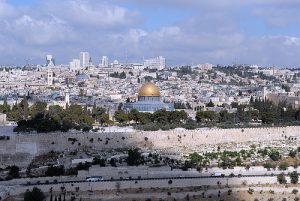
The citadel of Jerusalem (or Tower of David) is situated on the western side of the Old City, just south of the Jaffa Gate at the highest point of the southwestern hill of Jerusalem. A series of fortifications were built here over the course of more than twenty centuries as protection from the west and to control the city below. Every period has been identified in the study of architectural ruins. In the citadel’s foundations are buried the remains of Jerusalem’s fortifications from the end of the monarchic period (8th to 6th centuries BCE) to the Hellenistic and Roman periods, and demonstrate various construction phases belonging to different periods, distinguishable by differences in the masonry and in construction technique. The outline of the citadel known today is from the Crusader period; the citadel itself was built in the mid-16th century by the Ottoman sultan Suleiman the Magnificent, and incorporates the remains of earlier citadels dating from Ayyubid and Mamluk times.
Part of the wall was built by Hezekiah, king of Judah, at the end of the 8th century BCE. After about 300 years, the First Wall was restored by the Hasmonean rulers, who made considerable efforts to expand the city and strengthen its defenses. At the end of the 1st century BCE, King Herod improved the fortifications in this area and added three huge towers to protect the large royal palace in the south. After the destruction of Jerusalem in 70 CE, the Romans occupied and later came the early Arab rule in the 8th century, during which time a new citadel was established. Among its remains are a rounded corner tower measuring 10 m. in diameter, from which 4-m. thick walls extend to the north and to the west. Severe damage was caused to the structure when the Crusaders built their citadel in the 12th century when the early city wall became an inner terrace wall in the courtyard, which was buried under some 10 m. of debris which preserved it until its exposure during the archeological excavations.